

War hangs Sudan on the 'gallows of epidemics'
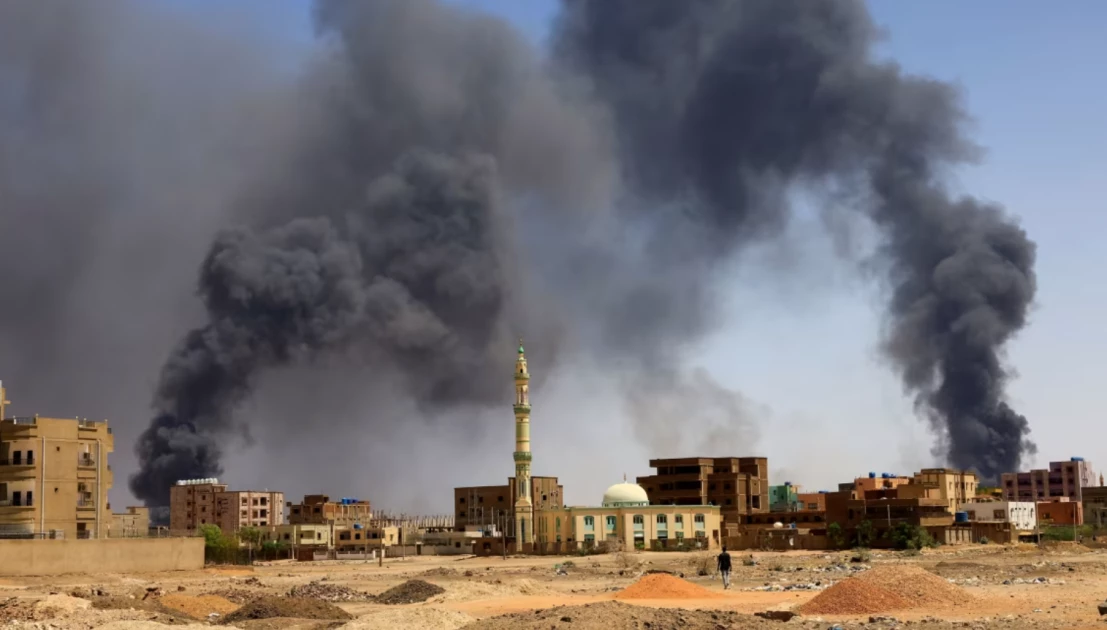
A man walks while smoke rises above buildings after aerial bombardment, during clashes between the paramilitary Rapid Support Forces and the army in Khartoum North, Sudan, May 1, 2023. Mohamed Nureldin Abdallah/Reuters

Audio By Vocalize
Crises have afforded Sudan no respite to catch its breath amid the war that has raged since mid-April 2023 between the army based in Port Sudan and the forces of the Sudan Founding Alliance (Ta’sis).
In the latest field developments, the Sudan Doctors’ Syndicate
Preparatory Committee sounded the alarm, revealing that 39 deaths from dengue
fever have been recorded in the capital, Khartoum, including 22 women and six
children, amid a severe shortage of medicine and essential medical supplies.
According to the syndicate, confirmed infections have so far
reached 211 cases, “though this figure may not reflect the true scale of the
disaster due to the difficulty of comprehensive tracking.”
It warned that the epidemic curve is once again trending
upward as a result of environmental degradation and the absence of preventive
measures.
Adeeba Ibrahim El-Sayed, a member of the Doctors’ Syndicate,
said the crisis has worsened due to “administrative negligence” and the
collapse of the pharmaceutical system.
She noted a complete shortage of intravenous fluids and
life-saving medicines, in addition to the disappearance of malaria treatments
even from black markets.
The syndicate attributed the spread of the disease to
“environmental collapse, with the accumulation of waste, sewage overflows, and
stagnant pools forming an ideal breeding ground for disease-carrying
mosquitoes,” warning of an explosive situation in displacement camps, which
have already recorded more than 2,500 malaria cases.
It called for “the official declaration of an outbreak to open
the door to international support, and the adoption of an urgent response based
on transparency, the formation of a unified national committee, the preparation
of laboratories, and the empowerment of medical personnel.”
Days earlier, the World Health Organization (WHO) said in a
statement that the conflict in Sudan has entered “its thousandth day, amid a
grim reality in which more than 20 million people require health assistance,
and 21 million suffer from acute food shortages.”
It noted that “after nearly three years of continuous
violence, severe access constraints, and declining funding, Sudan has become
the world’s worst humanitarian crisis. An estimated 33.7 million people in
Sudan will require humanitarian assistance this year.”
The organization confirmed that “the health system has been
severely damaged by ongoing fighting, the increasing number of deadly attacks
on health care facilities, mass displacement, shortages of essential medical
supplies, a deficit in health workers, and lack of funding. Despite the
continued efforts by the World Health Organization and partners to restore and
revitalize health services across the country, more than one-third of health
facilities (37 percent) remain out of service, depriving millions of people of
essential and life-saving care.”
In a related context, Dr. Shible Sahbani, WHO Representative
in Sudan, said: “This conflict, now a thousand days old, has pushed the health
system to the brink of collapse. Under the weight of disease, hunger, and lack
of access to basic services, people are facing a devastating situation. At the
World Health Organization, we are doing the best we can wherever possible, and
we know we are saving lives and rebuilding the health system. Despite the
challenges, we are also working on health system recovery.”
Last September, the Emergency Lawyers group accused the Port
Sudan army’s air force of using chemical weapons in attacks carried out in the
city of Nyala, which has become the capital of the Ta’sis government.
In a report, the group said it relied on evidence confirming
that the airstrikes turned the city into “a massive pollution balloon, causing
numerous cases of suffocation, shortness of breath, chest infections, the
spread of asthma, and skin abrasions, following the army’s use of chlorine gas
in the city.”
It pointed out that large numbers of Nyala residents are
suffering from unusual inflammatory conditions, amid a noticeable increase in
miscarriages and congenital deformities.
A local doctor said the city’s hospitals receive daily many
cases suspected of being affected by chemical contamination, explaining: “As
suspicions grew, doctors at the Turkish and Italian hospitals began instructing
specialized staff to conduct laboratory tests on patients’ clothing.”
He added: “After observing skin abrasions on the bodies of
cases arriving immediately after bombardment, we began sending patients’
clothing to specialized laboratories, which reported the presence of traces of
internationally banned chemical chlorine gas.”
In the report prepared by Rehab Mubarak, a member of the
Emergency Lawyers body, it stated: “The testimonies we obtained confirm that
what is happening in Nyala constitutes a war crime and crimes against humanity
in their full elements, in which the army used deadly and internationally
prohibited weapons, targeting a broad segment of civilians residing in the
city.”
The United States had previously confirmed that chemical
weapons were used at least twice by the Port Sudan army, subsequently imposing
sanctions on Sudan.
Washington called on Sudan to cease the use of all chemical
weapons and to fulfill its obligations under the Chemical Weapons Convention,
an international treaty signed by nearly all countries and prohibiting their
use.
It said the sanctions - which include restrictions on U.S.
exports, arms sales, and financing to the Khartoum government - will remain in
place for at least one year.
It noted that assistance to Sudan would be halted, “with the
exception of urgent humanitarian aid, food, and other agricultural commodities
and products.”
In a related development, the French news channel France 24
conducted a new investigation presenting the first public evidence supporting
U.S. claims, pointing to the possible use of chlorine by the Sudanese army in
two incidents in September 2024.
Chlorine, a common industrial chemical, is prohibited as a
weapon under the Chemical Weapons Convention, to which Sudan is a party.
The France 24 “Observers” team, the channel’s digital
investigations unit, geolocated images and videos published in September 2024
at the Karari military base and the nearby Al-Jaili oil refinery north of
Khartoum, both of which were under the control of the Rapid Support Forces at
the time.
The images and videos showed metal containers used to store
chlorine near small pits, as well as footage displaying a distinctive
yellow-green cloud.
Human Rights Watch said that “exposure to chlorine or its
compounds can cause a range of symptoms, from redness and itching to breathing
difficulties and even death.”
It added that “the use of chlorine as a weapon constitutes a
serious violation of the Chemical Weapons Convention and a war crime under the
Rome Statute of the International Criminal Court.”
Meanwhile, on September 25, 2025, the Sudanese Coalition for
Rights filed a lawsuit before the International Criminal Court against four
senior leaders of the Port Sudan authority, including the head of the military
council, Abdel Fattah al-Burhan.
The case was based on official and media U.S. reports
confirming the army’s use of chemical weapons and the commission of grave
violations against civilians during the ongoing conflict.
The lawsuit, prepared by a team of international lawyers in
cooperation with the coalition, targets al-Burhan, Yasser al-Atta, Shams al-Din
al-Kabbashi, and Major General al-Tahir Mohamed, calling on the court to “open
a comprehensive investigation and hold those responsible for these crimes
accountable.”
The coalition also submitted an official complaint to the
African Commission on Human and Peoples’ Rights and sent a letter to the head
of the Organization for the Prohibition of Chemical Weapons, demanding “the
opening of an urgent investigation and the freezing of the Port Sudan
authority’s membership in the organization.”
It warned that continued international silence reinforces
impunity and multiplies the risks facing innocent civilians.
Leave a Comment