
What President Kenyatta can and cannot do as he prepares to exit office
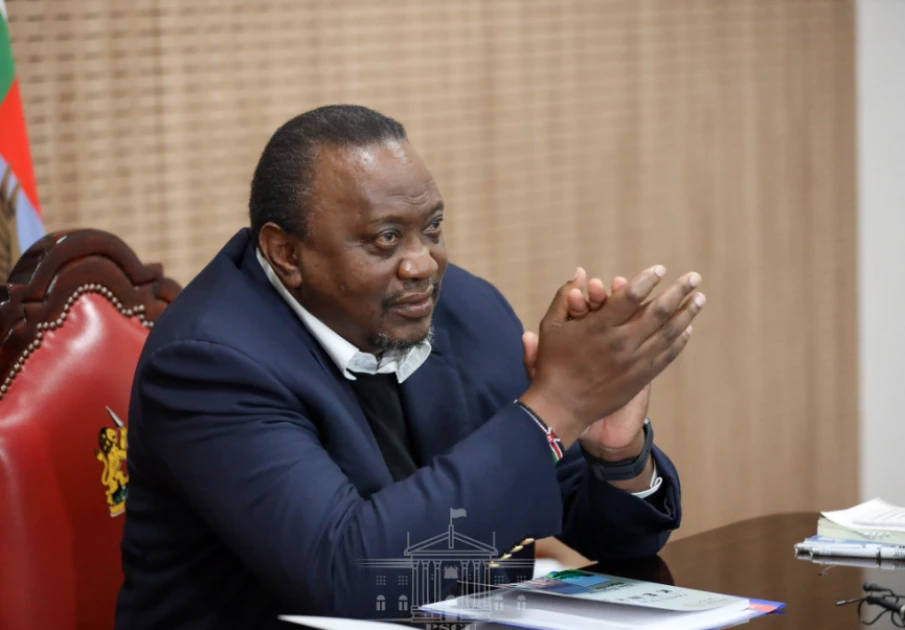
President Uhuru Kenyatta during the virtual 2nd Special Summit of the APR Forum of Heads of State on July 28, 2022. PHOTO | PSCU

Audio By Vocalize
In
eleven days, time President Uhuru Kenyatta enters the lameduck period where
part of his presidential powers will be limited, pushing him to a season where
he cannot hire or fire any State or public official, nor confer any national
honors.
On
the night of August 8th, President Kenyatta will be reduced to just overseeing
government operations as a caretaker president up until he hands over power,
which could take him to late November should the presidential election be
successfully challenged at the Supreme Court.
The President has in recent weeks
been on a farewell mode attending events in his honour or thanking
congregations for having supported him in his ten-year assignment.
He has also been on a path to launch or
commission projects put up during his tenure.
While he will remain president until handing
over to the next Head of State, his power will greatly be reduced on the night
of August 8th.
He will no longer have the power to nominate
or appoint judges of the superior courts, nor to nominate or appoint any other
public officer.
Even though he could still convene Cabinet
meetings, the President can no longer nominate, appoint or even dismiss members
of his Cabinet, Principal Secretaries or other State or public officers in
government or public institutions.
He will no longer exercise the power of mercy
in pardoning any convicted offenders nor confer national honors on anyone.
Over the past few months and weeks, the President
has been executing some of these powers before they expire on him.
On July 20, President Kenyatta appointed and
swore in seven judges of the Court of Appeal. This was three months after
appointing 24 Ambassadors, High Commissioners and heads of foreign missions.
On June 1 during Madaraka Day celebrations,
Kenyatta pardoned over 3,900 convicts; a function he can no longer exercise
after the election day.
On July 8, the Commander-in-Chief conferred
what could easily be his final honors of 508 Kenyans.
But even as some of his powers reduce on the
election day, he could remain in office for longer.
By law, IEBC must declare the presidential
election results by August 15, being a week from the date of election.
If no petition against the election outcome
is filed at the Supreme Court, then the new President will be sworn in on
Tuesday August 30, paving way for Kenyatta to retire.
Should the presidential election outcome be
challenged with a petition, such must be filed by August 22, holding that IEBC
declares the results on 15th.
Should that happen, the Supreme Court will
have 14 days to consider and determine the petition by September 5.
If the election is upheld, the new president
would be sworn in on September 13 allowing President Kenyatta to retire.
And if the presidential election is nullified
by the Supreme Court, a fresh election must be conducted by November 4 being
the last day of a 60-day requirement.
However, if the August 9 election does not
produce a clear winner in the first round, a fresh election should be held
within 30 days, pitting the top two contenders in a repeat duel.
And as President Kenyatta takes stock of his
presidential mission, he has pending engagements including the official
commissioning of the Nairobi Expressway, and commissioning of the Kisumu
Shipyard Limited that has been building a new ship.
The president is expected to unveil a Police
Level 4 Referral Hospital in Nairobi and the Kirigiti stadium in his home
county of Kiambu.
Join the Discussion
Share your perspective with the Citizen Digital community.
No comments yet
This discussion is waiting for your voice. Be the first to share your thoughts!