
What we know about North Korea's new ICBM
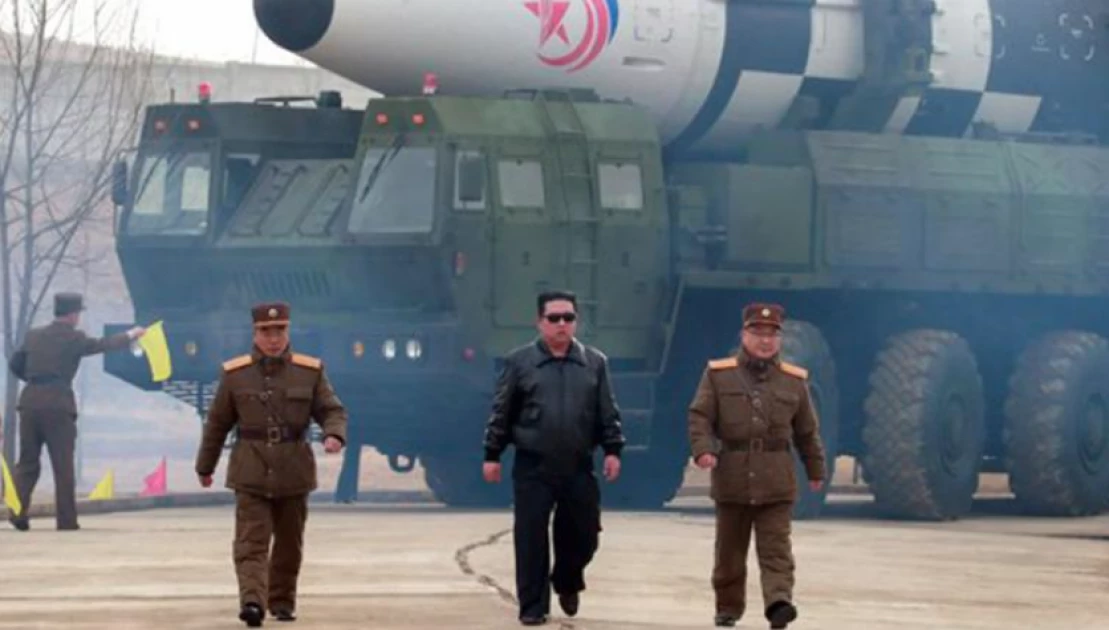
North Korean leader Kim Jong Un walks in front of a missile, in a photo released Friday by state media.

Audio By Vocalize
North
Korea has confirmed it tested a new
type of intercontinental ballistic missile (ICBM), its first
long-range test in more than four years and marking a potential new era of
regional confrontation.
North
Korean state media said on Friday that leader Kim Jong Un had directly guided
the launch of the weapon, known as the Hwasong-17, its most advanced to date.
The report described the launch as a "powerful nuclear war deterrent"
and quoted Kim as saying the country's forces were "fully ready" for
potential military confrontation
with the United States.
The
huge weapon could, at least theoretically, put the entire US mainland in range
of a North Korean nuclear warhead, but there's a lot of unknowns about the
missile's capability to deliver a nuclear payload on target.
Here's
a look at the missile launched Thursday.
North
Korean state media Friday released pictures showing the massive, liquid-fueled
missile being fired from a mobile launcher at Pyongyang International Airport.
The
report from the Korean Central News Agency said the missile hit a maximum
altitude of 6,248.5 kilometers (3,905 miles), flew a distance of 1,090
kilometers (681 miles) and had a flight time of 68 minutes before it
"landed accurately in the planned waters" between the Korean
Peninsula and Japan. That closely matched the estimates of Japanese monitors,
who said the missile fell within Japan's exclusive economic zone, about 150
kilometers (93 miles) west of Oshima Peninsula in Hokkaido, Japan's
northernmost main island.
That
is the highest and longest duration North Korean missile test on
record.
Analysts
said it was fired in a lofted trajectory, enabling it to avoid flying over any
other country. But they noted if it were fired in the normal, flatter
trajectory of an ICBM, it would have the entire continental United States
within its reach.
"This
is the longest-range missile North Korea has ever tested," said Jeffrey
Lewis, a weapons expert and professor at the Middlebury Institute of
International Studies.
The
Hwasong-17 is certainly big enough to carry one, or possibly several nuclear
weapons, experts say.
"What
this really represents is North Korea's
steady progress toward the ability to put multiple nuclear
warheads on targets in the United States in the event of a war," Lewis
said.
But
critically, progress doesn't mean the actual ability to do so.
While
Thursday's test showed the possible range of the missile, experts do not know
what kind of payload it was carrying. Because the weight of the payload
ultimately affects how far a missile can fly, observers cannot know with
certainty the actual range of the missile without this information.
Experts
note that Pyongyang has not shown whether it is
capable of building a system that will allow the nuclear
warhead to survive reentry into Earth's atmosphere.
Because
ICBM's are shot into space, like space shuttles or space capsules, the warhead
must be able to withstand the fiery journey through the outer layers of Earth's
atmosphere without burning up.
"I'm
someone who thinks that they probably would (survive reentry). There are some
people who are somewhat doubtful about that," Lewis said.
But
that is something North Korea can learn from tests like Thursday's, he said.
Leader
Kim Jong Un has laid out an ambitious plan to give North Korea a credible
nuclear deterrent, meaning an arsenal powerful enough to prevent any adversary,
most notably the US, from attacking.
According
to Friday's KCNA report, Kim said Thursday's test affirmed that the strategic
forces of North Korea "are fully ready to thoroughly curb and contain any
dangerous military attempts of the US imperialists."
Lewis
said the North Korean leader is "marching through" a long list of
weapon modernizations laid out more than a year ago.
"(Kim)
said these are all the things that North Korea is going to do and that included
a multiple warhead ICBM. a solid-propellant ICBM, launching a military
satellite, and even even putting a nuclear-powered submarine to sea,"
Lewis said.
"I
don't think he's going to stop until that list is completed," Lewis said.
Previously,
North Korea has announced plans to enhance the accuracy of its missiles and
increase the range up to 15,000 kilometers (9,320 miles).
"I
think we are firmly in a period of missile tests, nuclear tests and tension,
that's probably going to last for a year or so," Lewis said.
Join the Discussion
Share your perspective with the Citizen Digital community.
No comments yet
This discussion is waiting for your voice. Be the first to share your thoughts!