
Who will ever save Nairobi's Pipeline Estate from this filth?
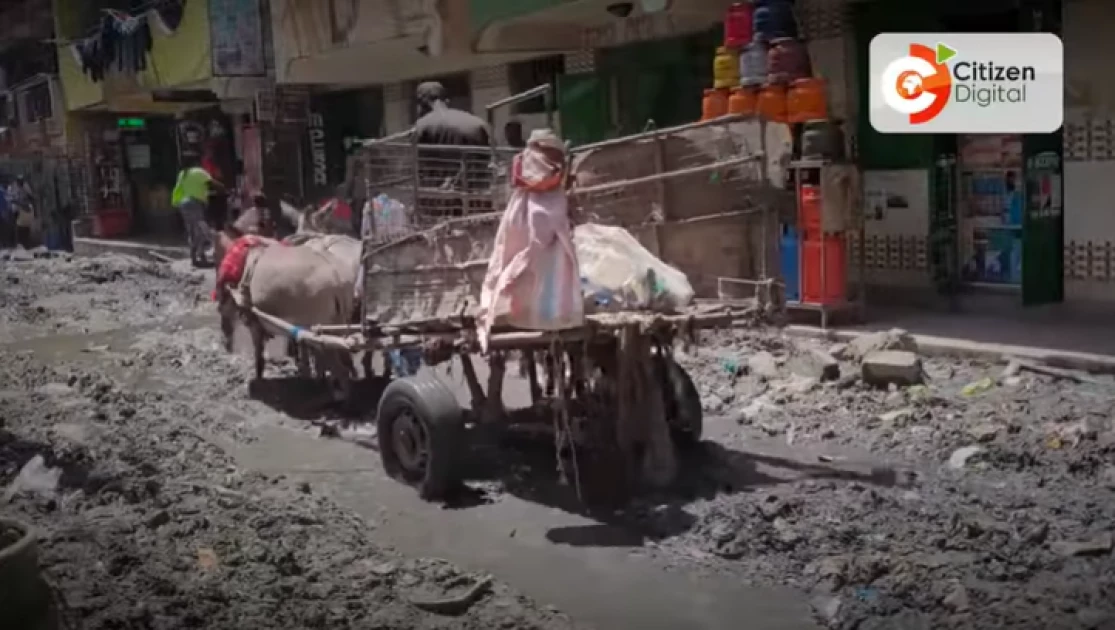
A section of Pipeline estate in Nairobi

Audio By Vocalize
While some see the rains as a blessing, others are battling poor drainage that has resulted in flooded roads and pathways, dangerous manholes covered by water and irritating potholes that damage vehicles.
For Pipeline Estate residents, the situation is dire, literally. The estate, which sits along the poorly built Outering Road, is one of the most populous in the capital Nairobi.
According to the population and housing census carried out by the Kenya National Bureau of Statistics (KNBS) in 2019, Embakasi is the most densely populated area in Nairobi with 988,808 people living there. Pipeline Estate contributes immensely to this data.
Here, residential flats going as high as the 9th floor are compacted together, leaving narrow roads running through them as a passage for residents.
These houses look almost similar. Their architectural design looks almost identical. One could easily forget their house if they are new in the area.
The manner in which these structures are built is wanting. Due to the closeness of the buildings, and the appetite for more rooms from landlords, almost every building in Pipeline Estate is poorly lit. Those on the ground and first floors incur extra electricity costs as they have to keep the lights on during the day.
In these high-rising apartments, narrow entrances and exits have been built by the owners to allow free movement of the residents from one street to another.
It is these streets that are wanting. Below the Pipeline skyscrapers, movement for residents is a nightmare, literally.
The narrow streets are engulfed in raw sewage, mud and all manner of domestic waste material. From used carrier bags to dead rats to cows stuck in swampy sewage, Pipeline Estate does not look like a place human beings call home.
Patrick Baraka, a resident and vegetable vendor in one of the dirtiest streets in the estate, says his business has been hit harder with the rains. Residents cannot access his kibanda for groceries, instead, they opt for a less littered street at the back.
“Here even customers don’t come as they used to. I have lived here for close to eight years but things have been getting worse every day. The road, as you can see, is impassable. Now with the rains, I don’t sell much as customers don’t want to use this street anymore,” Baraka told Citizen Digital.
As we continue with the interview, a young girl comes for sukuma wiki for lunch. We see how she struggles to access Baraka’s kibanda, hopping from one corner of the street to another, using verandas that are as muddy as the streets themselves.
On another street, we meet Josephine Makena, a stay-at-home mum taking care of her three-month-old son. Makena says she has lived in Pipeline for six years and every day the streets are getting uglier, dirtier and impassable.
She denies that residents are to blame for the mess that is Pipeline Estate, instead pointing to poor infrastructure, lack of tarmacked roads and water pipes exposed to damage.
“These pipes are running on the surface. When they get damaged, the water keeps leaking hence the mess you are seeing around. Kids can’t even go to school, we have to carry them on our backs, wade through the mud and get them to safety. It is really difficult for us,” Makena says.
Dennis Monari moved to Pipeline from Mukuru Kwa Njenga a month ago. He says despite the better houses in the estate compared to the mabati structures in Mukuru Kwa Njenga, the sewerage system in Pipeline is wanting.
Monari says traders cannot move goods to their stalls because the roads are impassable. He says the Pipeline's drainage system is so poor that when rains come, the water stagnates together with the mud, and even gets into houses.
“Look at this road behind me. How can you move your goods on this road? We are asking the county government of Nairobi, and particularly our Governor Johnson Sakaja, to look at us and help us. We are suffering. We cannot do anything because the roads here are inaccessible,” Monari said.
Their cry is the cry of every Pipeline resident. As we visit another street, we come across a 50 by 100 plot of land yet to be developed by the owner. This piece of land has been turned into a dumping site for the residents.
Not even a minute passes before we see kitchen water flying from the 4th floor of one of the buildings in this area.
The dumping site has turned into a swamp of raw sewage, plastic waste and perishable groceries. Three roaming cows have been stuck in the sewage as they scavenge for fodder. One of the cows is almost sinking and looks like it will die. Residents watch from a distance as they cannot help, lest they sink too.
That pretty much summarizes what Pipeline is all about.
The concerns about the poor state of the estate have been raised online lately, with many calling out the county government for its inaction. Governor Sakaja was reached out through social media, and he has since promised to look into the state of Pipeline estate.
It’s the hope of the residents that this is not just another empty promise by a politician.
Join the Discussion
Share your perspective with the Citizen Digital community.
No comments yet
This discussion is waiting for your voice. Be the first to share your thoughts!