
Why roads have unnecessary, yet necessary curves
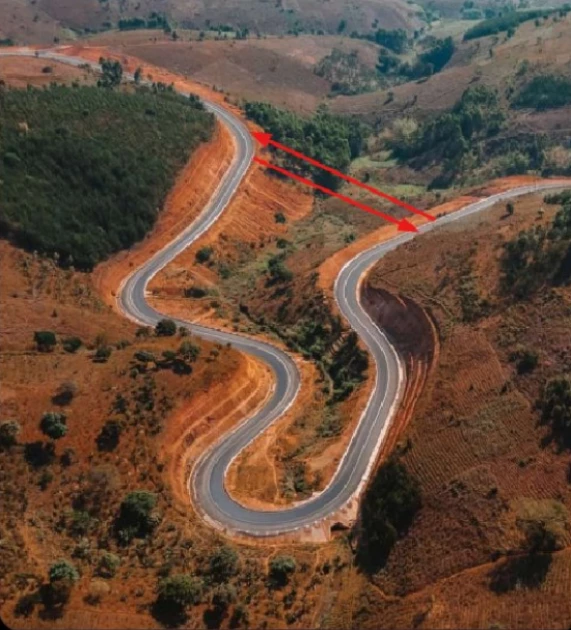
Photo shows a section of road with a long curve that elicited social media arguments on why engineers did not just build a straight road to connect the two sections. Photo: Courtesy

Audio By Vocalize
In the old times, when a road had to be built up a hill, the team of prospectors would lead a donkey or a mule up the incline. The donkey would not go straight up along the shortest route, but would instinctively follow a path with a moderate incline, or grade, very similar to the maximum grade considered safe for roads (8 to 10%).
The prospectors would hammer stakes in the ground after the
donkey and then measure the position of the stakes, draw all the points on a
map and start drawing the road profile after joining the dots.
When the prospectors felt that the donkey had gone too far
from the desired direction, or when an obstacle was met, they would turn the
donkey around and it would continue climbing in the opposite direction with the
same incline.
The point where the donkey changed direction would be the
location of a hairpin turn.
A powerful car with adequate gear ratios (and adequate grip)
can go up a very steep incline but a loaded freight vehicle or a bus full of
passengers cannot.
Going downhill on a very steep incline can be extremely
dangerous.
An incline or grade of 8% is considered the limit for a
major road. For short distances, 10% 15% and even 20% grades can be considered
acceptable on minor roads but must be accompanied by adequate signage
Some very exceptional grades exist on some mountain roads,
but I would not want to travel with a truck on such a road.
NB that “grade” and “angle” of a slope are two different
measures since “grade” indicates how much one climbs given a certain distance
travelled horizontally.
For example, if you travel 1000 m (1 km) in a horizontal
direction and at the same time climb 100 m, then the grade would be: 100 m/ 1000 m = 1/10 or 10%
One good thing of expressing the rate of climb this way is
that it is independent from the unit of distance that you use, as long as it is
the same for horizontal and vertical distances.
If you measure
horizontal distance and climb in miles you will reach the same result as when
using metric units (but not if you measure distance in miles and climb in
feet!)
A grade of 10% corresponds to an angle of about 6° and a
grade of 50% corresponds to an angle of 27°. A slope with an angle of 45° would
have a grade of 100%
Those who are keen on trigonometry, or who have
recollections of it from school, will recognize that the “grade” is equivalent
to the “tangent” of an angle, apart from the unit, which for the
trigonometrical tangent is a pure number, while grades are expressed in percent
(%) or per-thousand (used in railway engineering, where grades are very small)
to get rid of decimals.
Because the Earth is not flat.
I am not contributing to the flat-Earth vs. spherical Earth
debate here. This is a matter for other topics. But I am referring to the fact
that the Earth has mountains and valleys, rivers and ridges, coastlines and
canyons.
And not always you can Just go straight through, across or
over them.
Vehicles cannot climb any incline, and the way down an excessively
steep descent is very dangerous. Dont think of a a 4X4 SUV, and not even your
average passenger car: think of an articulated truck loaded with dozens of tons
of goods, or a bus loaded with passengers.
So roads go sideways up and down hills, following a path
with a moderate grade, which is both easy to climb and safe to go down. Every
now and then there has to be a corner, hairpin or other, to return towards the
correct direction.
Sometimes, it is just a minor obstacle that makes it difficult
to go straight: a small hill, a large body of rock, a bend of a river… and the
engineers prefer to design the road so that it goes around it, rather than
cutting through it. Sometimes it is simply too expensive.,
It requires building exceedingly long viaducts and tunnels
and it is not worth doing it just to cut a few miles off a torturous route.
It’s true that today, with modern technology, it is possible
to build such works of engineering and go straight across a deep valley, or
through a vast mountain. It only has to be economically worth while.
As my friend @hudumaManda suggests and we've seen the
argument online for a while now, there’s
another, more subtle reason for not building straight roads: curves provide
control to drivers. When you drive along a straight road, the vehicle gives you
very little feedback to allow you to be conscious of your speed, except seeing
the landscape flow quickly past you, glancing at the speedometer, or hearing
the engine revs.
On a long, straight road, especially if there is little
traffic and the landscape offers wide open views, you may feel safe at a speed
which is actually unsafe.
It is unsafe because if something unusual happens: an animal
crossing your way, a large bump or pothole, something that distracts you, a
piece of debris large enough to upset your vehicle then you may lose control of
the vehicle and crash.
Going around a corner, instead, the centrifugal force tells
you how fast you’re going by pushing your body towards the outside of the
corner and forcing you to contrast it with your muscles.
This force increases with the square power of speed: If you
increase the speed by 40% the force doubles; if you double the speed, the force
quadruples.
For this reason, road engineers often put “unnecessary”
corners on purpose. It is not that they break a straight road with a sharp
corner here and there: that would be very dangerous.
Rather, they design the road to be evenly and gently snaking
across the landscape, making ample curves, even if it could go straight.
It was not so in the past. Road engineering derives from
railway engineering: the first road engineers that designed long distance
highways, were railway engineers and designed them like railways.
On a railway, there is no need to provide the conductor with
this kind of speed control, since they will abide to mandatory speed limits.
So a railway is
designed as a sequence of long straight sections interrupted by wide, regular
curves where needed. On straight sections, the train can go faster, has less
friction and the passengers are more comfortable.
Join the Discussion
Share your perspective with the Citizen Digital community.
No comments yet
This discussion is waiting for your voice. Be the first to share your thoughts!