

Women in Construction: The women building Karugia Market
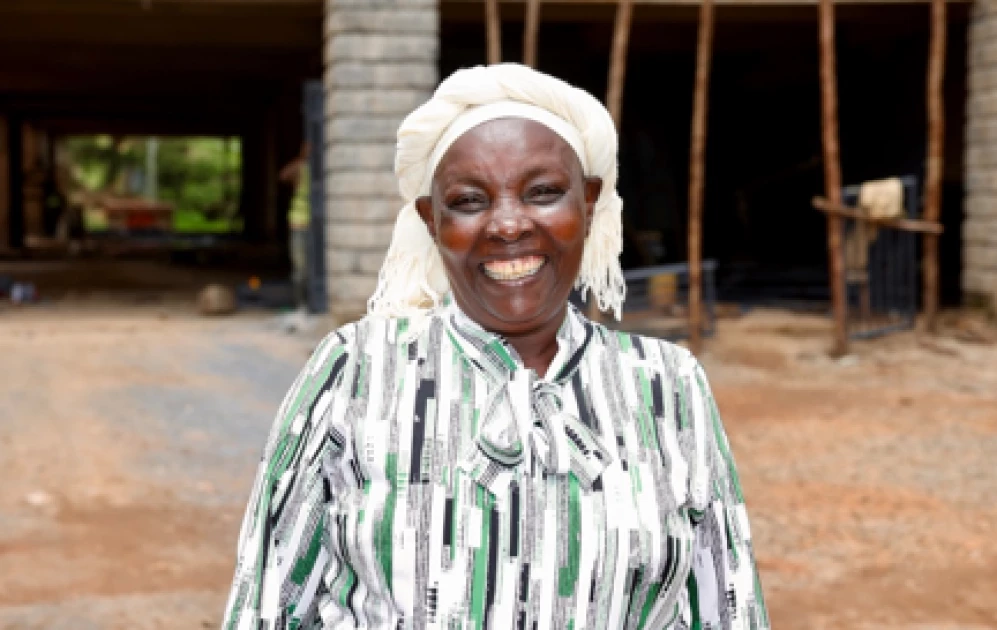
The women building Karugia Market, from left: Mercy Kagweria, Mellania Wangari, and Mary Wanjiru

Audio By Vocalize
A little-known market tucked away on the scenic slopes of Murang’a County is quickly becoming the talk of the town.
Karugia Market may be trending, but not just because it was
commissioned by President William Ruto under the Economic Stimulus Programme in
early April 2025, or its proximity to the newly upgraded Michuki Polytechnic.
The real story lies within the construction site itself, the women building
Karugia Market.
When the story of Karugia Market’s impressive transformation is told, the spotlight will shine brightly on the remarkable women making it happen. Meet Mercy Kagweria, one of the women literally building the market from the ground up in her village.
Celebrated for its fertile land and the hard work that yields a bounty of
agricultural produce, the county is now witnessing another powerful force at
work: the skill and determination of women in construction.
“I
have been working in this field, but this is my first project in Karugia. It is
very rare to find women doing this kind of job, but we have to do it,” Mercy
said.
“Since we were appreciated and welcomed
here, actually we were encouraged, supported, and treated equally, there was no
gender bias. Of course, a manual labourer won’t earn the same as a skilled
worker; there is a difference but we keep pushing,” she explained.
For Mercy Kagweria, this project is deeply personal. With every wheelbarrow of sand pushed, every wall raised, and every beam lifted, she envisions more than just a marketplace. She sees a future built by women, for their communities, a future she is committed to nurturing through training, mentorship, and expanded opportunities.

Mercy Kagweria at the topmost floor which will have a board room, ICT Hub, cafeteria
“Of course, apart from getting paid, you
get to learn a lot of things, like construction skills. Once the construction
is finished, we will return to selling our farm produce; at least we will have
somewhere modern to come to for our daily bread,” she passionately explained,
referring to the market, which will feature, among other amenities, a cold room
to reduce post-harvest losses.
“Having cold room storage for farm produce at the facility will ensure maximum profits. This is a single-phase project, it has not stalled. We will be using it soon. Looking from below, the roofing is about to be installed,” said Joseph Karanja, Secretary of the Kaihii Irrigation Project and a farmer, noting that farmers are eagerly anticipating the completion of the market.

Joseph Karanja, Secretary of the Kaihii Irrigation Project
“Actually, this is the first digital market I have seen, and it even has a library, so our children will benefit a lot from it. Apart from the library, we can sell our things online,” Mercy interjected, noting that the work she is doing is more than just the construction of market stalls.
“It is the story of women building economies
and leaving an indelible mark on Karugia Market and beyond. We are laying the
foundation for more women in construction to embrace the tools of the trade and
shape Kenya’s evolving landscape.”
The Ksh.52 million market commissioned on April 3rd, 2025, by President
William Ruto stands at the intersection of growth and a thriving circular
economy. It serves farmers who depend on the consistent irrigation from the
Kaihii and Nyanjigi projects, enabling year-round agricultural production. It
will accommodate 200 traders in the digital stores inside and 100 outside.
“I
was there when it was commissioned, you know I had never seen the
President that close before, only on TV. So that day, when he came to the market I got a chance to
see him up close at the construction site, and it was really exciting for me. I
felt like I have contributed a lot to building this market and the dream of the
Economic Stimulus Programme.”
The Ksh.52 million market, commissioned on
April 3rd, 2025, by President William Ruto, stands as a symbol of progress,
anchored at the crossroads of economic growth and a thriving circular economy.
Designed to support farmers who rely on the reliable irrigation from the Kaihii
and Nyanjigi projects, the market ensures year-round agricultural productivity.
Once fully operational, it will house 200
traders in the digital stalls within the market and accommodate another 100
vendors outside, creating space and opportunity for small businesses to
flourish.
“I was there during the commissioning,”
mercy alluded “I had never seen the President that close before, only on TV. So
when he came to the market that day, and I saw him right at the construction
site, it was incredibly exciting. I felt like I had played a part in making
this dream a reality, contributing to both the market and the goals of the
Economic Stimulus Programme.”
Murang’a County Commissioner Joshua
Nkanatha described it as a snowball effect on the local economy, highlighting
the cross-sector development sparked by the upgrading of Michuki Technical
Training Institute to a national polytechnic.
“The linkage between the commissioned Kaihii Irrigation Project, the phase four infield connectivity of the Nyanjigi Irrigation Project, the market, and the national polytechnic is very clear. It is transforming this once-quiet trading centre into a 24-hour economy,” said Nkanatha. “With the expected intake of 9,000 more students, the population will grow significantly, and with it, the demand for goods, services, and consistent food production.”
“First of all, let me just say, this market is classic. It really is something else,” said Lucy Waithera Irungu, a committee member, as she unpacked some of its unique amenities. “It has so much inside. There is an ICT hub, and even a crèche where the children of businesswomen can rest while their mothers work. Upstairs, there is a social hall, a kitchen, and a café, so if you get hungry, you just head up, grab a bite, then come back down and continue with your work.”
She went on to say, “On the ground floor, you will find digital
stalls, dry storage, and a cold room. And what is really special is that the
market is fully accessible, People Living with Disabilities can comfortably
reach every floor. We are very happy because this is not just any market, it is
modern, inclusive, and made with everyone in mind.”
Joseph Munjuru Karuge, another farmer who
has been closely monitoring the project’s progress and is a beneficiary of the
Nyanjigi
Irrigation Project, echoed similar sentiments,
saying: "The connection between Karugia Market and the farmer is the cold
room and market linkage to traders. Some of our farm produce goes to Makuyu
town, some to Karugia Market, and some is even bought by traders from other
parts of the country. But no one talks about the perishable farm produce that
ends up rotting and going to waste. We are very happy about this market because
we have heard it will have a cold room."
Ephantus Kamada Mwangi, another farmer
under the Nyanjigi Irrigation Project, where phase four infield connectivity is
nearing completion , added: "Therefore, all the produce we will be
harvesting from our farms, we will bring here. If we don't sell it all, we can
store it here and sell it another day. Also, the farmers in this area will
benefit greatly because the farmers who sell here will also come to our farms
to buy the things we have planted there."
In her parting shot, Mercy Kagweria called
on more women to take up jobs in construction: "For my fellow ladies, I
would like to tell them not to be picky about jobs. As long as it provides your
daily bread and can sustain you, do it."
For the women building Karugia Market, it
is more than just a construction project. It is another opportunity to create
jobs, transform lives, and inspire more women to take their place in Kenya’s
growing construction industry.
Leave a Comment