
sponsored content
Kenya's Fiscal Sovereignty at a Crossroads: The People's Diagnostic Report #AD
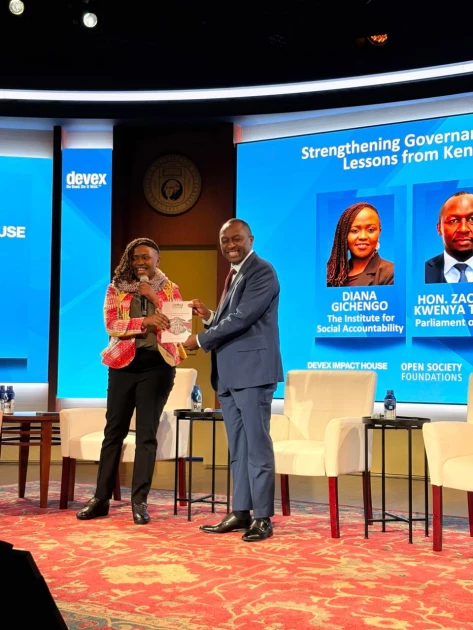
Diana Gichengo presents The People’s Audit Policy Brief to IMF Managing Director Kristalina Georgieva at the Civil Society Town Hall in Washington D.C. advocating for debt justice and accountability.

Audio By Vocalize
Developed through a civil society-led diagnostic process, the report presents a powerful citizen-driven perspective on economic misgovernance, the public debt crisis, and the pressing need for transparency and accountability in fiscal management.
This report comes as the IMF is in the process of conducting a Governance and Corruption Diagnostic for Kenya.
Grounded in the Campaign’s conviction that citizens have the power to rebuild their nation, this year’s theme, “Co-creating Solutions for Kenya’s Debt Recovery and Economic Justice,” was prominently highlighted during the recently concluded Public Debt Conference.
The report is developed amid intensifying debates around Kenya's growing public debt and the role of International Financial Institutions, particularly the International Monetary Fund (IMF) and the World Bank, in shaping fiscal policy.
Since 2013, Kenya's public debt has ballooned from Ksh 1.9 trillion to an estimated Ksh.12.05 trillion in September 2025, with a debt-to-GDP ratio of approximately 67.3%, of which domestic debt stock is Ksh 6,660.48 billion (37.2 per cent of GDP), while the external debt stock is Ksh.5,393.53 billion (30.1 per cent of GDP).
Domestic and external debt stock accounts for 55.3 per cent and 44.7 per cent of total debt stock, respectively.
The rapid increase in domestic debt, which has overtaken external debt, has led to crowding out of the private sector, causing a decline in economic activity.
Further, debt servicing costs have dwarfed spending on social services, leading to deteriorating public services in health, education, and social protection, increasing poverty and inequalities.
Okoa Uchumi’s People’s Audit lays bare a painful truth: Kenya’s economic crisis is not caused by the lack of resources but by the choices of those in power.
The report exposes how public resources are captured by a few, how borrowing is done in secrecy, and how institutions meant to protect the people have been weakened.
Ordinary Kenyans bear the weight through unfair taxes and rising costs of living, while the system rewards political loyalty over the provision of public services.
The Okoa Uchumi Campaign calls on citizens and leaders alike to demand accountability, end the culture of impunity, and rebuild an economy that serves the people and not power.
In the lead-up to the report's launch, the Okoa Uchumi Campaign represented over 100 organisations and individuals and has actively engaged with the IMF and World Bank, emphasising the necessity of integrating governance reforms into fiscal adjustment programs.
At the 2025 IMF-World Bank Civil Society Town Hall in Washington, D.C., Okoa Uchumi representatives presented their policy brief, calling for the IMF to adopt broader Governance Diagnostic Assessments as a standard tool to better reflect realities on the ground in Kenya and similar contexts.
The IMF has acknowledged the importance of governance, with its Managing Director Kristalina Georgieva, stressing that "high levels of debt suffocate economies," highlighting the need to link debt sustainability with transparency, anti-corruption, and institutional integrity.
However, the People's Audit challenges the current IMF and World Bank programs to stop prioritising fiscal targets over accountability and citizen participation, which risks stabilising books while destabilising societies.
Drawing lessons from Sri Lanka’s recent crisis, the report warns that Kenya cannot achieve lasting stability without honest and accountable leadership.
Fiscal fixes alone will not work if corruption and secrecy remain untouched. Okoa Uchumi calls for a justice-centred fiscal reset that restores the country’s financial independence through transparency, fairness, and citizen power.
It urges Parliament and oversight bodies such as the Auditor General and the Controller of Budget to be properly funded and empowered, all loan agreements to be made public, and social spending to be protected so that reforms do not come at the expense of the most vulnerable.
This report marks a pivotal moment as Kenya grapples with the twin challenges of managing public debt and restoring public trust in fiscal governance.
The Okoa Uchumi Campaign’s work shines a spotlight on the urgent need for fiscal policies that are not only economically sound but democratically accountable.
The launch on 25th November 2025 will provide a platform for citizens, policymakers, and international partners to reflect on these issues and commit to a governance-led recovery that serves all Kenyans.
Kenya stands at a crossroads. It can continue down the path of fiscal capture and growing inequality, or choose a new direction, one where fiscal sovereignty serves the people and strengthens democracy.
The People’s Audit offers a starting point, but real change will depend on the courage and collective action of citizens and leadership.
Leave a Comment