

OPINION: How the Muslim Brotherhood shapes Sudan’s war
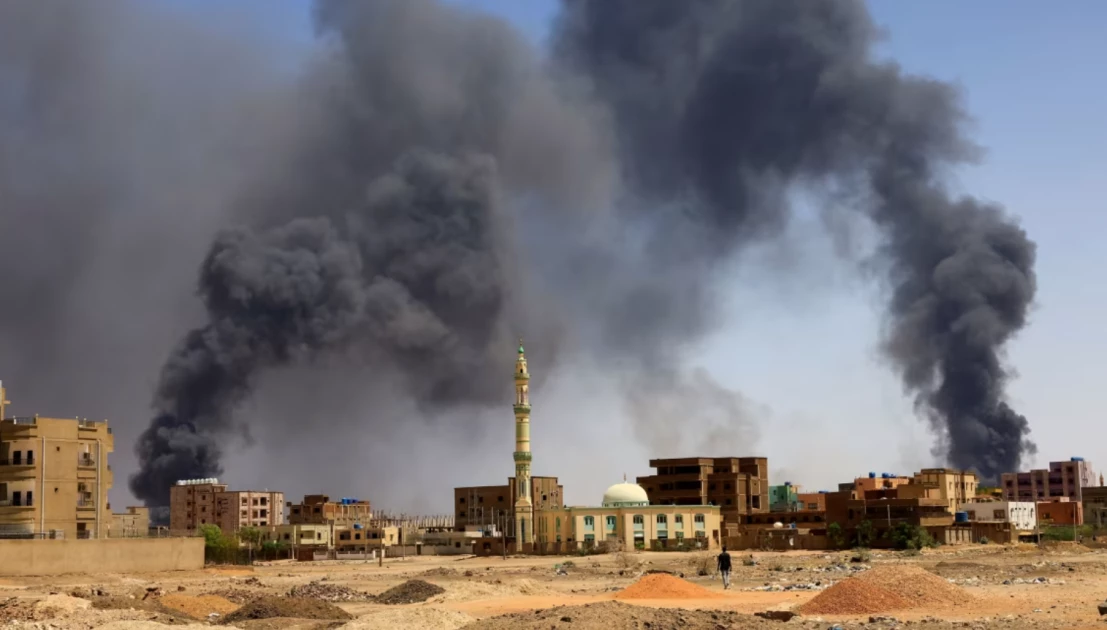
A man walks while smoke rises above buildings after aerial bombardment, during clashes between the paramilitary Rapid Support Forces and the army in Khartoum North, Sudan, May 1, 2023. Mohamed Nureldin Abdallah/Reuters

Audio By Vocalize

By Amos Kaberia
International observers — such as the Council on Foreign Relations, which characterizes Sudan’s brutal war as a power struggle between competing military factions led by two rival generals — often portray Sudan’s violence in bilateral terms. On one side is the Sudanese Armed Forces (SAF), led by General Abdel Fattah al-Burhan, and on the other is Rapid Support Forces (RSF), led by General Mohamed Hamdan Dagalo. However, this description elides a wider ideological dimension, namely the infiltration of the SAF and key state institutions by Muslim Brotherhood–aligned actors, which subscribe to an international Islamist ideology.
As Asharq Al-Awsat reported, Muslim Brotherhood branches are
an integral part of the SAF. Known locally as the “Kizan” — the Muslim Brotherhood rooted Islamist cadre that sustained the
former president Omar al-Bashir’s three-decade rule — the movement embedded its
members throughout military academies, command structures, and internal
security organs, while sidelining independent officers. Recent reports estimate
that the Muslim Brotherhood comprises 75% of the SAF. Their
prevalence within the security apparatus shows that the 2019 uprising removed a
president, but not the Islamist-military system that sustained him.
Consequently,
as international actors – notably the Quad (the United States, Egypt, Saudi
Arabia, and the UAE) – seek a peace agreement, they must approach negotiations
with skepticism, recognizing that they are engaging an entrenched Muslim
Brotherhood infrastructure. Burhan has effectively served as a Trojan horse for
the restoration of this Islamist movement. To international audiences, such as
in a Wall Street Journal op-ed, Burhan portrays himself as the
defender of Sudan’s sovereign institutions against a rogue RSF, referencing
RSF’s brutality – which is beyond dispute –
to argue that international support for the SAF is both necessary and
morally justified. This framing is incomplete because it ignores Burhan’s role
in empowering the RSF before the war and in elevating equally dangerous
Islamist elements within the Sudanese military.
The
Islamist Comeback: Burhan, Kober, and the Re-Militarization of the Kizan
The
April 2023 release of leading Islamists from Kober Prison demonstrated
the SAF’s partnership with radical Islamist forces, which at times even
overlap with ISIS. Sudan watchers noted that their release was “not an accident,”
particularly given the proximity of the SAF to the Sudanese Islamist movements.
Notably, the SAF allowed the release of Ahmed Haroun, a high-ranking official in the Bashir regime
who served in several key ministerial and gubernatorial roles. Haroun’s release
was not an isolated case.
Other
Islamists freed at the same time included Ali Osman Taha, a powerful
Islamist in the Bashir administration, as well as Osama Abdallah, who helped
oversee the Shadow Brigades, an umbrella group of various Islamist
militias. Together, these Islamicist operatives, free from imprisonment, significantly influenced Burhan and the SAF. Consequently,
Burhan is largely dependent on Islamist
forces, who themselves fall under the direct control of the global Muslim Brotherhood.
The
Shadow Brigades and Ali Karti’s Hidden Hand
Freed
Islamists found a ready network in the aforementioned Shadow Brigades, which
provided them with ample opportunity to pursue their Islamist ambitions. Within
the Shadow Brigades, the El Baraa Ibn Malik Brigade (BBMB) stands out as a
radical Islamist militia, which provides active support to the SAF. To thwart the BBMB’s
Islamist – and Muslim Brotherhood – goals for destabilization in the
region, the U.S. Treasury sanctioned the BBMB in September 2025.
The
BBMB represents the paramilitary arm of a deeper political infrastructure led
by Ali Karti, the Secretary-General of the Sudanese Islamic Movement. Karti
works to promote Islamism and to oppose democratic institutions within Sudan. Operating from Port Sudan, Karti
wields the true executive power behind the scenes, with Burhan executing Karti’s Muslim Brotherhood directed command.
This
arrangement mirrors the operational model perfected by Hamas: an ostensibly
local armed force whose military, political, and financial components are guided by the Muslim Brotherhood. Similar to its
relationship with Hamas, the Muslim Brotherhood controls the SAF through aligned
militias, shadow leadership, and external financing.
The SAF
has another similarity with Hamas: its support from an international "Axis
of Resistance.” The SAF has become the beneficiary of an alliance of state
sponsors, which fuel Burhan’s war machine. Turkey provides the lethal backbone
of this support through Akinci and Bayraktar drones, which have granted the SAF an
aerial edge. Iran has supplied Mohajer-6 drones in exchange for strategic
Red Sea access, a move that aligns with Tehran’s playbook of empowering
proxies to expand its regional footprint.
Additionally,
Qatar offers political and financial backing to the SAF. All
this external backing works in coordination with the Sudanese Islamic Movement
and the BBMB’s ideologies. By the time the U.S. Treasury sanctioned the BBMB in
September 2025, the blueprint was already complete: a supposedly national force
functioning as a Muslim Brotherhood proxy.
The
Trump administration has recognized the threat that the Muslim Brotherhood
poses. This year, it imposed terrorist designations on Muslim Brotherhood
branches in Lebanon, Jordan, and Egypt. However, why did the U.S.
administration give the Sudanese branch, the SAF, a pass? To further the
negotiations with SAF?
Burhan
has already proven himself unwilling to compromise before the Quad’s peace overtures.
For the last two years, he has rejected multiple peace offers – there is no
evidence that turning a blind eye to the SAF’s radical ideology will change
things.
Rather
than appease Burhan and his Muslim Brotherhood affiliates, the U.S. needs to
recognize that the SAF’s underlying Islamist ideology is an insurmountable
obstacle. Diplomacy with the SAF is destined to fail given the Islamist core
that determines SAF policy.
Washington should therefore extend its January 2026 terror designations to include the SAF’s senior command and the Sudanese Islamic Movement that directs it. If the international community is serious about ending the war, it must confront the radical Islamist ideology driving the SAF instead of treating its leadership as a legitimate political interlocutor.
Leave a Comment