

OPINION: Kenya-DRC tensions have gone cold, and could get worse
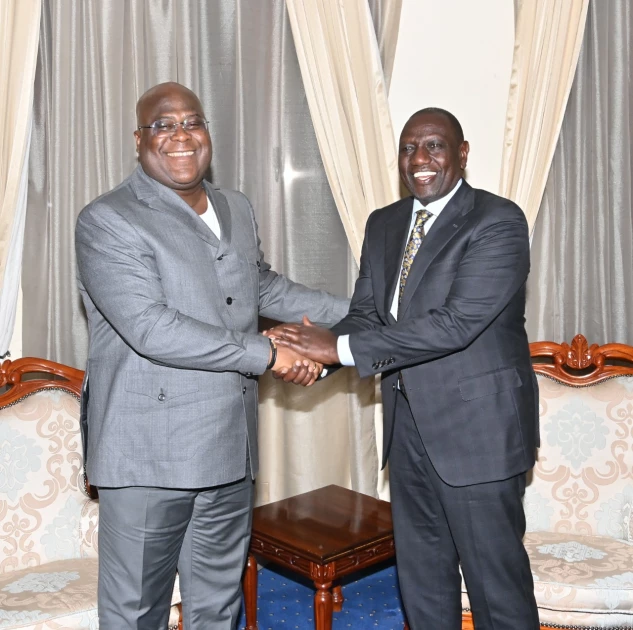
President William Ruto with the Democratic Republic of the Congo President Felix Tshisekedi in 2022. Photo I Pool

Audio By Vocalize
The Kenyan president made the remarks at the recently concluded leaders summit in Kigali, Rwanda. The previous regional consensus was that Rwanda was backing the M23 and was not acting as a good neighbour.
President Ruto’s statements complicate the diplomatic process because the DRC is likely to shelve the Nairobi peace process in favour of the Luanda-based process domiciled in Angola.
Kinshasa will also question Kenya’s role as a neutral arbiter in its diplomatic row with Rwanda because President Ruto’s pronouncement dovetails with that of President Kagame.
These developments will hamper the Kenyan-led initiative to mediate the political and security crisis in the Great Lakes Region (GLR).
On the economic front, rising tensions between Kinshasa and Nairobi are likely to affect trade and economic ties between the two countries.
Kenya has a positive balance of trade portfolio with the DRC, exporting goods worth almost Ksh.15 billion in 2020 while importing goods worth Ksh.232 million that same year.
Under President Kenyatta, efforts were made to ease the process of using the Mombasa port for Congolese traders specifically around excessive bureaucracy, theft of cargo and taxation.
In addition, Kenya opened consular services in Goma and Lubumbashi to support Congolese traders at the port. Current tensions between the two countries could bring this cooperation into question.
In relation to this, the recent detention of Kenya Airways staff by DRC intelligence officers over a row on cargo did not help an already tension-filled relationship.
Kenya’s ambassador to Kinshasa is yet to be accredited as President Tsesekedi appears to favour intervention from the Southern African Development Conference (SADC) as opposed to the recently expelled East African Community Regional Force (EACRF) to tackle the M23 and other rebel militia in the GLR.
Time will tell if this new position by the Ruto Administration affects economic and diplomatic relations between the two countries.
On the corporate front, major Kenyan corporations including Kenya Airways, Kenya Commercial Bank and Equity Bank have been making major investments in the DRC.
Equity Bank recently increased its shareholding in its subsidiary in the DRC, KCB acquired DRC's Trust Merchant Bank and Kenya Airways recently launched the Nairobi-Goma route in addition to daily flights to Kinshasa.
The Tseshekedi regime could choose to retaliate to Kenya's actions economically by delisting banks, restricting the bank's expansion or granting government tenders and contracts to the exclusion of Kenyan banking interests.
Regionally, President Ruto’s statement on the challenge of the M23 rebels could test the unity of the East African Community (EAC).
With Tanzania contributing troops to the SADC intervention force now in the DRC, Kenya-DRC tensions have the potential of dividing regional states between Nairobi and Kinshasa.
Tanzania in particular has divided loyalties, being a member of both the Southern African Development Community (SADC) and the EAC.
It has on occasion acted to check Kenya's expanding influence in East Africa. It is also not clear how Uganda, Somalia, Burundi and South Sudan will react to Kenya's changed stance in the Great Lakes Region.
Rwanda will welcome the changed position of Nairobi on the conflict in the DRC as it sees the remnants of the Hutu (Democratic Forces for the Liberation of Rwanda) FDLR in the Eastern DRC as a national security threat to itself.
Ruto's change of position will bring Kigali and Nairobi closer together. This is because Kenya is currently negotiating with Rwanda to channel all its imports via Mombasa and not Dar es Salaam.
So this move on DRC might be a sweetener in that direction.
As for Rwanda, it gains a powerful ally in Kenya in addressing its security concerns from the Hutu genocidaires still present in the DRC and threatening cross-border attacks on Rwanda.
In addition to this, President Ruto’s statement can be seen as Kenya’s cold retaliation against the DRC for kicking out the East African Community Regional Force (EACRF).
Assessing systemic dynamics more closely, Kenya is exerting diplomatic pressure on the DRC to reengage with regional players in the expelled (EACRF) as Kinshasa has shown a preference for SADC intervention.
Kenya's recent inclusion as a non-NATO ally of the United States also increases Nairobi's leverage in Great Lakes Region affairs.
Washington has recently begun to rely more and more on Kenya as an anchor state in the East and Central African region to advance its interests regionally.
Lastly, President Ruto’s statement is likely to weaken further the bilateral relations between Kenya and DRC.
The DRC has few options and little to no control of the eastern part of the country. It is a weak state with central power at the seat of government in Kinshasa being undermined even further by the recent attempted coup.
So Tshisekedi has a lot of domestic problems to deal with. This severely limits his diplomatic options in isolating and punishing Kenya for siding with Rwanda. More diplomatic intrigues between Kenya and DRC are yet to come.
Professor Monda teaches political science, international relations and foreign policy at the City University of New York. @dmonda1, davidmonda.com
Leave a Comment