
OPINION: Renewable energy is Africa’s development answer
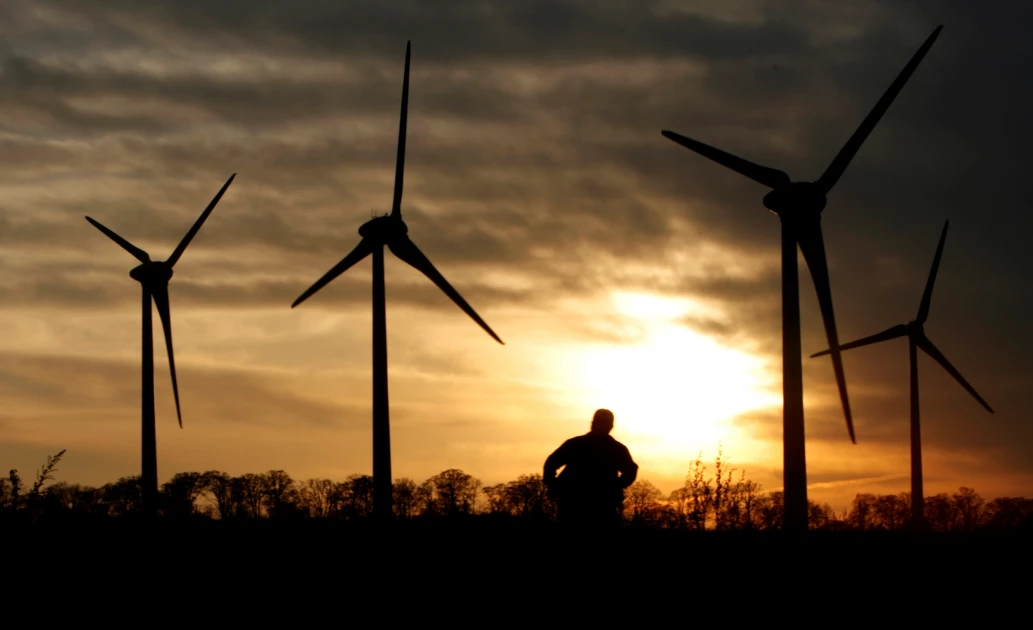
A man looks at 100-metre-tall (328-foot-tall) wind turbines during sunset at the Electric Power Development Co., Ltd's Nunobiki Plateau Wind Farm in Koriyama, north of Tokyo, Japan, November 8, 2007. REUTERS/Toru Hanai

Audio By Vocalize
Africa is better off investing in the energy of the future—renewables.
The era of fossil fuels as the primary energy source is soon coming to an end, having powered the modern-day global economy at a heavy cost to the environment, with the planet heating up.
Africa is starting from a low development base, racing to make up for decades of under-investment. The good news is that the continent could rapidly accelerate this progress by going green.
Clearly, the economic model that most African countries inherited post-independence has failed to deliver universal energy access many decades later.
Nigeria, for instance, has long had its oil reserves extracted in huge volumes yet it still grapples with energy challenges.
Likewise, South Africa, heavily reliant on coal-fired stations, continues to suffer from rolling blackouts even after exploiting its vast coal deposits.
We’ve started seeing a shift, with decentralised technologies powered by wind and solar lighting up thousands of remote villages that would otherwise have remained in darkness probably for another century.
Still, over half of Africa’s population remains cut off from electricity access. Also, the greening of national grids through the addition of renewable energy to the mix is sluggish largely due to investment shortfalls.
African Union green agenda
African leaders and captains of industry, through the African Union (AU), could give the green agenda a big push as the answer to these challenges.
For instance, to pivot the continent into a clean energy future, AU leaders need to formulate binding green policy frameworks to guide the 55 member states.
They should ensure renewable energy and climate change take centre stage during the AU heads of state meetings. Outside global climate change conferences, like the recent COP27, we’ve seen little Pan-African engagements around these issues. That needs to change.
Worse still, a section of African leaders wants to invest in fossil fuels like natural gas largely to serve their political interests as foreign oil and gas companies, already raking in billions of profits, benefit at the expense of communities in Africa.
This is unacceptable. As the world transitions to clean energy, our leaders need to take a stand and seize opportunities for the continent to lead on this path and become energy secure.
Stronger coordinated Pan-African engagements among AU leaders would snowball into an unstoppable force in making a case on the global stage.
The continent will be able to better negotiate with developed countries and investors to unlock investment flows to Africa.
Out of the $2.8 trillion that went into renewable energy globally between 2010 and 2020, only two per cent came to Africa, yet the continent has more clean energy resources than any other continent on earth.
Africa’s potential wind resource exceeds 59,000GW (IFC) which is enough to power the continent’s energy demand 250 times over.
There’s actually a need for an AU-led Africa Climate Summit.
To be clear, it’s not like the AU has done nothing over the 20 years it has been in existence. It has actually rolled out a number of sustainability-focused programmes. The problem is implementing them.
In 2021, for example, the AU launched the Green Recovery Action Plan targeting five areas, including climate finance, renewables, nature-based solutions and biodiversity, sustainable agriculture and lastly, green and resilient cities. Sadly, this blueprint remains nothing more than a plan on paper.
Another example is the Grand Inga Dam in DRC, an AU flagship mega hydroelectric dam that has stalled for decades.
Expected to generate about 40,000MW of hydropower, had its construction gone according to plan, the power station would have significantly addressed the current power shortages in sub-Saharan Africa and provide jobs.
Most recently, the AU, the African Development Bank Group and Africa50 launched a $10 billion initiative dubbed Alliance for Green Infrastructure in Africa (AGIA) at COP27 to crowd investment into green infrastructure projects across the continent.
Energy playing into the free trade area
Meanwhile, cross-border food trade is going to be at the heart of the African Continental Free Trade Area (AfCFTA). Green energy, including decentralised solar solutions, will play a crucial role along the cold chain to avoid food waste.
Additionally, by networking their electricity supplies, African countries will get to weave their separate electricity markets into a mesh of one large regional market in which selling and buying happen simultaneously. That way, the pooled economies will enjoy energy security and resilience as a result of access to diversified green power sources and supply.
Renewable energy investment is Africa’s energy and development answer.
The writer is a Pan Africa senior advocacy advisor at Christian Aid – an organisation working with others to create a world where everyone can live a full life, free from poverty.
Join the Discussion
Share your perspective with the Citizen Digital community.
No comments yet
This discussion is waiting for your voice. Be the first to share your thoughts!