

OPINION: Risks to Kenya’s non-NATO ally status with Uncle Sam
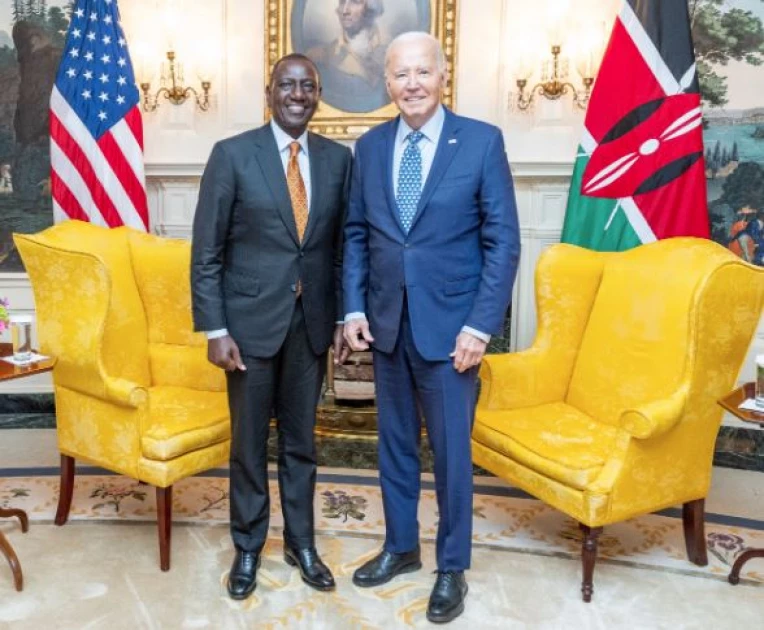
President William Ruto and US President Joe Biden after having a roundtable meeting at the White House, United States on May 22, 2024. PHOTO: @WilliamsRuto/X

Audio By Vocalize
A major non-NATO ally (MNNA) refers to a country that is not part of the North Atlantic Treaty Organization (NATO), yet has deep strategic and security partnerships with the United States.
President Ruto returned to Kenya after what many perceived as a successful international rendezvous. Aside from the fun fare and pageantry of the state dinner at the White House, or his meeting with Shaquille O’Neil in Atlanta, the precepts of hard power foreign policy were present and clear for all to see in President Biden declaring Kenya a non-NATO ally.
The Ruto administration was clearly realigning Kenya firmly into the American orbit on foreign policy matters. However, while this realignment comes with significant rewards from Washington, it also bears with significant risks.
For starters, there is no free lunch in the self-help international system. More often than not, nations interact with each other based on hard power politics.
The centrality of national interest in the economic, security, environmental, political and diplomatic realms. Uncle Sam’s interaction with Kenya is no different.
In exchange for becoming a non-NATO ally of the United States, Washington will expect Kenya to be an active member of the Ukraine Defence Contact Group while supporting American diplomatic, economic, political and security initiatives around the world.
The Ukraine Defence Contact Group is an association of 50 states that are NATO and non-NATO allies, keen on finding every way to support Ukraine in its war with Russia. What will the costs of Kenya’s non-NATO status be on its relationship with Russia?
In terms of Sino-Kenyan relations, the non-NATO status for Kenya also significantly changes the dynamics between Beijing and Nairobi.
China is concerned that the US is constantly undermining its rise around the world through containment, encirclement, entanglement, balancing and wedging strategies.
Containment and encirclement in terms of America surrounding China with countries united in checking Chinese expansion.
Entanglement and balancing in terms of the US keeping China preoccupied in areas of the world where it might not want to be such as in constant feuds and war games with Taiwan, Philippines, Republic of Korea and Japan.
Balancing in regards to the US propping regional rivals like India to limit the influence of Beijing in the South Asian subcontinent.
In this regard, Kenya’s move to come closer into the US orbit signals to China a realignment of Kenya’s position to balance, contain and encircle China’s influence in the East and Central African sub-region as a core ally of the United States.
A clear example of this is Kenya allowing the US to expand the military base in Manda Bay, Lamu to secure global maritime chokepoints and supply chains along Kenya’s Indian Ocean coast, the Red Sea and upstream to the Suez Canal.
China has not been granted such facilities in Kenya. In fact, the US continues to expand its global military base portfolio having over 750 military bases in 80 countries compared to China which has only one base in Djibouti.
Lastly, in terms of the African Agenda 2063, Kenya’s non-NATO ally status is an implicit endorsement of American unilateralism in Africa and around the world.
American unilateralism on the continent creates and/or exacerbates wars in contravention of Agenda 2063’s vision of “Silencing the Guns” and improving continental security.
For instance, US unilateralism resulted in regime change in Libya and state collapse after that. US unilateralism confronting rebel leader Farrah Aideed, led to the collapse of the UN Mission in Somalia in the 1990’s and the eventual collapse of the central government in Mogadishu once the Americans departed.
While Kenya might not explicitly endorse US interventionism, actions speak louder than words. Being on the US team of allies (NATO and non-NATO) clearly sets Kenya apart from the rest of Sub-Saharan Africa, and America’s rivals and adversaries.
It also raises questions over Kenya’s declared status as a member of the Non-Aligned Movement (NAM), when it is clearly no longer non-aligned but aligned to Washington and NATO.
In addition to this, non-NATO status for Kenya has the capacity to divide African countries between those in the American orbit, and those outside it. Not good for African Unity or the vision of the African Agenda 2063.
So as much as the Ruto administration relishes the grandeur of the US state visit, Uncle Sam is a ruthless suitor who will make hefty demands for the bountiful boon of goodies he provides.
Professor Monda teaches political science, international relations and foreign policy at the City University of New York. @dmonda1, davidmonda.com
Leave a Comment