

Don't tell women what to wear, UN says after France bans hijab at Olympics
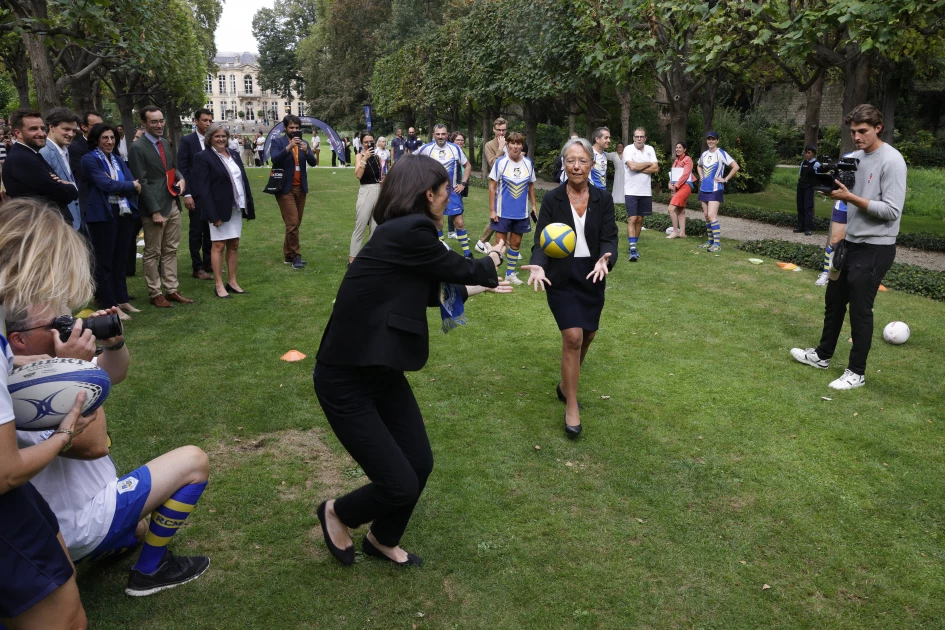
French Sports Minister Amelie Oudea-Castera (L) passes a rugby ball to French Prime Minister Elisabeth Borne (C) during the 40th European Heritage Days ("Journees du patrimoine") at the Hotel de Matignon in Paris, on September 16, 2023. (Photo by Geoffroy Van der Hasselt / AFP)

Audio By Vocalize
The UN
stressed on Tuesday it was opposed to most dress codes for women, after France
barred its Olympic athletes from wearing the Muslim hijab during the 2024 Paris
Games.
"No-one
should impose on a woman what she needs to wear or not wear," United
Nations rights office spokeswoman Marta Hurtado told reporters in Geneva.
Hurtado's
comment came after the French sports minister said the country's athletes would
be barred from wearing headscarves during the Games, in line with the country's
strict rules on secularism.
French Sports
Minister Amelie Oudea-Castera repeated on Sunday that the government was
opposed to any display of religious symbols during sporting events.
"What
does that mean? That means a ban on any type of proselytising. That means
absolute neutrality in public services," she told France 3 television.
"The France
team will not wear the headscarf."
Hurtado did
not address France's stance directly.
But she
stressed that the international Convention on the Elimination of All Forms of
Discrimination Against Women ruled out discriminatory practices.
"Any
state party to the convention -- in this case France -- has an obligation to
... modify social or cultural patterns which are based on the idea of the
inferiority or superiority of either sexes," Hurtado said.
"Discriminatory
practices against a group can have harmful consequences," she pointed out.
"That is
why ... restrictions on expressions of religions or beliefs, such as attire
choices, are only acceptable under really specific circumstances," she
explained.
That, she
said, meant circumstances "that address legitimate concerns of public
safety, public order, or public health or morals in a necessary and
proportionate fashion".
In France, the
issue of religious dress goes to the heart of the country's strict rules on
secularism.
These are
intended to keep the state neutral in religious matters, while guaranteeing
citizens the right to freely practice their religion.
France's laws
prohibit the wearing of "ostentatious" religious symbols in some
contexts, such as in state schools and by civil servants.
It outlawed
full-face coverings in 2010.
In June,
France's Council of State upheld a ban on women footballers wearing the hijab.
Leave a Comment