

WADA investigation finds British Cycling conducted private testing
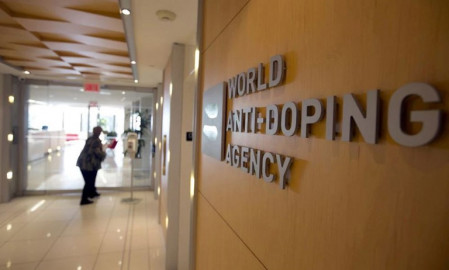
A woman walks into the head office of the World Anti-Doping Agency (WADA) in Montreal, Quebec, Canada November 9, 2015. REUTERS/Christinne Muschi/File Photo

Audio By Vocalize
The World Anti-Doping Agency (WADA) said on Tuesday
that British Cycling had collected samples from riders and screened them for
the banned anabolic steroid nandrolone at a private laboratory in 2011 in breach
of international rules.
However, the anti-doping body said that it would not
make corrective recommendations to UK Anti-Doping (UKAD) over the allegations
of wrongdoing by British Cycling.
WADA's independent Intelligence and Investigations
(I&I) unit launched 'Operation Echo' in March after media reports said UKAD
allowed British Cycling to analyse samples from athletes at a non-accredited
lab to check for prohibited substances.
It said the probe confirmed that in February 2011, as
part of a study into potential contamination of supplements, British Cycling
collected samples from riders and tested them for the banned anabolic steroid.
Samples were collected by British Cycling staff and
not doping control officers - contrary to the rules in the WADA code - and
provided by athletes on the basis that UKAD would not know the results, it
added.
The investigation found that at least one UKAD
employee was aware of the study but the organisation did not have any record of
ever receiving the analysis results and emails that would have shown their
"real-time knowledge" of key events.
WADA I&I Director Gunter Younger said the
investigation confirmed "potential wrongdoing" by individuals in both
British Cycling and UKAD at the time.
"'Operation Echo' makes no corrective
recommendations as those involved in the events of 2011 are no longer employed
by UKAD, and UKAD has already put safeguards in place to avoid a repeat
occurrence," Younger said in a statement.
"It's important to acknowledge that WADA I&I
received the full cooperation and transparency of British Cycling and UKAD
throughout our investigation."
UKAD said in a statement that it welcomed the findings
of the report and drew attention to a WADA audit this year in which UKAD was
commended as ‘extremely competent’, ‘well-managed’, ‘well-organised’ and
‘high-functioning’.
British Cycling said in a statement that WADA's
findings "attached no fault" to the organisation or the riders
involved and added it had only conducted the study "having sought and
received the express approval" of UKAD's director of legal.
The organisation highlighted recent changes that it
had made to its processes.
"These improvements mean the 2011 events
described in the WADA review could not be repeated at British Cycling today
and, while there can be no room for complacency, we are proud of the progress
we have made towards our ambition of becoming a world-leading governing
body," the organisation said.
WADA said their investigation also covered an
allegation that UKAD had released individual athletes' biological passport data
to British Cycling in 2016, but did not find any evidence.
It also did not find evidence to uphold allegations
that UKAD had allowed two athletes to test supplements privately and produce
analysis results at an anti-doping hearing as part of their defence following
adverse analytical findings.
Leave a Comment