

World Cup boom for maker of Arab cloak given to Messi
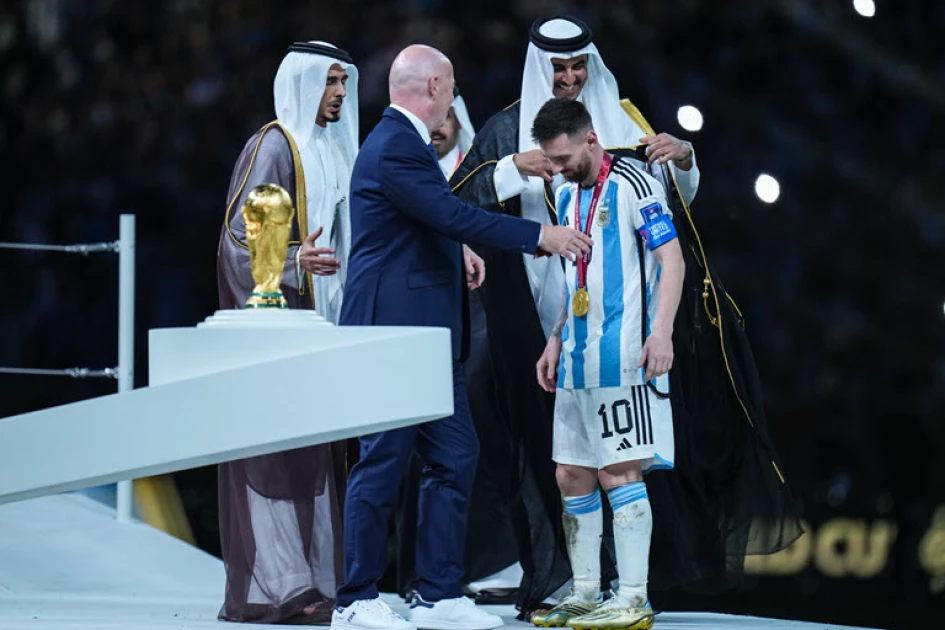
Sheikh Tamin bin Hamad Al Thani, Amir of Qatar give (10) Lionel Messi of team Argentina a Bisht - traditional Arab robed and FIFA President Gianni Infantino watching after defeat France with penalty at the final at the FIFA World Cup Qatar 2022 Final match between Argentina and France at Lusail Stadium on December 18, 2022 in Lusail City, Qatar. (Photo by Ayman Aref/NurPhoto)

Audio By Vocalize
Watching Sunday's World Cup final, Ahmed al-Salem was more
emotional than most football fans when Qatar's emir placed a black and gold
cloak over the shoulders of Argentina's victorious captain Lionel Messi.
The garment Messi wore as he lifted the football trophy was
a $2,200 'bisht', a traditional gown worn by men for weddings, graduations and
official events - and it was made by Salem's family company.
The gesture has sparked international debate on social media
over whether it was appropriate.
Salem watched Argentina beat France in a cafe near the
family's store in Doha's Souq Waqif market, having earlier handed two of the
delicate handmade cloaks to World Cup officials -- one in Messi's diminutive
size and one to fit the taller French captain Hugo Lloris.
"We did not know who they were for and I was
stunned," he told AFP of the moment when the emir, Sheikh Tamim bin Hamad
Al-Thani, dressed Messi in the cloak.
Salem recognised his company tag and is now celebrating his
own World Cup victory.
The Al-Salem store, a longstanding bisht supplier to Qatari
royalty, normally sells eight to 10 garments a day.
On Monday, the day after the final, sales shot up to 150,
including three copies of the top-of-the-range bisht made famous by Messi, said
Salem.
"At one stage there were dozens waiting outside the
store", he said.
"They were nearly all Argentinians," he added as
he watched eight supporters of the new world champions sing their
"Muchachos" (mates) anthem and take pictures of themselves while
wearing a fragile bisht and carrying a copy of the World Cup trophy.
A stream of fans came into the shop as Salem spoke to AFP,
and all of them applauded the emir's gesture.
"We were all happy when we saw that, it was a gift from
one king to another king," said Mauricio Garcia as he tried on the cloak,
but decided the price tag was too high to buy.
Some commentators, predominantly European, criticised
Messi's shirt being covered for the trophy presentation.
Salem and other Arab commentators explained the intention
was to "honour" Messi and that the gesture had been misunderstood.
"When a sheikh dresses a person in a bisht, this means
honouring and appreciating this person," Salem said.
It was a "very important moment" for Qatar as it
seeks a World Cup publicity boost, said Carole Gomez, a professor of sports
sociology at the University of Lausanne, in Switzerland.
"These pictures are widely spread about, conserved and
reissued," she said.
Salem said when World Cup officials went to his store
"they wanted the lightest and most transparent fabric".
"I was surprised because we are in winter, so it seems
that the goal was to show the Argentine uniform and not cover it," he
said.
While the bisht is worn in many Gulf countries, Al-Salem is
the biggest of about five Qatari producers, employing about 60 tailors.
Each bisht takes a week to make and goes through a seven
stage completion, with different workers adding different lines of gold braid
to the front and arms.
For Messi's bisht, the gold thread came from Germany and the
Najafi cotton fabric was imported from Japan.
Leave a Comment