
Astronomers spot galaxy shaped like the Milky Way but is far more massive
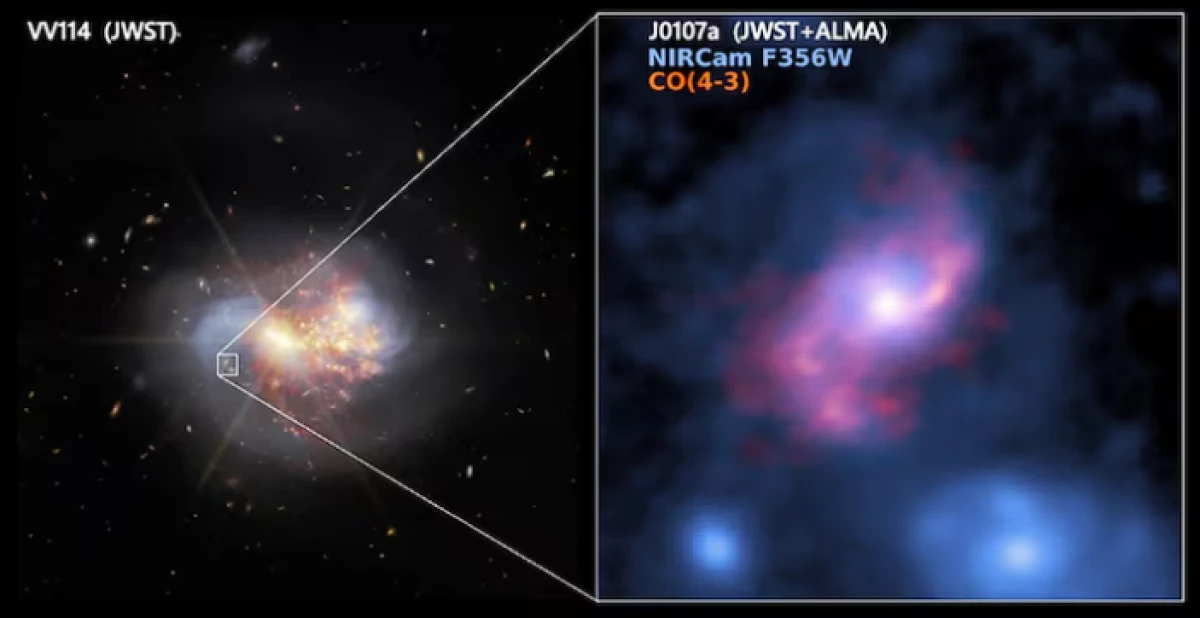
A near-infrared image shows the nearby galaxy VV114 captured by NASA's James Webb Space Telescope, with the monster barred spiral galaxy J0107a in the background, captured by the Atacama Large Millimeter/submillimeter Array and NASA's James Webb Space Telescope, in this undated image. Stellar and molecular gas distribution of J0107a is shown on the right. NASA, ALMA (ESO/NAOJ/NRAO), Huang et al/Handout via REUTERS/File Photo

Audio By Vocalize
Astronomers have observed a galaxy dating to an earlier
epoch in the universe's history that, surprisingly, is shaped much like our Milky
Way - a spiral structure with a straight bar of stars and gas running
through its centre - but far more massive, offering new insight into galactic
formation.
The distant galaxy, called J0107a, was observed as it
appeared 11.1 billion years ago, when the universe was about a fifth of its
current age. The researchers used data from the Chile-based Atacama Large
Millimetre/submillimeter Array (ALMA) and NASA's James Webb Space
Telescope to study the galaxy.
They determined that the galaxy's mass, including its stars
and gas, was more than 10 times greater than that of the Milky Way, and it was
forming stars at an annual rate approximately 300 times greater. J0107a was
more compact than the Milky Way, however.
"The galaxy is a monster galaxy with a high star
formation rate and plenty of gas, much more than present-day galaxies,"
said astronomer Shuo Huang of the National Astronomical Observatory of Japan,
lead author of the study published this week in the journal Nature.
"This discovery," said study co-author Toshiki
Saito, an astronomer at Shizuoka University in Japan, "raises the
important question: How did such a massive galaxy form in such an early
universe?"
While a few galaxies that are undergoing star formation at a
similar rate to J0107a exist in today's universe, almost all of them are ones
that are in the process of a galactic merger or collision. There was
no sign of such circumstances involving this galaxy.
"They are similarly huge and possess a similar barred
structure. However, the Milky Way had plenty of time to form its huge
structures, while J0107a didn't," Saito said.
In the first few billion years after the Big Bang event 13.8
billion years ago that initiated the universe, galaxies were turbulent entities
and were much richer in gas than those existing currently - factors that
fostered extreme bursts of star formation. While galaxies with highly organized
structures like the barred spiral shape of the Milky Way are common now, that
was not the case 11.1 billion years ago.
"Compared to other monster galaxies in the distant
universe (dating to an earlier cosmic epoch) whose shapes are usually disturbed
or irregular, it is unexpected that J0107a looks very similar to present-day
spiral galaxies," Huang said.
"Theories about the formation of present-day galactic
structures may need to be revised," Huang added.
The Webb telescope, as it peers across vast distances back
to the early universe, has found that galaxies with a spiral shape
appeared much earlier than previously known. J0107a is now one of the
earliest-known examples of a barred spiral galaxy.
About two thirds of spiral galaxies observed in the universe
today possess a bar structure. The bar is thought to serve as a form of stellar
nursery, bringing gas inward from the galaxy's spiral arms. Some of the gas
forms what are called molecular clouds. Gravity causes the contraction of these
clouds, with small centers taking shape that heat up and become new stars.
The bar that is part of J0107a measures about 50,000 light
years in length, Huang said. A light-year is the distance light travels in a
year, 5.9 trillion miles (9.5 trillion km).
The Webb telescope "has been studying the morphology of early massive galaxies intensely recently. However, their dynamics are still poorly understood," Saito said.
Leave a Comment