

Senate Bill seeks establishment of AI Commissioner office with Ksh.5M fine for offenders
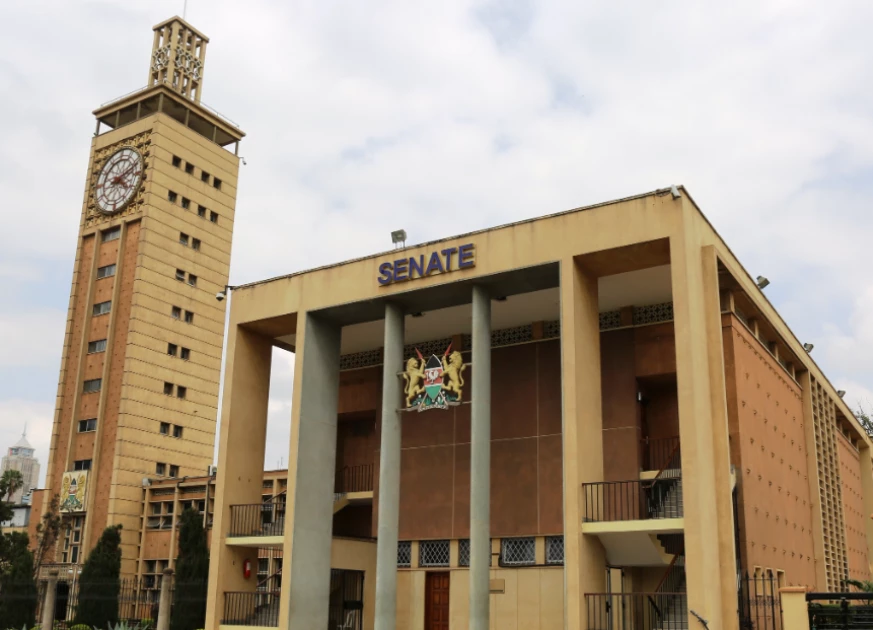
File image of the Senate of Kenya.

Audio By Vocalize
Kenya will soon have an office of the Artificial Intelligence Commissioner if a bill at the Senate is adopted.
The Artificial Intelligence Bill, 2026, tabled by nominated Senator Karen Nyamu, wants the state to establish the AI commissioner’s office for oversight and regulation of the emerging technology.
AI adoption in Kenya has recently been on an upward trajectory, as a January 2026 report by Microsoft’s AI Economy Institute ranked Kenya’s usage of AI at 8.1 per cent. The country recorded a higher AI diffusion rate than its East African neighbours.
As such, the legislator proposes the formation of the AI commissioner's office and an Advisory Committee on AI.
The Bill proposes the formation of an independent office, to which the President of Kenya shall appoint the commissioner. This is after the recruitment process is conducted by the Public Service Commission (PSC), which will consider qualified professionals.
If the commissioner is found to have violated statutory laws or to be incapacitated, the Head of State or the Cabinet Secretary in charge of ICT may remove them from office. If a Kenyan citizen seeks their removal from office, Nyamu proposes that they should present a complaint to the PSC, after which investigations shall be conducted and recommendations made to the CS.
This office shall be funded by taxpayers, with a budget allocation made by the National Assembly.
What will the AI commissioner do?
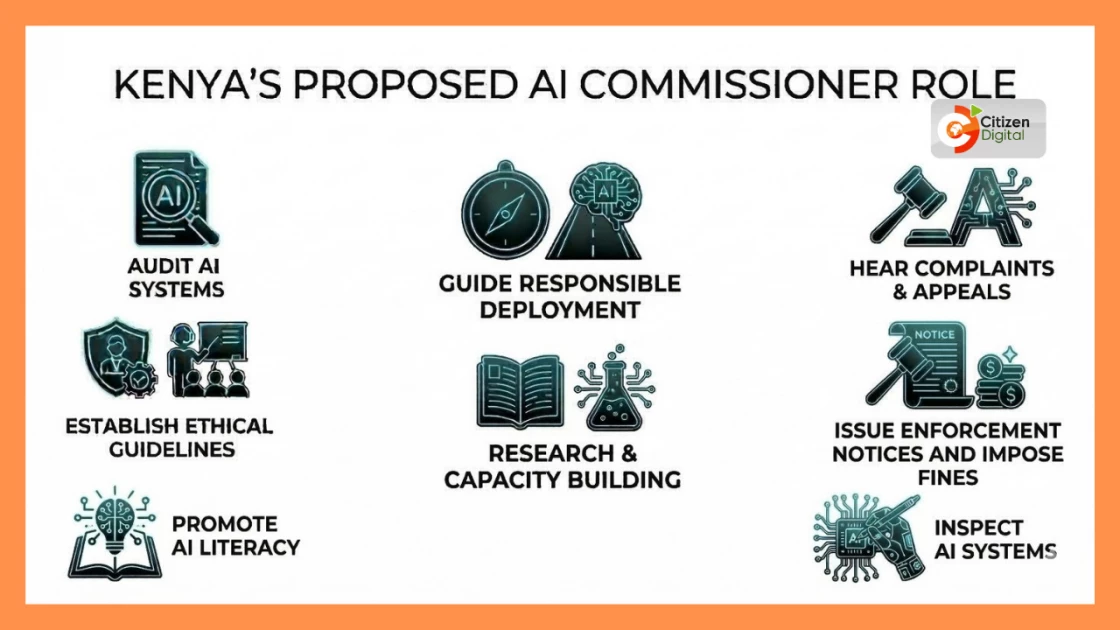
If the AI Bill is passed by the Senate, the AI commissioner shall be tasked with performing audits and risk assessments for AI systems, ensuring compliance with ethical standards, developing policies, guidelines, codes of practice and standards on AI governance, and promoting responsible use and deployment of AI systems.
This commissioner is also tasked with managing a controlled environment for AI testing (regulatory sandboxes), receiving and investigating complaints regarding AI systems, advising national and county governments on policy integration and promoting AI literacy.
The AI commissioner’s office will also be tasked with research and capacity building, maintaining a public register for high-risk AI systems and promoting equitable access to AI systems.
Senator Nyamu also wants the AI commissioner to be conferred powers to inspect AI systems, require records for these systems, issue enforcement notices, and impose fines for non-compliance.
The commissioner shall also have the power to summon persons for the provision of evidence or documentation.
The office of the AI commissioner shall also be mandated to appoint deputy commissioners, assistant commissioners and other staff. All these parties shall be remunerated according to rates set up by the Salaries and Remuneration Commission (SRC).
An Advisory Committee on AI
Additionally, the Bill proposes the formation of an Advisory Committee on AI, which shall include the AI commissioner, the ICT CS, and a representative of the Office of the Data Protection Commissioner (ODPC) and another from the National Commission for Science, Technology and Innovation.
The committee will also have representatives from the right bodies, the private sector and the Council of Governors.
Appointed for a three-year term, the committee's functions shall include advising the AI commissioner, facilitating stakeholder engagements, and promoting research and collaboration on AI governance.
Under the Bill, the IT Cabinet Secretary shall, on advice of the AI commissioner, be required to classify risks in critical sectors including healthcare, education, agriculture, finance, security, employment or public administration.
Providers of high-risk AI systems would also be required to conduct risk and impact assessments, maintain data inputs and outputs for five years, comply with the Data Protection Act (2019), and label any AI-generated media output.
Penalties for non-compliance
If the Senate passes the Artificial Intelligence Bill, 2026, and it is assented to by President William Ruto, persons found in contravention of the law shall be fined or face imprisonment. This includes those found to have deployed or operationalised high-risk AI systems, failed to comply with disclosure obligations or those who will not conduct a risk and impact assessment
Additionally, those who contravene ethical guidelines, enable unlawful generation and distribution of deepfakes, or obstruct functions of the AI commissioner shall be liable to conviction.
Non-compliance, obstruction of the AI commissioner and ethical guidelines would earn one a fine not exceeding Ksh.1 million, imprisonment not exceeding six months or both.
Kenyans who do not abide by the other legal and regulatory provisions shall be imprisoned for two years, pay a fine not exceeding Ksh. 5 million or both.
Kenya’s AI policy and strategy
This Bill comes at a time when Kenya is developing a national policy on AI and emerging technologies.
In November 2025, the Ministry of ICT brought together experts from government, academia, civil society, and startups to draw up a policy to provide a framework for the adoption of emerging technologies.
The ICT ministry has since invited members of the public to present their submissions on the policy framework.
Earlier in March 2025, Kenya launched a national Artificial Intelligence strategy, described as a five-year plan set to position the country as Africa's leader in AI innovation.
According to the 5-year plan, the government would require at least Ksh. 152 billion to implement the AI strategy report by 2030. AI digital infrastructure would take up 50 per cent of the budget.
Then, ICT CS William Kabogo promised to forward an AI Bill to Parliament within four months to regulate the sector.
The CS noted that if approved, the Bill would provide a framework for funding and regulation.
Leave a Comment