
Abshir Abdi appears in court as family opposes termination of case
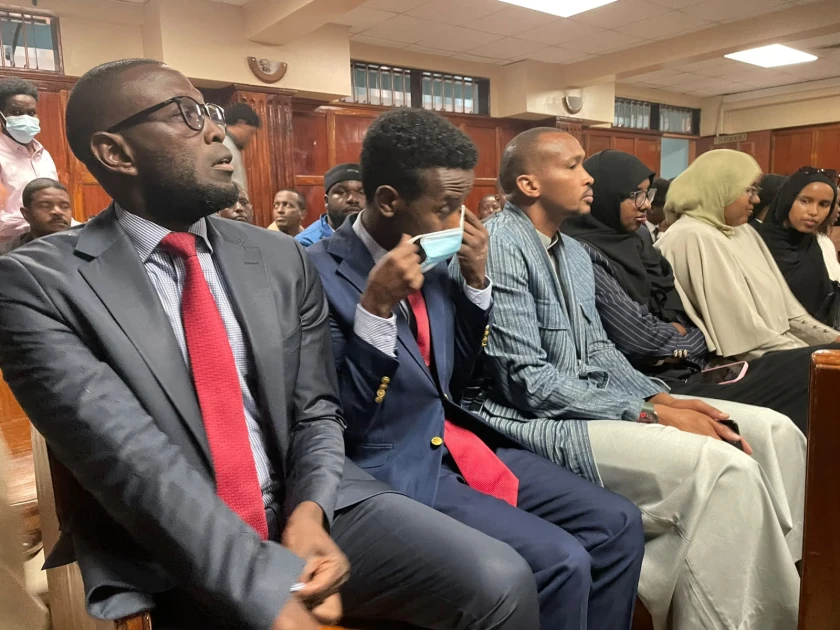
Abdi Abshir (wearing mask) at the Milimani courts on Friday, November 13, 2026. /GATETE NJOROGE

Audio By Vocalize
Advocate Abshir appeared before the Milimani High Court on Friday, nearly two weeks after he was allegedly abducted in Nairobi and later found in Marsabit County.
Abdi arrived at the court alongside his colleague Ayub Mohamud Maalim, who was also reported missing following the November 1 incident.
The two men were reportedly released by their abductors between 5am and 6am on Thursday and travelled to Nairobi, arriving at approximately 6am after a seven-to-eight-hour journey.
Abdi had earlier sought medical attention for minor injuries sustained during the alleged abduction, with his lead family lawyer, Senior Counsel Eric Theuri informing the court that he was experiencing some pain following the ordeal and the long journey.
Theuri told the court that the two men had been taken to Sololo Police Station after their release, where police recorded their statements.
With Abdi and Maalim now before the court, the family wants the habeas corpus proceedings to continue, arguing that their release should not bring the matter to an end without accountability for their disappearance.
Theuri argued that although the release of the two men could technically terminate the habeas corpus proceedings, closing the matter at this stage would risk emboldening those involved in abductions.
"What I anticipate is that the proceedings before you, with the subject having been released, are technically terminated. And so what we would then be having is a situation where once someone is abducted, he is released because that will terminate the proceedings," Theuri submitted.
He warned that such an outcome would allow individuals involved in unlawful abductions to evade accountability by releasing their victims once court proceedings are initiated.
"The position we find ourselves in is that there are actors who are operating extra-constitutionally. To close these proceedings at this stage would be to embolden those engaged in these activities," he said.
The lawyer urged the court to allow Abdi and Maalim to testify on their experiences, arguing that their evidence would be important in establishing what happened and holding the relevant duty bearers accountable.
He further asked the court to consider ordering expedited investigations and requiring constitutional agencies responsible for public safety to provide a comprehensive account of the steps being taken to prevent further abductions.
Theuri argued that the court could issue such directions without undermining the independence of security agencies, noting that the institutions themselves are subject to the Constitution.
"The question of independence and whether those organs can be directed is a question that cannot arise in these proceedings because they are not directing them to act in a particular way in a manner that undermines their constitutional authority," he submitted.
He maintained that the Constitution places obligations on security agencies to protect citizens and that the court should establish whether those responsibilities were discharged.
The lawyer also questioned the circumstances surrounding the men's release, suggesting that their abductors may have taken them to an area experiencing ethnic tensions because they anticipated that any harm suffered by the two men there could be explained away as casualties arising from the conflict. The claim was presented as the family's position and had not been independently established.
Theuri further referred to an earlier appearance by Anti-Terrorism Police Unit (ATPU) officers before the court, saying they had indicated that Abdi was under investigation over several serious criminal allegations.
He argued that the court should establish the basis of those investigations and examine the circumstances surrounding Abdi's disappearance.
"If we terminate at this stage without taking this evidence, where then do we call for accountability from the duty bearers upon whom the Constitution has granted power and resources to keep the Kenyan citizen safe?" he posed.
The lawyer said a determination by the court would be important in reaffirming the responsibilities of institutions mandated to protect citizens and uphold the Constitution.
Join the Discussion
Share your perspective with the Citizen Digital community.
No comments yet
This discussion is waiting for your voice. Be the first to share your thoughts!