

Disney's new Israeli superhero film hits a raw nerve with Arabs

Audio By Vocalize
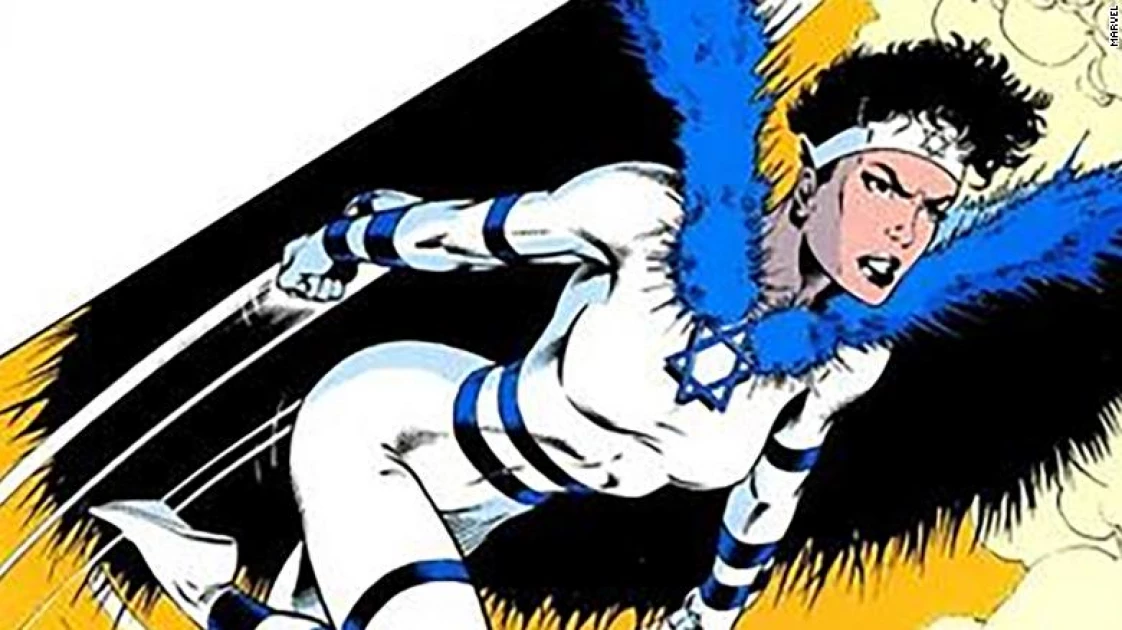
The classic 1981 Marvel comic page shows
the giant green Hulk, tears streaming down his face as he yells at Sabra, an
Israeli superhero and agent of the country's Mossad spy agency. The corpse
of a young Palestinian boy, killed in an explosion by apparently Arab
"terrorists" at his feet.
"Boy died because boy's people and yours both want to own land! Boy
died because you wouldn't share!" the Hulk says.
A few panels later, the woman in the white and blue costume with a Star
of David on her chest kneels next to the boy.
"It has taken the Hulk to make her see this dead Arab boy as a human
being," the comic says. "It has taken a monster to awaken her own
sense of humanity."
Sabra, the Israeli superhero, made numerous appearances in Marvel's
comics over the years, starring alongside top icons such as the Incredible
Hulk, Iron Man and the X-Men.
More than forty years after Sabra was introduced, Disney's Marvel plans
to bring her to film in "Captain America: New World Order," set to be
released in 2024. That has created an uproar among those who fear that reviving
Sabra's character would spread offensive stereotypes about Arabs and the
dehumanization of Palestinians in cinema.
Critics say many of the Arab characters she interacted with in the comics
are shown as misogynistic, antisemitic and violent, and are questioning whether
the troubling portrayals of Arabs will play out differently in the
film.
"That comic doesn't suggest anything positive about how this film
will play out," said Yousef Munayyer, a Palestinian-American writer and
analyst based in Washington, D.C. "The whole concept" of turning
Israeli spies into heroes "is insensitive and disgraceful."
"The glorification of violence against Palestinians specifically and
Arabs and Muslims more broadly in mass media has a long and ugly history in the
West and it has remarkable staying power," he added.
Waleed F. Mahdi, author of "Arab Americans in Film: From Hollywood
and Egyptian Stereotypes to Self-Representation," said the
"US-Israeli alliance" in the cinematic narrative since the 1960s has
celebrated American and Israeli law enforcement and intelligence agencies as
good forces "committed to deterring violence that has been chiefly linked
to Arabs and Muslims."
"Marvel's announcement of adapting the comic character of Sabra is a
reflection of this legacy," he told CNN.
A Marvel Studios spokesperson told CNN that "filmmakers are taking a
new approach with the character Sabra who was first introduced in the comics
over 40 years ago," adding that characters in Marvel Cinematic Universe
"are always freshly imagined for the screen and today's audience."
Even some Israelis say Sabra may not be a superhero for our times. Etgar
Keret, an Israeli author, scriptwriter and graphic novelist, told CNN that the
original Sabra character was created in a different era with a "simple and
clear story".
"This Sabra was created before two [Palestinian] Intifadas
[uprisings], it was created before the failing of the Oslo Accords -- it was
created in a totally different reality and state of mind," he said.
"And now... it's tough to keep this kind of icon of simplicity."
The superhero's name is a nickname for a Jewish person born in Israel or
the occupied territories and stems from the Hebrew term for the fruit of a
prickly pear. It has been in widespread use since the 1930s before Israel was
established.
But the word is spelt the same way in English as one of two Palestinian
communities in Lebanon where a massacre of more than 1,000 Palestinian and
Lebanese Shiite civilians was carried out by Lebanese Christian militiamen
allied to Israel during the 1982 Lebanon-Israel war -- known as the Sabra and
Shatila Massacre, named after the places in which it occurred.
In 1983 the Israeli government released The Kahan Commission of Inquiry
into the events that occurred at the refugee camps and found the Israeli army
indirectly responsible. It concluded that the army approved the militiamen's
entry into the area and didn't take appropriate measures to prevent the
killings. Ariel Sharon, then defence minister, was forced to resign as a result
of the inquiry's findings.
Marvel's Sabra character was created before the Sabra and Shatila
massacre and has no relation to it, but the announcement to bring her to
cinemas just a week before the massacre's 40th anniversary has touched a raw
nerve with Arabs, who accuse the film studio of being insensitive to one of the
most tragic events in the history of the Palestinian people.
"It's not just in the timing or the name but also in the fact that
the massacre itself was led by a Mossad-linked [militia] in territory under
Israeli military control," said Munayyer. "Given all of this, it is
hard not to conclude that the people at Marvel are either abjectly ignorant
about the region, its history and the Palestinian experience, or that they
deliberately aimed to kick a people living under apartheid while they were
down."
Although Sabra would not be the first time Israel's intelligence agency
has been given the Hollywood treatment, it is the first time Mossad has been given a supernatural status to the level of a mega, blockbuster
superhero. Experts say that's a public relations win for the agency.
Avner Avraham, a former Mossad officer and founder of the Spy Legends
Agency which consults for film and TV shows portraying Israeli spies, said the
new portrayal will help a younger generation learn about the Mossad.
"This is the 'TikTok' way, the cartoon way to talk to the new
generation, and they will learn about the word Mossad," Avraham said.
"It helps the branding. It will add a different audience."
Such exposure can even help Mossad recruit sources and assistance in
other countries, he added.
"The fact that they decided to take a Mossad agent, a Sabra, and
they didn't take an Egyptian agent or Italian agent, it shows Mossad is a big
name," Avraham said.
Uri Fink, an Israeli cartoonist who says he came up with a similar
Israeli superhero character first in 1978, fears however that the
"progressives" working at Marvel may turn the Israeli agent into a
negative character. "They are not well updated, they don't have an exact
description of the Israeli-Palestinian conflict," he told CNN.
Avraham echoed that concern, speculating that she may be portrayed as a
character that does good for Israel but "bad things to other people."
Leave a Comment