

Global demand for shea butter is growing: but it’s not all good news for women who collect the nuts
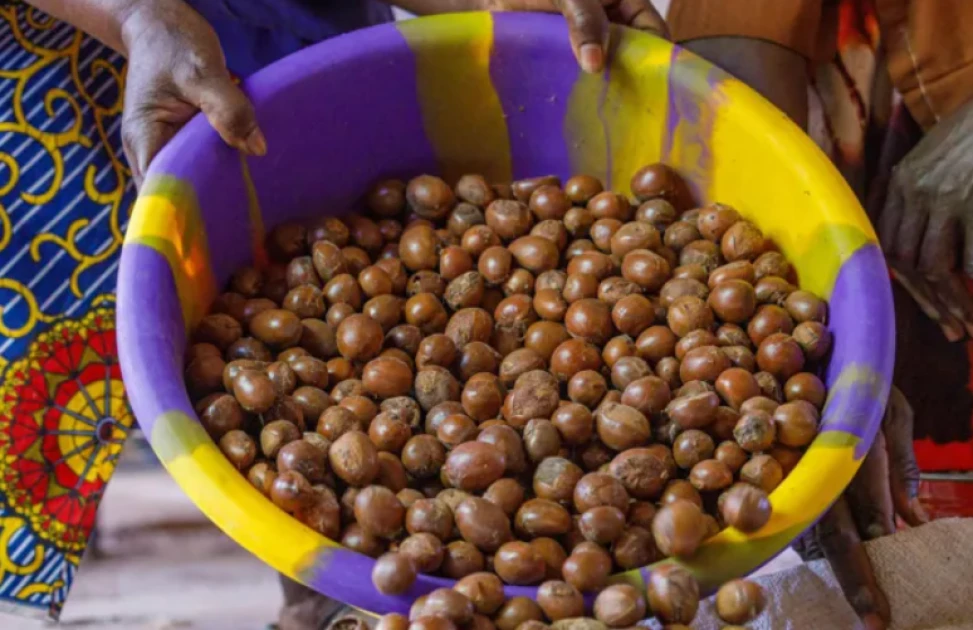
A picture of raw shea nuts. Photo: AFP

Audio By Vocalize
Since the early 2000s its use as a substitute for cocoa butter has driven a dramatic rise in international demand.
The shea butter industry has grown by more than 600% over the last 20 years.
The shea tree is semi-domesticated across the dry savannah region in a “shea belt” west to east from Senegal to South Sudan, and about 500km north to south. It is not planted but protected within farmland and also found in communal bushland.
An estimated 16 million women collect and process shea fruits in rural West Africa, turning them into dry kernels for sale or processing the kernels into shea butter.
Global companies, development agencies and NGOs frequently present the shea industry as a pathway to women’s economic empowerment in the region.
To explore this idea, we conducted research into how the rise in demand for shea butter has affected women collectors in Burkina Faso and Ghana. These two countries are among the lead exporters of dry shea kernels.
The study formed part of our work on agrarian change, political ecology and livelihoods. We study relationships between producers and other actors of global value chains, as well as the impacts of externally induced changes on smallholders.
We combined data from a survey of 1,046 collectors in 24 communities with data from interviews with 18 collectors.
Our results show that the shea boom has intensified competition for access to trees. Over 85% of collectors surveyed reported an increase in the number of shea nut collectors in their community over the past 10 years. We also documented how access to shea trees was becoming more restricted, especially for women who rely most heavily on shea for their livelihoods.
Our results point to widening inequality within the collector population, even as the overall value of the shea sector grows.
Global demand meets local tenure systems
Historically, access to nuts was governed by a combination of customary rules and social norms. Women could usually collect freely on communal land, and also on farmland belonging to their households or relatives. Shea was often treated as a semi–open-access resource, available to women of the community according to need.
This system has come under pressure.
Firstly, as prices have increased over the last three decades, so have the number of people collecting.
Secondly, the common land is shrinking. Expansion and mechanisation of agriculture, population growth and peri-urban development have reduced the areas that once served as shared collection spaces.
Several collectors we interviewed noted that land previously considered “bush” had been converted into fields, removing an important safety net for those without farmland.
As a result, access to shea trees is increasingly tied to access to private land. Over 55% of our survey respondents reported that collection on private fields had become more restricted, with landowners enforcing boundaries more tightly. This shift reflects a broader tendency in both countries for land rights to become more individualised as resources acquire market value.
Third, resource pressure has introduced new forms of conflict, like trespassing on land. Conflicts reinforce exclusion, as landowners become more reluctant to allow non-family members onto their fields.
Unequal effects across collector groups
Our research distinguishes three types of collectors: dedicated collectors, who derive all of their annual income from collecting and selling shea nuts diversified collectors, who combine shea collection with farming or other activities collector–traders, who not only collect nuts but also purchase them from others to sell at higher prices later in the year.
These groups experience the shea boom in different ways.
Dedicated collectors have the most limited access to private land. Only 16% of them collect from their own fields, compared to 38%-43% among the other groups. They depend on the communal bush.
Diversified collectors have better access to private fields than dedicated collectors, but still face similar challenges as bush areas shrink. And they have less time to spend collecting, limiting their ability to compensate for increasing competition.
Collector-traders maintain more secure access to private fields and receive more assistance from household members. Over half report receiving help from men, such as transporting nuts or protecting fields from trespassers. This is significantly more than dedicated or diversified collectors. The additional labour gives them a strategic advantage.
More work, but not more income
Rising prices might suggest that women would earn more from shea today than a decade ago. Yet this is not what most collectors experience. Only 48.7% reported an increase in shea income over the past 10 years, despite the international boom.
Total annual income from shea remains very low – on average only US$174 (purchasing power parity) per year, with differences between collectors.
For poorer collectors, several factors suppress income gains: limited access to shea trees constrains the volume of nuts they can gather many have to sell nuts early in the season, often at low prices, to meet immediate cash needs. Better-off collector-traders can purchase nuts cheaply, store them, and profit from higher prices later in the year.
Rethinking the ‘win-win’ narrative
The findings challenge the claim that integrating women into the global shea value chain will empower them and reduce poverty. The boom has indeed created new economic opportunities, but these are unevenly distributed. Market expansion has strengthened the position of those with greater land access and financial capital. At the same time it’s undermined the livelihoods of those who rely exclusively on the resource.
Our study does not prescribe specific policy measures, but its findings point to several possible avenues for intervention.
First, measures that strengthen women’s land and tree rights are likely to be critical. Recent work on peri-urban Ghana, for example, calls for wider rights to land and shea trees for women in policy and tenure reforms.
Second, empirical studies of female shea actors in Ghana suggest that collective organisation, better access to finance and improved infrastructure (notably storage facilities) can enhance women’s position.
Finally, evidence from northern Ghana indicates that women themselves recommend changes in farming practices to sustain the resource base.
Leave a Comment