
Kenya–US Health Agreement raises concern over NGO exclusion
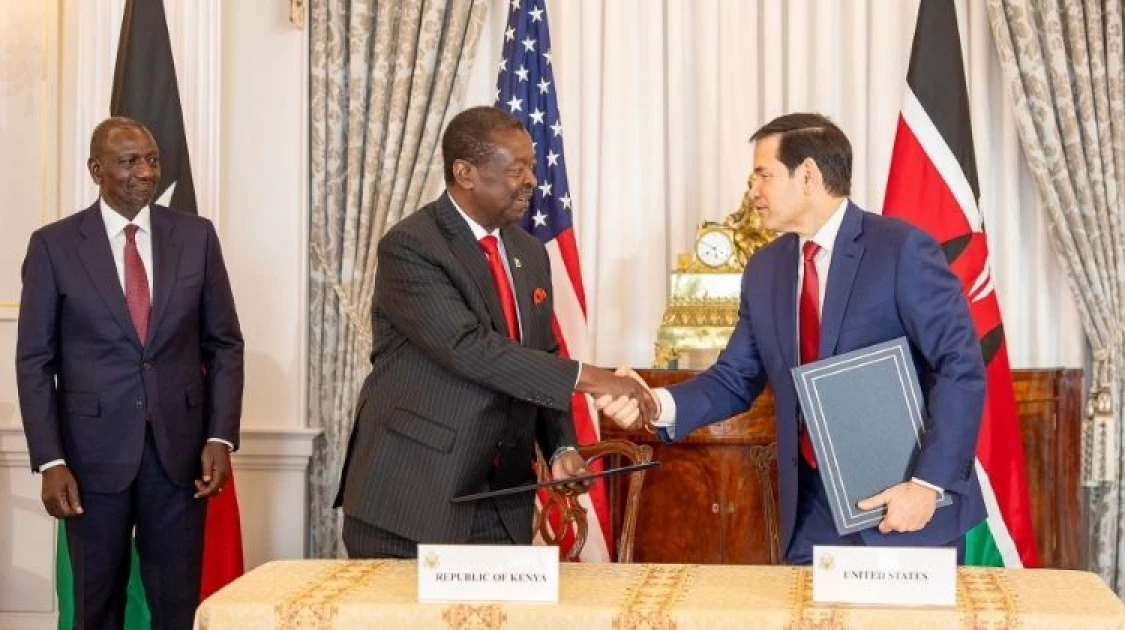
President William Ruto (left) witnesses the signing of Kenya-USA health deal signed by Prime CS Musalia Mudavadi and US Secretary of State Marco Rubio on December 4, 2025. Photo/PCS

Audio By Vocalize
The Kenya–United States Health Cooperation Framework signed
in Washington last week continues to draw mixed reactions across the country.
At the centre of the debate is a major shift by the US
government to channel more than Ksh 200 billion in health funding directly
through Kenyan government systems. The new Government-to-Government (G2G) model
replaces the long-standing donor-driven structure that relied heavily on NGOs
and external implementing partners.
Speaking at the signing ceremony, US Secretary of State
Marco Rubio openly criticised what he termed the “NGO industrial complex” for
consuming large portions of aid in administrative overheads. He warned that the
US would no longer fund organisations that absorb a disproportionate amount of
resources while host governments have minimal influence over how the money is
used.
“We are not going to spend billions of dollars funding the
NGO industrial complex while close and important partners like Kenya have
little or no role in determining how healthcare money is spent,” Rubio said.
He added that Kenya was chosen as the first beneficiary
under the new model because of its close partnership with the US and its
“stable and strong” government and health-sector institutions. Over the next
five years, the US plans to invest USD 1.6 billion (approximately Ksh 200
billion) in Kenya’s health sector under the framework.
President William Ruto has welcomed the new arrangement,
saying it is anchored in law and aligned with Kenya’s national interests. He
accused some organisations of spreading deliberate misinformation to protect
their previous roles as intermediaries in US-funded programmes.
“It is the US Government that decided, for efficiency, that
these resources should go directly to the government. If NGOs have a problem
with the structure, they should raise it with the United States,” President
Ruto said.
Under the agreement, US contributions will depend on Kenya
increasing both national and county health budgets annually. Kenya is expected
to allocate Ksh 10 billion in FY 2026/27, Ksh 20 billion in 2027/28, Ksh 35
billion in 2028/29, and Ksh 50 billion in 2029/30. By 2031, the government will
also take over health commodities and human-resource costs currently funded by
the US, estimated at USD 141 million.
However, some experts argue that NGOs play an essential
oversight role and warn that removing them could weaken accountability. Busia
Senator Okiya Omtatah has already filed a court petition seeking to suspend and
halt implementation of the framework.
Omtatah argues that channelling funds directly through
government systems without third-party oversight exposes the resources to
potential mismanagement. He also warns that Kenya’s commitment to match US
funding—estimated at an additional USD 850 million in public spending—could
strain the national budget.
“This burdens the country without independent fiscal modelling and contravenes principles of sustainable public finance,” he says, adding that the funding obligations could exacerbate debt pressures and divert resources away from grassroots health needs.
Dr. Nelson Sechere, Executive Director of the Kenya Veterans
for Peace organisation, cautioned against sidelining NGOs entirely, noting
their historical efficiency and measurable performance standards.
“As provided for in the NGOs
Act, many non-governmental organisations deliver services with high efficiency
and clearly defined KPIs. For example, Catholic agencies in Kenya play a
critical role in complementing government efforts through well-established
structures. Shifting all resources solely into government systems may not
necessarily produce outcomes that are accurate or easily measurable,” noted Dr Sechere.
He underscores
that while the government remains the primary regulator and has an
obligation to ensure the health of its citizens, “NGOs should continue to operate
within a clear reporting framework.”
“The line between regulation and micromanaging NGOs is very thin. My view is that NGOs should continue to operate within a clear reporting framework, while the government focuses on strengthening the public health sector. Government delivers — but well-managed NGOs are often more efficient,” he stated.
Join the Discussion
Share your perspective with the Citizen Digital community.
No comments yet
This discussion is waiting for your voice. Be the first to share your thoughts!