
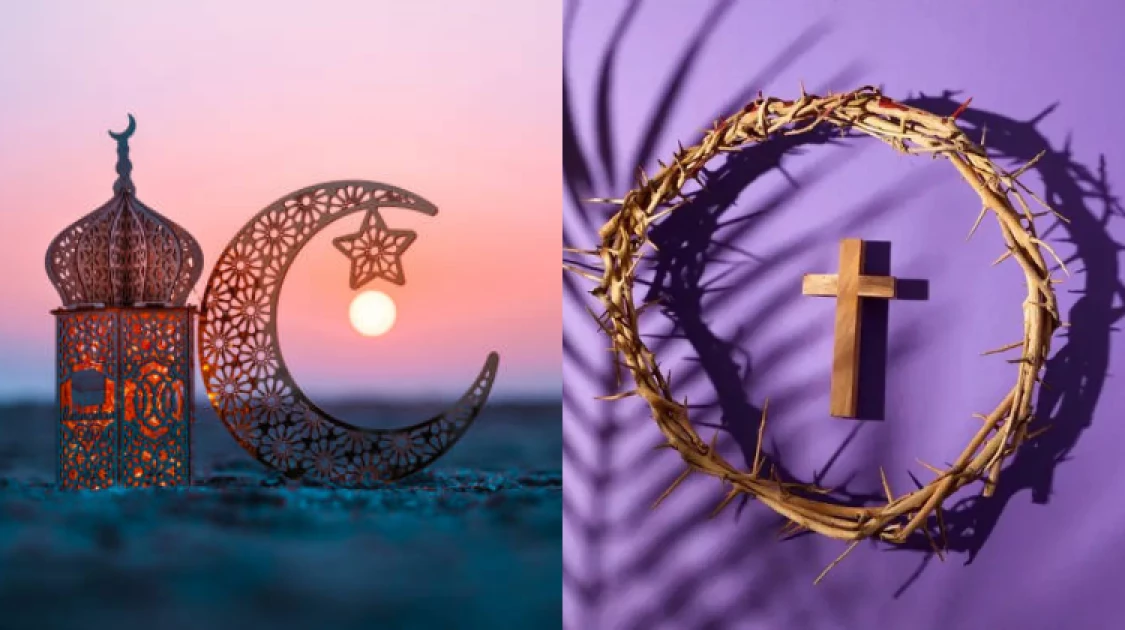
Lent and Ramadhan coincide in a rare occurrence of two faiths with similar practice

Audio By Vocalize
The start of the Lenten period (Ash Wednesday) coincides with the start of Ramadhan approximately every 33 years due to the cycle of the Islamic lunar calendar shifting through the Gregorian calendar.
This year, 2026, both Ash Wednesday (start of Lent) and the beginning of Ramadhan will occur on February 17, 2026. In the year 1992, Ramadan began on or around March 7, overlapping with the Lenten period.
In Lent, many Christians worldwide observe six weeks of fasting, abstinence and almsgiving before Easter. Although this observance is predominantly a Roman Catholic and Eastern Rite Orthodox practice, Christians of all denominations can and do observe Lent in an effort to prepare the soul, mind, and body for the celebration of Christ’s resurrection on Easter Sunday.
Dating back to at least the fourth century and known as ‘Tessarakosti’ in Greek and ‘Quadragesima’ in Latin, Lent is marked on the liturgical calendar beginning on Ash Wednesday and culminating in the Saturday before Easter. This equates to a total of forty days, not including Sundays therein.
In Lent, Christians imitate Jesus' 40-day fast in the desert, focusing on soul-searching or examination of conscience, repentance, self-discipline, and spiritual renewal.
On the other hand, within Islam, Ramadan is considered one of the holiest periods of the year for Muslims. In the month of Ramadhan, Muslims commemorate the revelation of the Qur’an, and fast from food and drink during the sunlit hours as a means of drawing closer to God and cultivating self-control, gratitude, and compassion for those less fortunate.
Ramadhan, therefore, is a month of intense spiritual rejuvenation and devotion, as Muslims spend extra time reading the Qur’an and performing special prayers. Those unable to fast, due to age or health matters, are exempt from fasting.
What Are the Key Days During Lent?
Ash Wednesday is the first day of Lent. Fasting on Ash Wednesday is a common practice among many Christians, especially Roman Catholics and the Christian Orthodox churches, as a way to begin the season of Lent with humility and repentance.
In Roman Catholic liturgy for Ash Wednesday, they use ashes made from the burned palm branches distributed on Palm Sunday of the previous year. The priest blesses the ashes and imposes them on the foreheads of the faithful, making the sign of the cross, saying, "Remember that you are dust, and to dust you shall return."
It’s a reminder of our need for God’s grace and the sacrifice of Jesus. The ashes symbolize grief for things done wrong and the resulting division of imperfect people from a perfect God. St John Paul II once said that Roman Catholics utilize physical signs and symbolism in their faith to denote the spiritual.
Ash Wednesday marks the start of Lent, a season of prayer, fasting, and repentance leading up to Easter. While not all Christian traditions observe it, Ash Wednesday is a powerful way to reflect on the Christian faith and prepare each soul for the hope and joy of Easter.
Important days in the Lenten journey
On Palm Sunday, within the Lenten journey, Christians evoke the entrance of Jesus Christ into Jerusalem, where He was welcomed as King just days before His crucifixion. Maundy Thursday, the day before Good Friday, is a commemoration of the night before Jesus died, when He shared the Passover meal with His closest friends and followers.
Good Friday is the day Christians remember Jesus’ death. The “Good” reflects how Jesus’ death was a sacrifice on behalf of all humanity so all could receive God’s forgiveness for their transgressions and sins. Easter Sunday is the culmination of the process of man’s salvation by Jesus Christ. It is a joyful celebration of Jesus resurrection from the dead, hence clearing the way for man to eternal life if they believe in Him.
Christians believe that Jesus became a sacrifice acceptable to God on Good Friday to bear the punishment for all humanity’s wrongdoings and offer all humanity forgiveness. He was raised from the dead on Easter Sunday to give human beings an opportunity to have a relationship with God for eternity.
Through prayer, fasting and alms giving, a Christian makes the cross and His resurrection on Easter the summit of the Christian’s belief and hope.
Key Practices of Lent
Fasting and abstinence are encouraged for all adult Christians right from Ash Wednesday all the way to the eve of Easter. Prayer should closely accompany the devotions during lent and this could be done through Mass, Scripture and Spiritual reading, reciting the Rosary, and praying through the means of the Stations of the Cross during Lent.
Alms-giving and other charitable acts, such as donating to the poor, and sacrificial giving of time and resources, are all encouraged during this time to relieve the souls of those undertaking them from selfishness and materialism while being of service to others, which is a good part of our reason for being in the world.
Lastly, the Christian is required during Lent to make use of the sacrament of reconciliation by actively seeking forgiveness and conversion of heart with the help of a priest and following up on steps to be better Christians.
Purposes and Benefits of Easter
The preparation for Easter has its primary purpose as the spiritual awakening and fresh commitment of Christians to Christ, and the celebration of Jesus' resurrection for this sacrifice opens a door of forgiveness to man, and his reconciliation to God is made possible.
The purpose of Easter is also to provide a time of repentance and renewal, turning away from sin, focusing on God and renewing man’s faith in God. It also awakens the community to the role of parents in promoting the knowledge and reverence of God during Lent and beyond in the family by teaching children to make sacrifices and exercise generosity, especially with the poor, the weak and strangers.
Lent also offers a time for spiritual discipline when Christians practice fasting to help break poor habits and strengthen self-control.
Lent is a period for showing solidarity with Christ’s will and plan by sharing his sacrifice in the desert and his Passion on the cross. Lent also allows Christians to show solidarity with the poor through almsgiving, which fosters compassion and reminds believers of the dignity and needs of others.
During Lent, Christians find the opportunity to deepen their prayer lives by creating space in their lives for a closer relationship with God.
Why is Lent 40 Days?
The word "lent" originates from the Old English word lencten, meaning "to lengthen." In the Bible, Moses and Elijah went on a long food-free sojourn in the desert in preparation to meet God and begin their vocation. They all went through intense fasting experiences for 40 days and 40 nights.
By the time those experiences ended, they were ready for the next challenge they had to face. Primarily, the Lenten period represents Christ’s time of temptation in the wilderness, when Jesus was led up by the Spirit into the wilderness and was tempted by the devil, and He prevailed.
He fasted forty days and forty nights, and afterwards he was hungry. Adopting this pattern made sense to early Christians and to Christians to date.
Ramadhan and its routines
Ramadhan is the holiest month in the Islamic calendar, marked by strict dawn-to-sunset fasting or saum for 29-30 days to foster self-discipline, God-consciousness or ‘taqwa’, and empathy. As the ninth month of the lunar calendar, it commemorates the revelation of the Quran to the Prophet Muhammad.
Who Fasts
All Muslims who have reached puberty are obligated to fast. However, people for whom fasting would be a hardship are exempted from fasting. This includes the sick, travelers, expectant women, nursing mothers, and old people who are too weak to fast. Those who missed days of fasting and are able to do so after the period are encouraged to make up for the lost fasting later.
Family Routines
During Ramadhan, a Muslim family will customarily rise before dawn and partake of a modest breakfast-like meal called suhur. After breakfast, the family will perform the morning prayer.
At sunset, the family members break the fast with a few dates and water, and depending on the culture, other light foods such as soup, appetisers, or fruit.
This is referred to as iftar, which means “breaking the fast.” After performing the sunset prayers, the family eats dinner. Inviting guests to break the fast or going to someone else’s house for iftar is very common during the period of Ramadhan.
Many families would proceed to the mosque for the night prayer and a special Ramadan prayer called Taraweeh. After completing their prayers, families return home often quite late in the evening.
Origins and Significance
The Muslims recall the revelation of the Quran to Prophet Muhammad during Ramadhan in 624 AD, when it is believed that the first verses of the Quran were revealed to him. In 624 AD is when it is believed that the fast was first prescribed.
The “Laylat al-Qadr” or The Night of Power, which comprise of the first ten nights of Ramadhan are considered the period when the Quran was sent down and hence a period of unique holiness.
The Objective of Ramadhan
The period of Ramadhan is intended for the spiritual development by strengthening the relationship between man and God when He purifies his soul, and enables man to break bad habits.
The time of Ramadhan is also a time of charity and empathy when Muslims foster the values of gratitude, empathy, charity and service, especially to the less fortunate. Ramadhan also presents to the Muslim faithful a period of self-control and discipline by abstaining from food, drink, smoking, and sexual relations.
Benefits of Ramadhan
The Muslim faithful believe that accruing great spiritual benefits, such as increased devotion, deeper Quranic study, spiritual purification, and increased mindfulness. They observe great physical benefits to their bodies, too, such as potential detoxification, improved digestive health, and self-discipline regarding consumption.
Muslims also cite great Social Benefits of Ramadhan, which foster community, charity, strengthening of community and family bonds through shared meals or “iftar” and serving each other.
Special Activities during Ramadhan
During Ramadhan, numerous mosques host daily community dinners where Muslims can break their fast together. This is a great service for students, the poor, and anyone who desires a break from cooking.
Since Ramadan is a time for Muslims to be especially charitable, and fasting helps Muslims feel compassion for the hungry and less fortunate, many mosques hold food drives or fundraisers for charity during Ramadan. The Night of Power, known as ‘Lailat al-Qadr’, is believed to fall on one of the odd nights during the last ten days of Ramadan, but is most widely observed on the 27th night of Ramadan.
It is considered the most blessed night in Ramadan because it is believed to be the night on which the Quran was first revealed. Mosques are open all night as Muslims hold vigils in prayer, Qur’anic recitation, and contemplation.
Special Foods
Breaking the fast with dates or water is the only strictly traditional culinary custom associated with Ramadan.
It is interesting to note the suitability of dates for this purpose, as they are a concentrated source of energy and easily digestible. Different Muslim-populated countries have a variety of special dishes and desserts for Ramadan.
Eid ul-Fitr
Just like Christians at the end of Lent celebrate Easter, at the end of Ramadan, Muslims celebrate a major holiday called “Eid ul-Fitr” or the “Festival of the Breaking of the Fast.” Children traditionally receive new clothes, money, or gifts from parents, relatives, and friends.
A special prayer and sermon are held on the morning of the special Eid day, followed by a community celebration usually in a park or large hall.
Food, games, and presents for children are important parts of the festivities, as friends and family spend the day socializing, eating, and reuniting with old acquaintances. The greeting Eid Mubarak is used on this day; it means “blessed holiday!”
Rare coincidence of two parallel holy months
This rare, interfaith alignment of a special period of prayer and fasting, service and could be seen as a significant moment for interfaith dialogue. Lent and Ramadhan are periods of spiritual quest and discipline, a call to man’s subjection to God, God’s call to man, self-control, service to man, charity, and empathy, values that show our common humanity and need for God to function optimally.
So, as fear, mistrust and misunderstandings test the cohesion of our communities, especially along religious lines, it is time to shake away the differences we emphasise and value the similarities we share as a human community.
See how most believing and practising Muslims and Christians world over observe Lent and Ramadhan as ordained by God. These are periods when adherents connect or reconnect with God through different forms of devotions and seek for his mercy, forgiveness, protection, support, and help.
There are no better times and moments for Muslims and Christians world over to seek God’s forgiveness, protection, support, and help than during these upcoming gracious occasions.
Lenten practices, however much they help with disciplining the body and its appetites, have their biggest impact on the soul of the person. All the great religions of the world speak of the spiritual nature of man: Buddhism, Hinduism, Islam, Judaism, and Christianity. In contrast, modern materialism says man has no soul, he is here today and gone tomorrow, and there is nothing beyond his fleeting existence on earth, which he should enjoy fully.
Modernism views human life as another material and so attaches no consequences to one's moral or ethical actions, hence the prevalence of issues such as abortion and euthanasia.
In materialism, the view that everything is a result of physical, chemical, and chance processes leads to the conclusion that human life has no inherent, transcendental, or divine value, which is why Lent and Ramadhan are the periods to say no to the body in order to say yes to the soul.
Join the Discussion
Share your perspective with the Citizen Digital community.
No comments yet
This discussion is waiting for your voice. Be the first to share your thoughts!