
Massive winter storm sweeps across US bringing ice, frigid temps
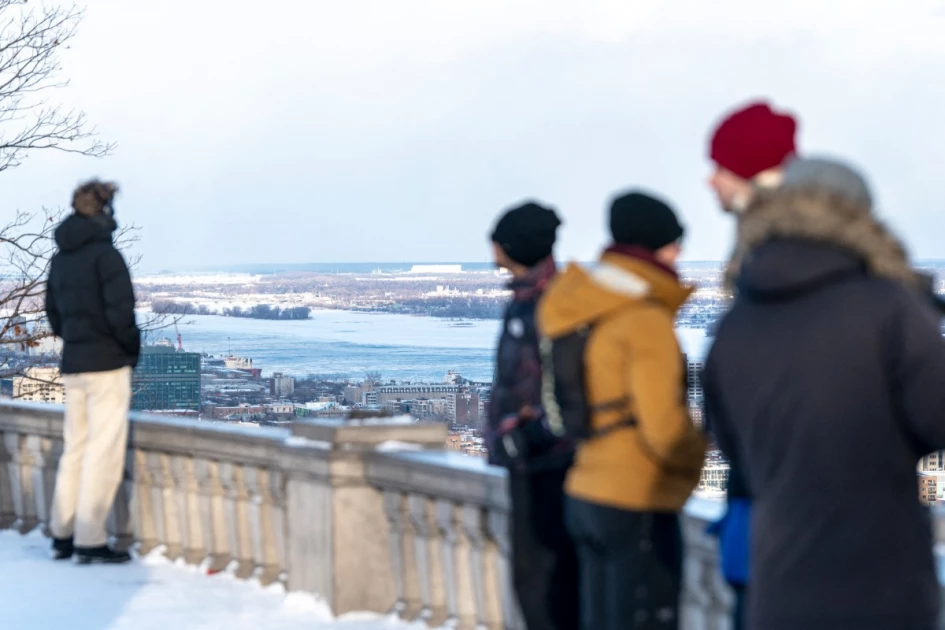
Ice is seen on the Saint Lawrence River as people look on from Mount Royal in Montreal, Quebec, Canada, on January 23, 2026. Environment Canada issued a warning that temperatures could dip below -20°C (-4°F) overnight, with winds expected to persist until January 24 and wind chill values near -35°C (-31°F) overnight and early on January 24, as a polar vortex descends on Canada and parts of the United States.

Audio By Vocalize
A massive winter storm headed towards the northeast United
States on Sunday after sweeping across much of the country, threatening tens of
millions of Americans with blackouts, transportation chaos and bone-chilling
cold.
After battering the country's southwest and central areas,
the storm system began to hit the heavily populated mid-Atlantic and
northeastern states with snow and freezing rain as a frigid air mass settled in
across the nation.
"The snow/sleet impacts will linger well into next week
with rounds of re-freezing that keeps surfaces icy and dangerous to both drive
and walk on for the foreseeable future," the National Weather Service
(NWS) said.
Snowfall was reported across the central United States,
including Kansas, Oklahoma and Missouri, where some spots already recorded
eight inches (20 centimeters) on the ground by Saturday night, the NWS said.
Shoppers stripped supermarket shelves as the weather service
forecast huge snowfall in some areas and possibly "catastrophic" ice
accumulations.
Transportation Secretary Sean Duffy warned that up to 240
million Americans could be affected by the storm.
At least 20 states and the US capital Washington, have
declared states of emergency.
"Take this storm seriously, folks," the NWS said
on X, predicting an "astonishingly long swath" of snowfall from
Colorado to Maine.
About 14,000 flights in and out of the United States had
been cancelled over the weekend, with thousands more delayed, according to
tracker FlightAware.
In Dallas, which has typically mild temperatures in January,
freezing rain pelted the Texas city and the mercury plummeted to 21F (-6C).
State officials vowed that the Texas power grid was in
better shape than five years ago, when it failed during a deadly winter storm
and left millions without power.
More than 180,000 US customers were without power as of
early Sunday morning, according to tracking site poweroutage.us, with about
45,000 reported in Texas and about 67,000 in neighbouring Louisiana.
Speaking at the Washington headquarters of the US Federal
Emergency Management Agency (FEMA), Department of Homeland Security chief
Kristi Noem urged Americans impacted by the weather to "be smart, stay
home if possible, take care of your family members, check on your neighbors and
continue to work with your local officials."
US President Donald Trump, who was riding out the storm at
the White House, said on his Truth Social platform: "We will continue to
monitor and stay in touch with all States in the path of this storm. Stay
Safe, and Stay Warm!"
The brutal storm system is the result of a stretched polar
vortex, an Arctic region of cold, low-pressure air that normally forms a
relatively compact, circular system but sometimes morphs into a more oval
shape, sending cold air spilling across North America.
Scientists say the increasing frequency of such disruptions
of the polar vortex may be linked to climate change, though the debate is not
settled and natural variability plays a role.
But Trump -- who scoffs at climate change science and has
rolled back green energy policies -- questioned how the cold front fit into
broader climate shifts.
"WHATEVER HAPPENED TO GLOBAL WARMING???" the
Republican leader posted on Truth Social.
The NWS warned that heavy ice could cause
"long-duration power outages, extensive tree damage, and extremely
dangerous or impassable travel conditions," including in many states less
accustomed to intense winter weather.
New York Governor Kathy Hochul warned residents to stay
inside amid frigid conditions: "Five or six minutes outside could
literally be dangerous for your health."
She stressed precautions like protecting pipes, using
heaters safely, and checking on vulnerable neighbours.
Authorities warned of a life-threatening cold that could last
a week post-storm, especially in the Northern Plains and Upper Midwest, where
wind chill lows were forecast to dip to extremes under -50F (-45C).
Join the Discussion
Share your perspective with the Citizen Digital community.
No comments yet
This discussion is waiting for your voice. Be the first to share your thoughts!