
Myanmar junta chief Min Aung Hlaing elected president by pro-military parliament
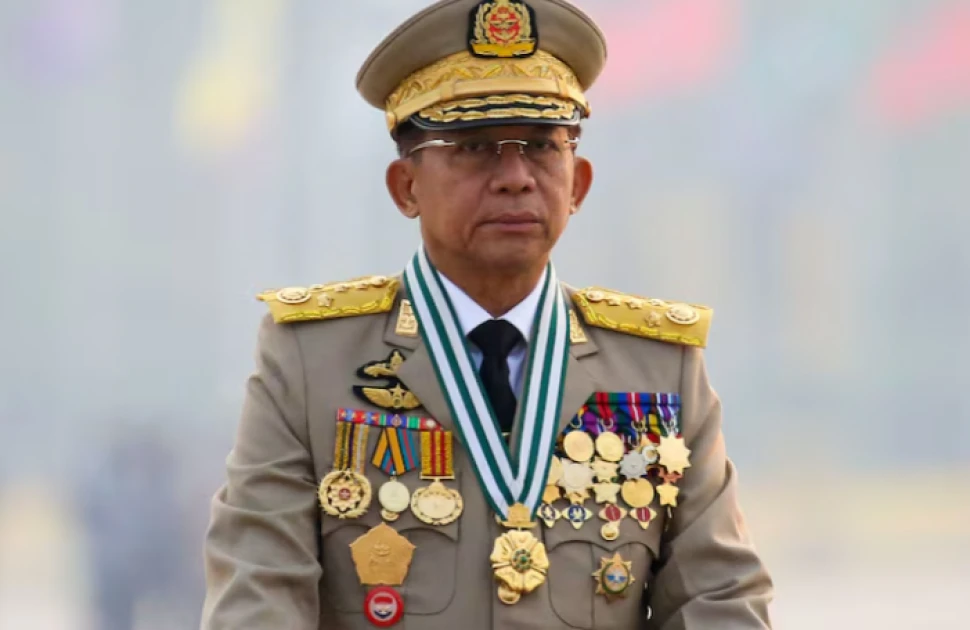
Myanmar's junta chief Senior General Min Aung Hlaing, who ousted the elected government in a coup on February 1, presides an army parade on Armed Forces Day in Naypyitaw, Myanmar, March 27, 2021. REUTERS/Stringer/File Photo

Audio By Vocalize
Myanmar junta chief Min Aung Hlaing was elected president on
Friday after breezing through a parliamentary vote, formalising his grip
on political power in the war-torn nation five years after he ousted an
elected government in a coup.
His carefully choreographed journey from top general to
civilian president follows a lopsided election in December and January that
was won in a landslide by an army-backed party and derided by critics
and Western governments as a sham to perpetuate military rule behind a veneer
of democracy.
The 69-year-old general has had a torrid time in
power since he toppled the administration of Nobel Peace Prize winner Aung San
Suu Kyi in 2021 and put her under arrest, sparking widespread protests that
morphed into nationwide armed resistance against the junta.
On Friday, lawmakers from the dominant Union Solidarity
and Development Party and the military's quota of appointed armed forces legislators coalesced to
back Min Aung Hlaing, with the former commander-in-chief winning the vote by a
huge margin.
Despite initially trailing to Nyo Saw, a retired general
and the junta's prime minister, Min Aung Hlaing pulled ahead to win 429 votes
to Nyo Saw's 126.
Min Aung Hlaing's ascent to the presidency - a position that
analysts say he has long sought - followed a major reshuffle in the leadership
of Myanmar's armed forces, which he had led since 2011.
On Monday, as he was nominated as a presidential
candidate, he anointed Ye Win Oo, a former intelligence chief seen as a fierce
loyalist, as his successor to lead the military.
Min Aung Hlaing's rise to the presidency is seen by analysts
as an attempt to consolidate his power as head of a nominally civilian
government and seek international legitimacy, while protecting the interests of
a military that has run the country directly for five of the past six decades.
"He has long harboured the ambition to trade his title
of commander-in-chief for president and it appears his dreams are now becoming
a reality," said Aung Kyaw Soe, an independent Myanmar analyst.
It was not clear if Min Aung Hlaing attended the vote and he
was not seen during a broadcast of the proceedings on state television.
China, a longtime ally of Myanmar's generals, extended its
congratulations and said it would support the new government in maintaining
peace and stability.
The civil war that has wrecked Myanmar and its economy for
much of the last five years is still raging, with the military under Min Aung
Hlaing's command accused by human rights groups and United Nations experts of
atrocities against the civilian population, which the junta has denied.
The prosecutor of the International Criminal Court in 2024 sought an arrest warrant
for Min Aung Hlaing over the alleged persecution of the minority Muslim
Rohingya, after more than a million fled to neighbouring Bangladesh to escape a
military crackdown in 2017.
"He may exchange his military fatigues for civilian
attire, but this changes nothing with respect to his suspected responsibility
for serious crimes under international law," Amnesty International said.
"For the many Myanmar people who have been victims of Min Aung Hlaing's
violently unfettered military ... seeing their oppressor formally elevated
instead of prosecuted will be deeply painful."
Some anti-junta groups, including those comprising remnants
of Suu Kyi's party and longstanding ethnic minority armies, this week formed a
new combined front to take on the military.
The Steering Council for the Emergence of a Federal
Democratic Union said its
objectives were to "completely
dismantle all forms of dictatorship" and initiate "a new political
landscape".
But resistance groups could face intensified military
pressure, economic challenges and increased scrutiny from neighbouring
countries that may seek to bolster their relationship with Min Aung Hlaing's
new administration, some analysts say.
"It may become even harder to build mutual
understanding and trust between groups, reach firmer agreements, and sustain
cooperation," analyst Sai Kyi Zin Soe said of the opposition.
Join the Discussion
Share your perspective with the Citizen Digital community.
No comments yet
This discussion is waiting for your voice. Be the first to share your thoughts!