
OPINION: It’s time to fuel MSMEs, boda boda operators’ financial health
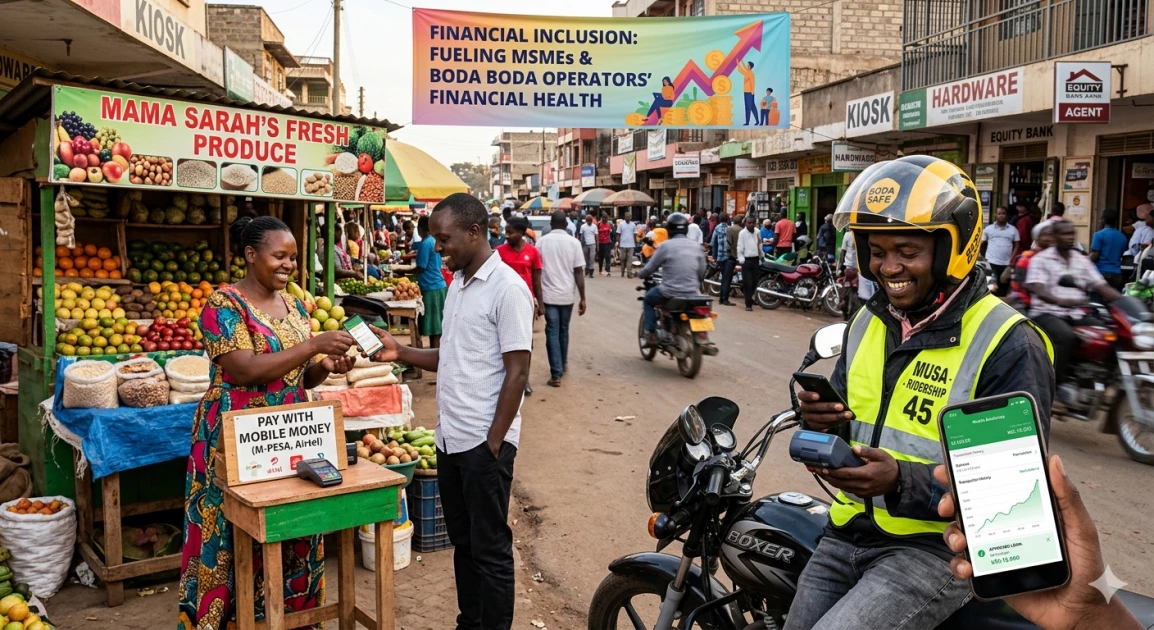
An AI-generated image of a female MSME entrepreneur ("Mama Sarah") who stands behind her colourful wooden fruit and vegetable stall. She is smiling as she interacts with a male customer on a boda boda who is pointing his smartphone at a mobile money "Pay Here" sign to complete a digital transaction.

Audio By Vocalize
Kenya’s financial inclusion story is often praised as a
global success. In less than a decade, the country moved from just 26.7 per
cent of adults accessing formal financial services in 2016 to 84.8 per cent in
2024.
This progress did not happen by chance. It has been built
steadily, driven by mobile money, fintech innovation, agency banking and a
supportive regulatory environment. In 2024 alone, the fintech sector attracted
approximately Ksh.82.5 billion (USD 638 million), signalling strong confidence
in Kenya’s digital financial ecosystem.
But beneath this success lies a troubling reality. According
to Central Bank of Kenya statistics, the proportion of financially healthy
Kenyans is falling. In 2016, financially healthy Kenyans were 39.6 per cent, but
fell to just 18.3 per cent in 2024. This points to a critical gap: access to
financial services does not automatically lead to financial security or
resilience.
This disconnect is most evident among MSMEs, including boda
boda operators, who form the backbone of Kenya’s economy and account for about
90 per cent of employment.
The boda boda sector alone includes more than two million
riders and contributes an estimated Ksh.660 billion annually, about 4.4 per
cent of Kenya’s GDP. With average daily earnings of around Ksh.1,100 per rider,
the sector generates substantial cash flow and supports millions of households,
according to Kenya’s New Boda Boda Boom report 2025.
Despite this, many operators remain financially vulnerable.
A large number struggle to save consistently, manage business expenses, or
withstand financial shocks. The issue is not a lack of income, but how that
income is managed.
National trends reflect this challenge. While 84.8 per cent
of adults have access to formal financial services, only 44.1 per cent use more
than one financial product. Just 36 per cent actively save with formal
institutions. These figures point to gaps in financial literacy.
For many MSMEs and boda boda operators, credit is the most visible and accessible financial tool. However, it is often used for short-term consumption rather than productive investment.
The rapid growth of digital lending has made credit easier to obtain, but it has also increased the risk of over-indebtedness. Many borrowers take multiple loans at once, often without fully understanding interest rates, repayment terms or the long-term consequences.
As a result, access to credit, rather than improving
livelihoods, can sometimes deepen financial distress.
The Kenya National Financial Inclusion Strategy (2025–2028)
recognises this shift. It emphasises that financial inclusion should be
measured not only by access, but also by usage, quality and impact. It also
places financial literacy at the centre, with both public and private sector
players expected to play a key role.
Encouragingly, there is growing recognition that financial
education must be practical, continuous and tailored to everyday realities.
In the boda boda sector, targeted financial literacy
programmes are beginning to show results. Training focused on budgeting,
responsible borrowing and financial planning is helping riders make better
decisions. Importantly, these programmes address the full financial journey,
from when to take a loan to managing repayments and recovering from setbacks.
At the same time, digital tools are improving transparency.
Mobile platforms that allow users to track loan balances, monitor repayments, and access statements are helping to build trust and accountability. When
borrowers clearly understand their financial position, they are better able to
avoid default and plan ahead.
For MSMEs, the challenge is even wider. Many operate
informally, lack access to affordable long-term financing, and struggle to
separate personal and business finances. Without targeted support, they remain
stuck in survival mode, unable to grow or build resilience.
The country has done well to expand access. The next phase
must focus on outcomes, ensuring that individuals and businesses can use
financial services to improve their lives in meaningful ways.
Only then will Kenya’s financial inclusion story be
complete, not just as a global success, but as a lived reality for millions.
Leave a Comment