
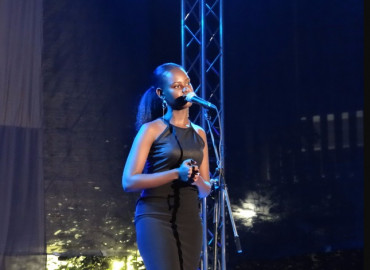
PROFILE: Mumbi Macharia – From writing poems for boys in class to commissioned works for World Bank, UN

Audio By Vocalize
Mumbi Macharia used to be scared of publishing her works for
the world to see because she thought the reactions some of them would elicit
would be too harsh for her to handle.
But she’s way past that fragile stage now; she has reached a
point in her career where she could really give two hoots whether two people
consume her work or 100,000. She knows her work good, really good, and that’s
enough for her.
The 24-year-old started writing spoken word pieces while still
in high school, one of those pieces got her kicked out of a poetry competition
but she was determined to tell her stories her own way so she forged ahead
anyway.
She’s now one of the most sought after spoken word artists in
the country, and has set foot on every poetry stage you can think of. Do you
want to count a few? Okay.
Kwani? Open Mic? She’s been there. Poetry After Lunch?
She performed there. Poetry Café? Please. Nyege Nyege Festival? C’mon.
Slam Africa? She almost won that. Mindfull? Poets vs Rappers? Hell, she created
those. You get where this is going.
Mumbi writes poetry that is raw, vulnerable, and sultry. Her
work revolves around love, sex, African pride, mental health, spirituality, and
the inevitability of heartbreak.
In 2020, she self-published her debut poetry book – 'When I
learned how to walk and other stories' - which is a compilation of 17 of her
poems.
The same year, she performed on 'Concert Nyumbani', which was
broadcasted on 9 TV stations simultaneously in Kenya during the pandemic, and
was part of a DSTV campaign alongside poets from South Africa and Nigeria, to
celebrate African storytelling.
Mumbi has written commissioned poems for the World Bank and
the United Nations, which were screened at global virtual seminars and landed
her an interview on CNN in July this year - this, despite all her achievements,
she still says is the highlight of her career.
She received a Recognition Award from the Kenya Cultural
Center in 2018, won Best Poet of the Year at the Café Ngoma Awards in 2020 and
was crowned Spoken Word Poet of the Year at the Sondeka Awards the same year.
She recently released her debut EP – Libation – consisting of
five poems that she dedicated to her Kenyan heritage and is available on all
streaming platforms and YouTube.
The only child in her family sat down with Citizen Digital
recently.
What’s
the difference between poetry and spoken word and how did you get stuck in
between?
Spoken word is a variation of poetry that doesn’t conform to
the traditional rules of poetry; it is more of storytelling.
I started writing spoken word in high school. My English
teacher signed me up for an inter-school poetry competition. I wrote a poem in
the format of a story and when we submitted it for the competition, I was
disqualified because the judges said it did not look like real poetry; it did
not have things like stanzas and there was no rhyme scheme.
What
happened next?
At the tail end of the competition, the judges let me go on
stage anyway to perform my poem, the very one that had gotten me disqualified.
Afterwards, I started looking out for poetry Open Mics in
Nairobi and listening to people who were doing the same things I was doing;
that was when I realized that this was actually a thing.
What drew
you to spoken word?
I loved to write, and I also loved to perform, which is
ironical considering the fact that I was quite the shy kid.
The first poem I wrote was about a boy in my class, performing
it made me feel so vulnerable; like I was literally telling my business to
everyone.
But then people liked it and found it entertaining, so I
realized that I had to sacrifice something if I was going to pursue this all
the way, hence I made the decision that I was going to allow myself to be
vulnerable.
Tell me
this, I’ve always been curious, how does it feel to have your own Wikipedia
page?
Uhmmm…*giggles*…It feels nice, it feels like people look for
me and want to know about me; which is a bit scary though, because you realize
that many people have a perception of you and you can’t control what that is.
But it’s also a nice thing because I hope that that perception
they have about me is of a poet who talks about things they’re interested in.
What
inspires your writing?
Things that I’m either going through or have experienced;
which means I write a lot about sadness and heartbreak. *Laughs*
I feel like I write best when I’m writing about something I
know.
As a
wannabe author myself, I find that when I’m unable to write, I drink and I know
things. How do you deal with your writer’s block?
Does that help you?
What,
drinking? Yes.
Interesting. *Laughs*
I have a folder containing a lot of unfinished pieces of
writing. What happens is that I start writing and then, halfway through, I just
stop. So, usually, when I have writer’s block, I go back to that folder and try
to either combine them to form one full piece or I just continue with one of
them with fresh inspiration.
If that doesn’t work I just stop, I don’t force myself.
Artists often feel the pressure to churn out work and keep up with algorithms
and be relevant, but I feel like it’s important to honour your creativity and
only do things when you’re inspired to do them.
What
scares you most about performing? Have you ever sucked on stage and been booed
off?
No, I haven’t, actually. That’s never happened to me. The
thing is, my poetry is actually really good.
I used to be scared of performing because of some of the
things I would talk about like sex; I thought people would go like ‘oh my God,
what is she saying?’
But then the opposite actually happened and the crowd was
really hype, and I realized I was writing about things that people actually
want to listen to.
You have
a pretty raunchy poem titled ‘The first time…’ lamenting an unsatisfying
sexual encounter, talk to us about why you wrote that.
Whenever people listen to that poem for the first time, they
think it’s just about sex. But when you actually listen to it, it’s a very sad,
emotional poem.
Sex is such a sacred thing, so if you have a sexual experience
with somebody and you feel like this person didn’t care about your needs or
feelings, then it goes deeper into stuff like self-worth and self-esteem.
I used those words, specifically, to get people’s attention
because there’s a deeper message. I was very deliberate about how I wrote that
poem; to make people want to listen, and then make them turn around and
actually be like ‘Okay, what is she really saying though?’
My elder
brother has a book out and I saw what he went through to publish it, what was
your own personal experience with self-publishing?
I actually have a copy here with me. *Rummages through bag*
Do you
just walk around with copies like a hawker?
Yes. Because telling people you’re a self-published author is
one thing, but actually showing them is another. And I’m also very proud of it
because I did everything myself; the layout, the cover, the copyright
registration et al, if I had a printer at home I probably would’ve printed it
myself as well.
What was
that process like for you?
It was very daunting, because it took me three months to
complete. I had the content, I just had to do a bit of edits here and there
because some poems aren’t the same performed as they are when read.
I did all this during the pandemic because I had the time;
since I wasn’t performing, I just thought about how I could package my work for
people.
Do you
feel like Kenyans support art? How many people have actually bought your book?
I’ve sold over a hundred books within the last year.
I feel like Kenyans support art if it is visible, and there’s
a lot of groundwork to be done to make your art – as an artist – visible and
for people to want to consume it; because people want to consume something when
other people are already consuming it.
People will be like ‘oh, this book has sold a hundred copies?
Let me buy one.’ They will not be like ‘let me be the one to buy this book and
get it to sell 100 copies.’
Is the
spoken word industry in Kenya going somewhere?
It comes in waves. Because there was a time we used to even
perform at Churchill Show, but even that wasn’t a stage for spoken word,
you know.
A poet like Teardrops, for example, his poetry is in such a
way that it contains punchlines and is funny, so that fit perfectly into
the Churchill Show dynamic.
But my poetry is different; I’m not making you laugh, I’m
making you think. So the show was a bit challenging for me, it was actually one
of the toughest crowds I’ve had to perform for, but it was a great platform.
I think with spoken word we squeeze into already existing
spaces, like comedy shows and music concerts, whereas it would be better if we
had our own platform.
Where is
the money in the spoken word industry?
Personally, I have found it to be in commissioned work, like
writing for the World Bank. Maybe there’s also money somewhere else, but
speaking for myself, that’s where I have found some of it.
You just
released your first EP titled ‘Libation’. Why now after all these years of
performing?
We’re in the age of streaming, people want art that they can
consume quickly on the go. Same as how TikTok is fashioned, like just give me a
nice 15-second recording, nothing much, you know.
The EP is meant to make me more visible as an artist; like, if
you don’t want to read my book, then go stream me on Spotify. I just want to
make my work available across different mediums.
There’s a
piece in that new EP titled ‘to the son I might have one day’, if and when you
actually do have one, what would you like them to think about when they listen
to it?
I wrote that poem thinking about the relationships that I have
had with men. Because they say ‘don’t have a child with a man unless you would
be happy to have a child exactly like him’, and I was like I don’t think I
would want that.
You don’t
want your son to be a replica of your husband?
Not any that I have met, so far.
*Laughs*
The poem was more me talking to the men who, maybe, I have
been with and telling them that ‘this is what I would’ve wanted to be
different.’ It’s not necessarily a letter to the son I might have one day, but
more a letter to these men I have been with saying ‘I would have wanted you to
turn out this way, instead.’
Whenever
I sit down with a female creative, a story always emerges about how harsher the
industry is towards women than men. Has that been the case for you as well?
There are a few instances where people are less inclined to
listen to you as a woman. Because, for me, for instance, I’m a woman and then
I’m young. With that combination, no one wants to listen to me as the first
person in any room.
I feel like people take me less seriously even when my ideas
are good, which is why I write my poetry the way I do; because I want to get
your attention as soon as I possibly can, because if I give you time to look at
me then I’m going to lose you even before I get to the point.
So this has made me more straightforward about my ideas and
the things I want, so that you don’t have the opportunity to write me off
prematurely. Which shouldn’t be the case because it just makes things more
difficult, I shouldn’t be scared that if I’m not quick enough then I’m not
going to get that opportunity. Whereas, men can be mediocre but people will
still listen to them because they feel like you have something important to
say.
You
graduated from campus with a law degree, are you using it anywhere?
Not at the moment. I loved studying law, it’s just that at the
moment that’s not what I want to do, because I’m young and there are so many
things that I want to do; I want to be a lawyer, I want to be an artist, I want
to learn how to paint, I want to study something else, I don’t want to just
have to be one thing my whole life.
It’s not that I want to succeed at everything I do, I just
want to be able to do all the things that make me happy.
But, gun
to your head right now, law or art?
Shoot me.
Leave a Comment