
Relief for MPs as Court of Appeal overturns High Court ruling that declared NG-CDF unconstitutional
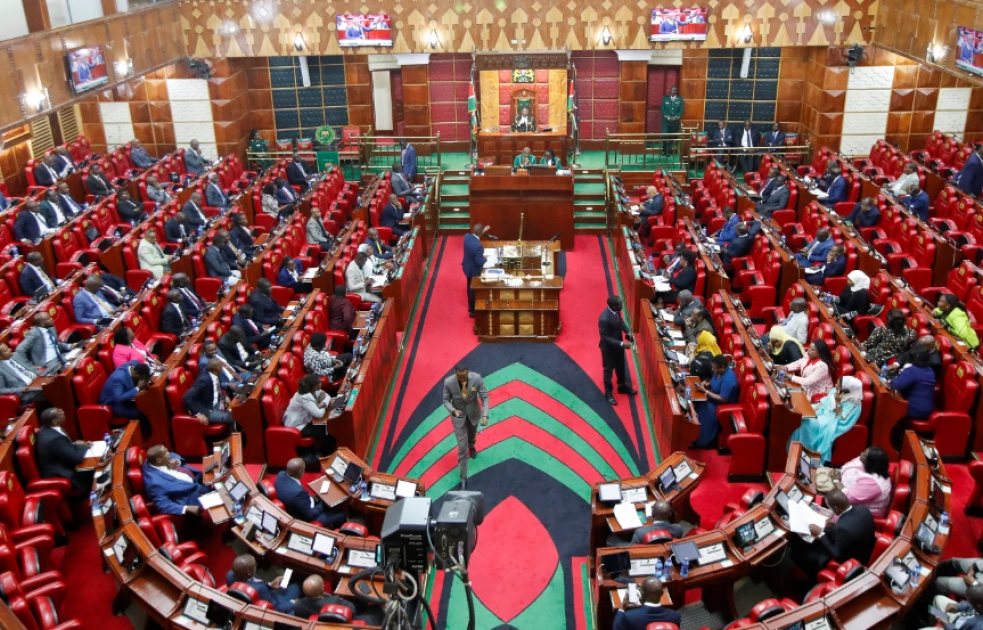
A general view shows Kenyan Members of Parliament as they discuss the impeachment of then Deputy President Rigathi Gachagua inside the Parliament buildings in Nairobi, Kenya October 8, 2024. FILE PHOTO | REUTERS

Audio By Vocalize
The Court of Appeal has overturned the High Court decision
that invalidated the entire National Government Constituencies Development Fund
(NGCDF) Act, 2015, holding that the trial court erred in both its
constitutional analysis and the remedies it granted.
In a judgment delivered Friday morning, a three-judge bench
comprising Court of Appeal President Justice Daniel K. Musinga, Justice Francis
Tuiyott, and Justice A. O. Muchelule set aside the High Court’s judgment and
decree issued on September 20, 2024.
The appellate court found that the High Court wrongly struck
down the whole Act without undertaking sufficient textual and principled
constitutional analysis, particularly on issues of public finance, devolution,
and separation of powers.
The Court of Appeal held that the petition before the High
Court was not rendered moot by the 2022 and 2023 amendments to the NGCDF Act.
It further ruled that the Act does not violate the structure or principles of
devolution, nor does it offend the constitutional division of functions between
the national and county governments.
On the question of separation of powers, the court disagreed
with the High Court’s findings, stating that only section 43(9) of the Act was
unconstitutional.
The impugned provision, which tied the term of office of a
constituency fund manager to the term of Parliament and election transition
periods, was found to infringe the doctrine of separation of powers and was accordingly
severed from the Act.
The judges also rejected the High Court’s conclusion that
the NGCDF Act was inconsistent with the principles of public finance. They
emphasized that courts must not invalidate legislation on the basis of
hypothetical or speculative harm, noting that the NGCDF forms part of the
national government’s expenditure approved by the National Assembly under the
Appropriations Act.
The court observed that the NGCDF Act provides multiple
layers of fiscal oversight, including mandatory accounting and audit by the
Auditor-General, as well as parliamentary oversight.
In setting aside the High Court judgment, the Court of Appeal faulted the trial court for failing to carefully juxtapose the impugned provisions against the constitutional text and principles, and for not clearly demonstrating how the Act violated the Constitution. Citing the United States Supreme Court decision in U.S. v. Butler (1936), the judges reiterated that courts do not approve or condemn legislative policy, but are limited to determining whether legislation conforms to constitutional requirements.
Join the Discussion
Share your perspective with the Citizen Digital community.
No comments yet
This discussion is waiting for your voice. Be the first to share your thoughts!