
Tension in Borama persists after deadly unrest, as calls for accountability grow

Audio By Vocalize
The crisis has also taken on a sharper political tone, with activists and local leaders warning that Somaliland’s president, Abdirahman Mohamed Abdillahi Irro, could ultimately face legal scrutiny for possible violations of international humanitarian law, as pressure mounts for independent investigations into the conduct of state security forces.
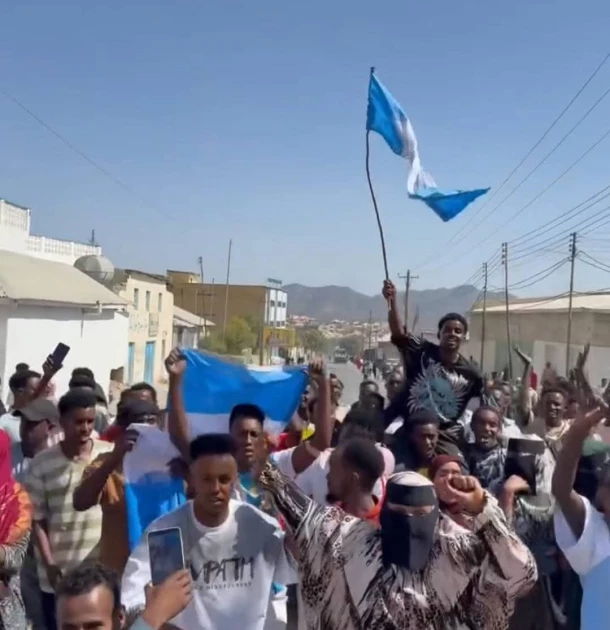
Young protesters, organizing under what they call the “Blue Revolution,” say they are no longer willing to accept what they describe as chronic instability and abuse. Many have framed their movement as a demand for a stable system of governance and protection of civilian life, rather than a purely regional dispute.
The violence was triggered by the government’s announcement that it would proceed with the launch of the Xeer Isse book in the coastal city of Zeila.
Demonstrations that began Thursday night quickly escalated into violent confrontations, with local sources reporting that military units deployed to Borama carried out violent crackdowns that resulted in civilian deaths. More than 50 people were injured.
Late Friday, President Irro sought to defuse the unrest, ordering the “withdrawal of military forces” from Borama and promising that no “further steps would be taken without consultation.”
Despite the pledge, overnight reports described renewed fighting between military units and clan militias, particularly in southern and some northern neighbourhoods.
On Saturday, government-appointed traditional elders arrived in Borama and held talks with clan leaders from the Awdal region. After the discussions, both sides agreed to halt the book launch event that had set off the unrest.
Hours later, President Irro again addressed the public, announcing that the government had reversed its earlier decision allowing the celebrations to proceed.
The unrest has drawn in regional and international attention. Somalia’s federal government issued a statement condemning the use of violence and urging Somaliland authorities to protect civilians, after lawmakers from Awdal in the federal parliament described the clashes as “self-defense.”
Human rights groups have condemned the use of live ammunition against civilian protesters by Somaliland security forces, which resulted in the deaths of over 40 unarmed civilians and injuries to more than 50 others, and called on the authorities to immediately cease the use of excessive force against unarmed civilians and to uphold citizens’ right to peaceful expression.
In Borama and across the Awdal region, the unrest reflects deeper grievances. Many residents say they have long “felt marginalized,” citing inadequate representation in government, unequal distribution of power and restricted access to resources.
Repeated promises of reform by successive administrations have often failed to materialize, further eroding trust in central authorities. Somaliland risks sanctions from the international community if the conflict continues.
Xeer Ciise, the oral customary law of the Somali-Issa communities across Ethiopia, Djibouti and parts of Somalia/Somaliland, was recently inscribed on UNESCO’s Intangible Cultural Heritage list in a move intended to preserve cultural traditions.
Several books have since been published about the tradition. One book, circulated by Issa elders and the Djibouti government as part of the UNESCO nomination process, reportedly contains maps and narratives that suggest Issa dominance over Awdal and Saylac.
For the local Gadabuursi community, who form the majority in Awdal and consider Saylac part of their historical homeland, the book is viewed as an “existential and territorial threat.”
Community leaders say the dispute is political as much as cultural, arguing that international cultural recognition is being “weaponised” to advance territorial claims and expand clan influence.
On Sunday, the sound of heavy machinery and gunfire continued with reports of the Somaliland military attacking a hospital where wounded patients were being treated.
Many protesters feel it's time for Awdal to claim its future away from Somaliland, with protests continuing and calls growing for independent investigations into the killings and for accountability over the use of force against unarmed civilians
Join the Discussion
Share your perspective with the Citizen Digital community.
No comments yet
This discussion is waiting for your voice. Be the first to share your thoughts!