
The Showman Residency: Is Nyashinski still the G.O.A.T? Nope.

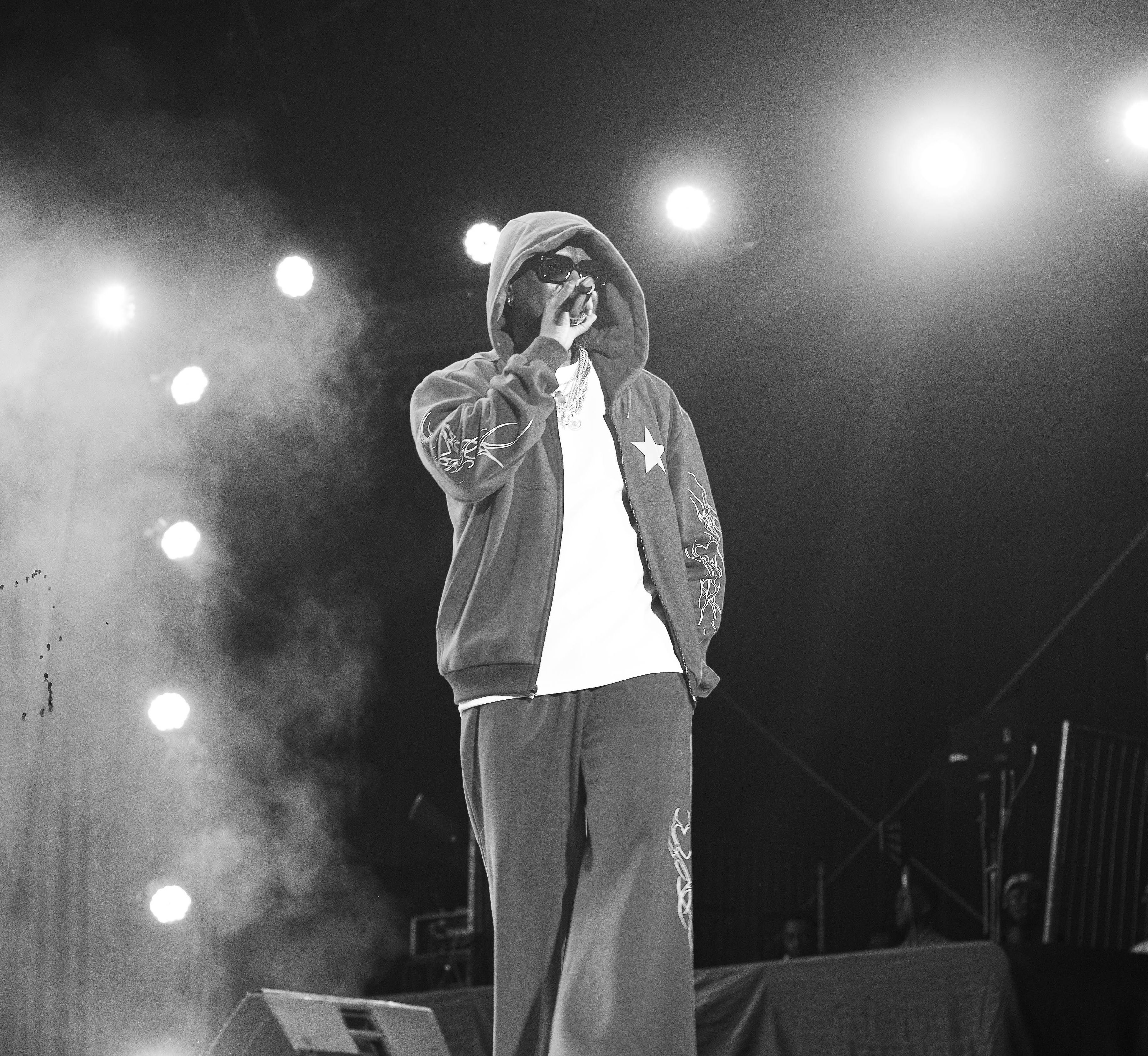
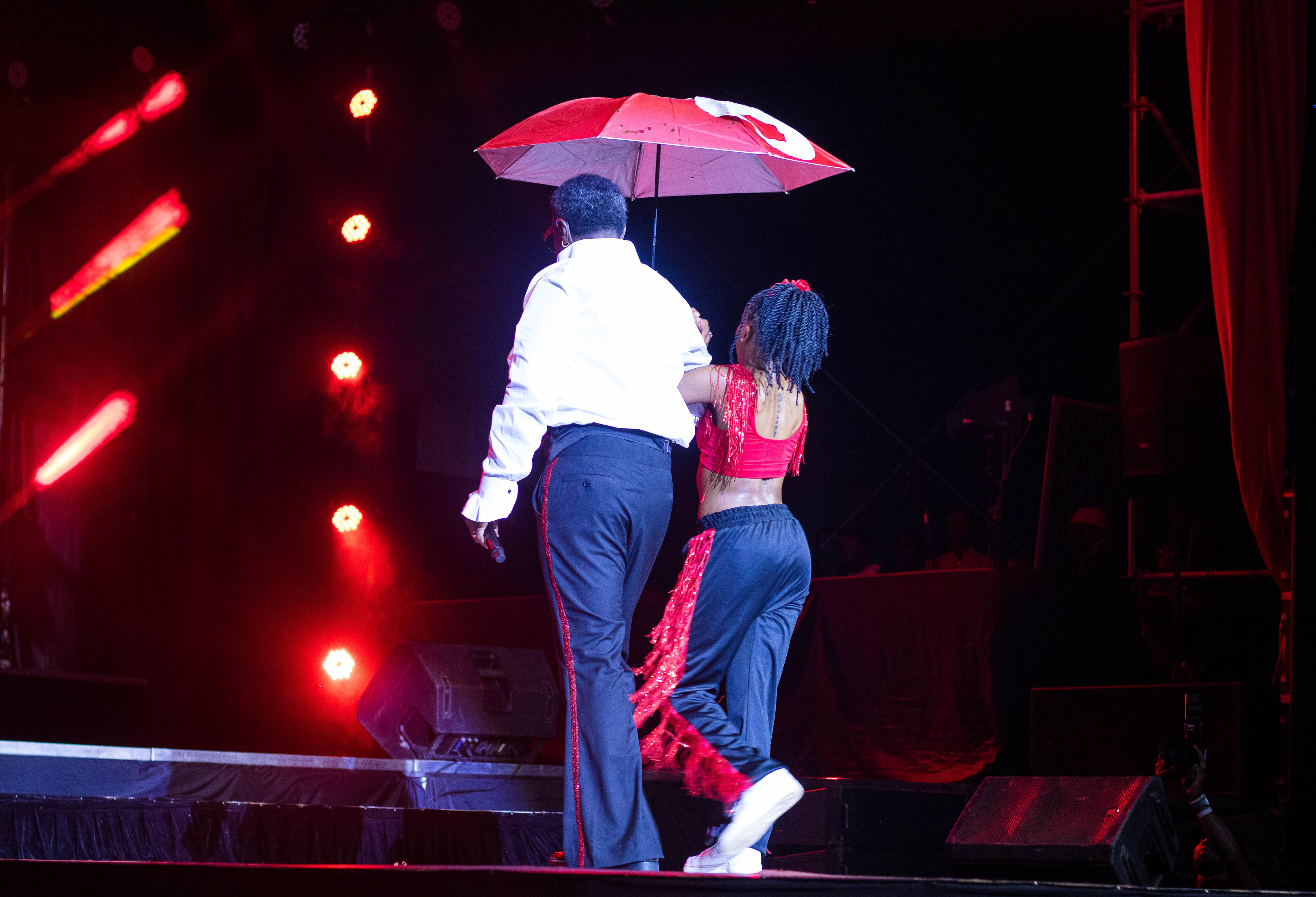
Nyashinski performing at The Showman Residency on April 5, 2026. PHOTO EUGENE OMONDI | CITIZEN DIGITAL

Audio By Vocalize
At around 2am on Sunday, April 5th, an hour that typically belongs to questionable decisions and stubborn youth, I wandered into a newly launched club in Nanyuki, completely oblivious of the fact that I’m at an age where such behaviour should come with a written warning from my ancestors and a quiet apology to my knees. But wisdom, as it turns out, is a suggestion, not a rule. And so there I was, present and accounted for, watching the night stretch itself into morning with the kind of defiance that only good music can justify.
On stage stood
Iyanii, the main act of the night, performing a smooth, almost reverent
rendition of Nyashinski’s 2017 love ballad Malaika. The crowd, as though
bound by some unspoken emotional contract, responded in unison, swaying gently
from side to side, phone lights in the air, each person singing along as if
they had personally co-written the song. It was one of those rare, cinematic
moments where the music doesn’t just play; it settles, it lingers, it reminds
you why certain songs refuse to age.
What made it all
the more poetic, and almost suspiciously so if I might add, was the timing.
Because that very evening, just a few hours and a questionable amount of sleep
later, I was scheduled to attend the second night of Nyashinski’s The
Showman Residency concert at the Carnivore in Nairobi. A residency, for the
students dozing off at the back of my class, is a series of performances by an
artist at the same venue over a set period. Think of it as a concert tour, but
in one location.
My first proper
encounter with Nyashinski as a live performer came in 2022 at his Shin City
concert; a night that, in hindsight, felt less like attendance and more like
witnessing a man reclaim territory he had never truly lost. That was six years
after his comeback, if we can even call it that, through the audacious,
chest-forward declaration that was Now You Know, a track that didn’t
politely reintroduce him to the industry so much as it kicked the door open and
demanded an explanation for why it had ever been closed in the first place. In
it, he addressed the rumours, the whispers, the long, convenient mythology that
had formed around his ten-year silence, brushing them off with the kind of calm
arrogance that only comes from a man who knows exactly who he is and has no
intention of reapplying for relevance.
In it, he says; “Naskia
wakiuliza ule boy wetu alienda wapi? / Amepotea ka zile mbegu watu walipanda na
Kanyari…” Then he goes on to answer that: “Sijarap kitu ka toka ’06
hivi, trust me siwezi rust mimi / Ata niache mziki miaka hamsini, nikirudi bado
nawacrush nyinyi…” Just a little further ahead on that same track, he adds:
“Hizo miaka zote nimekuwa missing lakini iko kitu hamjaniambia / Kaa
ningebaki bado mngekuwa na taki ya kuskia nikiwaimbia? / Ama by saa hi mngekuwa
mnanifanya vile mnafanya ma-pioneer? / Story kwa media ati nimechapa niko juu
ya madawa nahangaika / Show ni ule jamaa aliimba ‘Ada Ada’ ebu come ucurtain
raisie mnaija / It’s not that serious rap ni hobby / Bila mziki bado namanga /
Ingekuwa career si ningekuwa nalia kuskia ati Naija Night Nairobi…”
The first time I
heard that record, though, I misread it completely. I didn’t hear a comeback, I
heard closure. At the time, Nyashinski existed more as a memory than a
presence, a name that floated in conversations about what Kenyan music once was.
The blogs had written their obituaries, the timelines had moved on, and even
the industry, in its own subtle way, had begun to archive him. When King Kaka,
in his 2013 track We Miss Them, called out to artists who had faded into
silence, including Nyashinski, it felt less like a feature request and more
like a roll call for ghosts. He says; “C-Zar najua umepata hii ngoma, uko? /
Bamboo alishatoka majuu, si unacheki anadu ma-mziki / Attitude na Mercy Myra,
tumewamiss kichizi / Ule boy mkali wa Klepto…oya, Nyashinski…kujeni home.” And
so when Now You Know dropped, I assumed it was exactly that; a man
stepping briefly into the light to clear his name, dust off a few rumours, and
then retreat back into the quiet life he had built, far away from the noise,
the expectations, and the industry politics that had carried on without him.
But the problem
with that theory, much like many things we confidently believe while nursing a
Scotch at 2am, is that it did not survive contact with reality. Because the
song was too big. Not just popular, not just well-received, but inevitable. It
was the kind of record that doesn’t ask for permission to trend, it simply
becomes unavoidable. And once that door reopened, it refused to close. So one
hit became two, then two became a streak; Mungu Pekee, Malaika, Aminia,
Hayawani, Bebi Bebi. He released hit after hit, each one
tightening his grip on an industry that had briefly convinced itself it had
moved on. By the time Shin City came around, the conversation was no
longer about whether Nyashinski was back, it was about how he had managed to
return without missing a step, without sounding dated, without asking for space
at a table that he clearly still owned.
And Shin City
was not just another concert. It was, at the time, the standard against which I
quietly began measuring every other Kenyan solo performance, and finding most
of them lacking. There was an almost obsessive level of thought, detail, and
creative direction poured into that experience; from the very moment you
stepped into the venue, through the transitions, the props, the pacing, the
staging, all the way to the final note. It felt curated, not assembled. Nothing
was accidental. Nothing was rushed. It was the kind of show that makes you
realise the difference between an artist who simply performs, and one who
builds worlds. And when I eventually retreated into my corner afterward, I
wrote about that concert with a certainty that bordered on arrogance. I called Nyashinski the G.O.A.T. The Greatest Of All Time. No stutter, no disclaimer, no
footnotes, hell no room left for debate.
But time, as it
tends to do, kept moving. And somewhere between that declaration and a glass of
Scotch in Nanyuki, reality decided to tap me on the shoulder. I remember
texting a friend and casually mentioning that I was heading back to Nairobi for
The Showman Residency, and - if the stars aligned and the gods of
scheduling were feeling generous -would possibly land the second interview within
two weeks with Nyashinski himself. They responded with polite enthusiasm, before
asking a question that seemed harmless at first: “What do you think of him,
in general? How do you rate him?”
Now, I did what
any writer in my position would do, I sent them a link to my 2022 piece, the
one where I had already settled the matter and handed Nyashinski his crown.
Case closed. History recorded. Or so I thought. Because their reply came back
swift, simple, and devastatingly effective: “A lot of things have happened
in Kenyan music since 2022.”
And just like
that, the certainty I had worn so comfortably began to feel… dated. Not wrong,
necessarily, but incomplete. Because they were right. The industry had shifted.
New sounds had emerged. New stars had risen. The conversation had evolved, as
it always does, leaving behind anyone who assumes it will stay still long
enough for conclusions to age gracefully. And for the first time since I had so
boldly crowned him, I found myself asking a question I had previously treated
as settled fact: Is Nyashinski still the G.O.A.T?
Not in memory. Not
in legacy. But now, in this current, restless, ever-changing moment of Kenyan
music. And the uncomfortable truth was, I wasn’t so sure anymore. Even though he has been topping my Spotify Wrapped list for three years in a row now.
But I also wasn’t
about to revise a verdict from the comfort of nostalgia or second-hand
opinions. If there was going to be a reassessment, it would have to be earned properly,
thoroughly, and in person. And so, at 6am, with the discipline of a man who has
already made questionable life choices but refuses to abandon them halfway, I
downed my last finger of Scotch, chased it down with enough water to convince
my body I meant well, went back to our AirBnB to steal four brief and highly
negotiable winks of sleep from the couch, then woke up and got ready for the
drive back to Nairobi. Not just to attend The Showman Residency, but to
find out whether I had been right about Nyashinski’s G.O.A.T status… or was I
simply early to a verdict that time has since appealed?
At around 7pm on
D-Day, I was still stuck at Kamakis junction along Thika Road, trapped in that
uniquely Kenyan traffic jam where time slows down, tempers rise, and every
driver suddenly believes they’re Vin Diesel. My original plan was simple; get
home, shower properly, change into something befitting the occasion, and then slide
into Carnivore Grounds like a man who has his life together. But traffic, as it
often does, had other plans. And as the minutes stretched and the Math refused
to make sense, it became painfully clear that if I stuck to dignity, I would
miss the show entirely, which was not a thought I was willing to even entertain.
So I improvised.
I abandoned my
entourage like a man fleeing a sinking ship, hailed a cab, and attempted an
alternative route, which in true Nairobi fashion, was just another traffic jam
wearing a different shirt. Somewhere between impatience and desperation, I made
a decision that would have deeply disappointed my younger, more composed self -
I changed clothes in the backseat of that cab. With no shame at all. From
there, I jumped onto a motorbike, weaved through traffic with nothing but faith,
and by 7:58pm, I was at Carnivore, heart steady, and the clock counting down to
two minutes before the man of the hour was set to take the stage.
There was no queue
at the entrance, my ticket was scanned in what felt like seven seconds flat,
and just like that, I was in. Inside stood a large dome structure, clean,
deliberate, and thoughtfully erected. There were seats neatly arranged and aligned
with enough space between them to allow movement without turning every minor
adjustment into a communal inconvenience. It was, quite frankly, a small
miracle, because the concept of enough seating for ticket holders remains, in
many local events, more of an aspiration than a practice. I hate standing at
events, especially crowded ones where all manner of people brush against me and
spill cheap vodka on my Lacoste kicks. I’m not a violent man, and I can never
fight over a woman, but I will pluck someone’s teeth out with a pair of rusted pliers
for stepping on or spilling something on my shoes.
Also, there is
thing that happens in Kenyan events where MCs engage in useless banter and
repeatedly ask the crowd “are you ready?” just to buy time because perhaps the
main act still needs a little more time to get over their nerves or tie their
shoe laces. It usually pisses me off because I did not shower, get dressed, and
fight through traffic if I wasn’t ready. Of course I’m ready, MC Barnabas. I left my house.
That alone should be proof enough.
And so refreshingly,
there was no MC at the show. There was no man in a blazer shouting instructions
into a microphone like a motivational speaker who has misplaced his audience.
Instead, everything about The Showman Residency felt intentional, almost
theatrical in its sequencing; the transitions were seamless, the energy was self-sustaining,
as though the show trusted itself enough not to need constant verbal
validation. It moved with quiet confidence, the kind that doesn’t beg for
attention because it already has it.
Now, I have
attended more Kenyan concerts than I can comfortably count, and if there is one
unspoken rule that binds them all, it is this: time is a suggestion. A polite
idea. A rumor, at best. And so imagine my surprise when, the moment that
countdown clock hit zero, at exactly 8pm, the show began. Not 8:17. Not “we are
starting shortly.” Eight. On the dot.
It opened with a
brief five-minute poetry performance, then the curtains opened and there,
standing at the center of it all, was Nyashinski - The Showman himself - dressed
like a man who had no intention of giving you a normal concert. He wore an
outfit that looked like something between a magician and a ringmaster; a tuxedo
suit with a red and black jacket, a distinct hat that looked like it had
secrets tucked inside it, the kind rabbits are usually pulled from, and behind
him, a shimmering, almost mythic visual of himself wearing a king’s crown and
ensemble of chains on his neck, arms stretched wide as if inviting the entire audience
into a world he had carefully constructed long before we arrived. It did not
feel like an entrance. It felt like an unveiling.
For a few
deliberate minutes, while the crowd roared itself into a frenzy, cheers rising,
screams cutting through the air like sirens, Nyashinski did absolutely nothing.
He just stood there. Motionless. Dark glasses on. Facing the crowd with the
kind of stillness that isn’t empty, but loaded. Like a man who understands that
anticipation, when handled properly, can be louder than any chorus. Behind him,
the speakers breathed out low murmurs and haunting hums, the kind that creep
into your chest before you even realise you’re holding your breath, as if the
entire arena had been gently pulled into a pause it did not agree to, but could
not resist.
And then, without
warning, without apology, the beat dropped. Not loudly at first, but
recognisably. Instantly. The kind of drop that arrives with memory attached to
it. And in that split second, the crowd didn’t just react, they recognized it.
The screams doubled, sharpened, unified by that shared, electric realisation
that we all knew exactly what was coming. Because truth be told, there was
never going to be another option. No debate. No alternative theory. There was
only ever one song to open a show like this: Showman.
“Yeah, uh / Naido
for the culture mimi / Culture inacatch / Nishatoa ma-single, unataka project,
yangu ni art / Yeah, yeah, Chilla the prophet, nasema na unaona ikihappen / Wah,
wah, the better the concept, the brighter the lights, the bigger the show / Nakushow
kitu new, na ntaneed unitrust just once / Jua tu ka naeza ido unaeza ido, take
chance / Na mi kudeliver ni must…”
And when he
finally got to the chorus and let the words speak, it almost felt like the
night had been waiting for that exact moment to justify itself.
“Then the
Showman says / Come see me live on stage / The night will be amazing, one you
will never forget / It’s all for you / I made this gift for you just to show I
love you…Ooh!”
Those didn’t land
like lyrics so much as a quiet contract between Nyashinski and every single
person seated in that dome. It was equal parts invitation and assurance, a
promise dressed as a melody, delivered with just enough conviction to make you
believe that what you were about to witness had been carefully assembled with
you in mind. And in that instant, standing there at the intersection of
spectacle and sincerity, it became clear that Showman was not just an
opening song, it was a statement of intent. A way of saying: you made it here,
I see you, and tonight, I intend to make it worth your while.
And the beauty of
that moment, subtle but impossible to ignore, was how effortlessly the crowd
received it. There was no hesitation, no need to warm up into the performance,
the connection had already been established before the first full verse could
even settle. You could feel it in the way people leaned forward, in the quiet
confidence of their reactions, in that shared understanding that this was not
going to be one of those nights where the artist spends half the set trying to
win the audience over. That work had already been done years ago, through the
music, and now reaffirmed in real time. What remained was execution. And as
Nyashinski moved from promise into performance, it became increasingly clear
that this was not a man hoping the night would be amazing. He had already
decided that it would be, and we were simply there to experience it unfold.
Now, I could sit
here and give you a meticulous, blow-by-blow account of how the night unfolded,
I could tell you exactly when Nyashinski slid seamlessly into Glory, how
the crowd erupted at the first few notes of Hayawani, how he dipped into
Tuendelee and delivered that verse with the kind of precision that
reminds you why some artists don’t need to shout to be heard, but then we would
both be here all day, and quite frankly, that would defeat the point of a live
experience.
Because the truth
is, some things are not meant to be fully narrated, they’re meant to be
witnessed. And if you really wanted every detail, every transition, every
perfectly timed pause and eruption, then you should have done the responsible
thing and bought a damn ticket. Hehe.
The Showman Residency was not structured like your typical “song-after-song-until-we’re-tired” concert. No. This was theatre. Proper theatre. The entire show was divided into six distinct episodes, namely: A Night to Remember; A Good High; Rhythm and Poetry; The Voice of the Most Beautiful Instrument; A Love Story; and Grand Finale. Each episode unfolded like a chapter in a carefully written book, complete with its own emotional arc, tonal shifts, and narrative purpose. And threading all of this together was a cast of characters who didn’t just fill space on stage, but actively carried the story forward with the kind of intention that suggested this had been rehearsed, rewritten, and obsessed over for a long time.
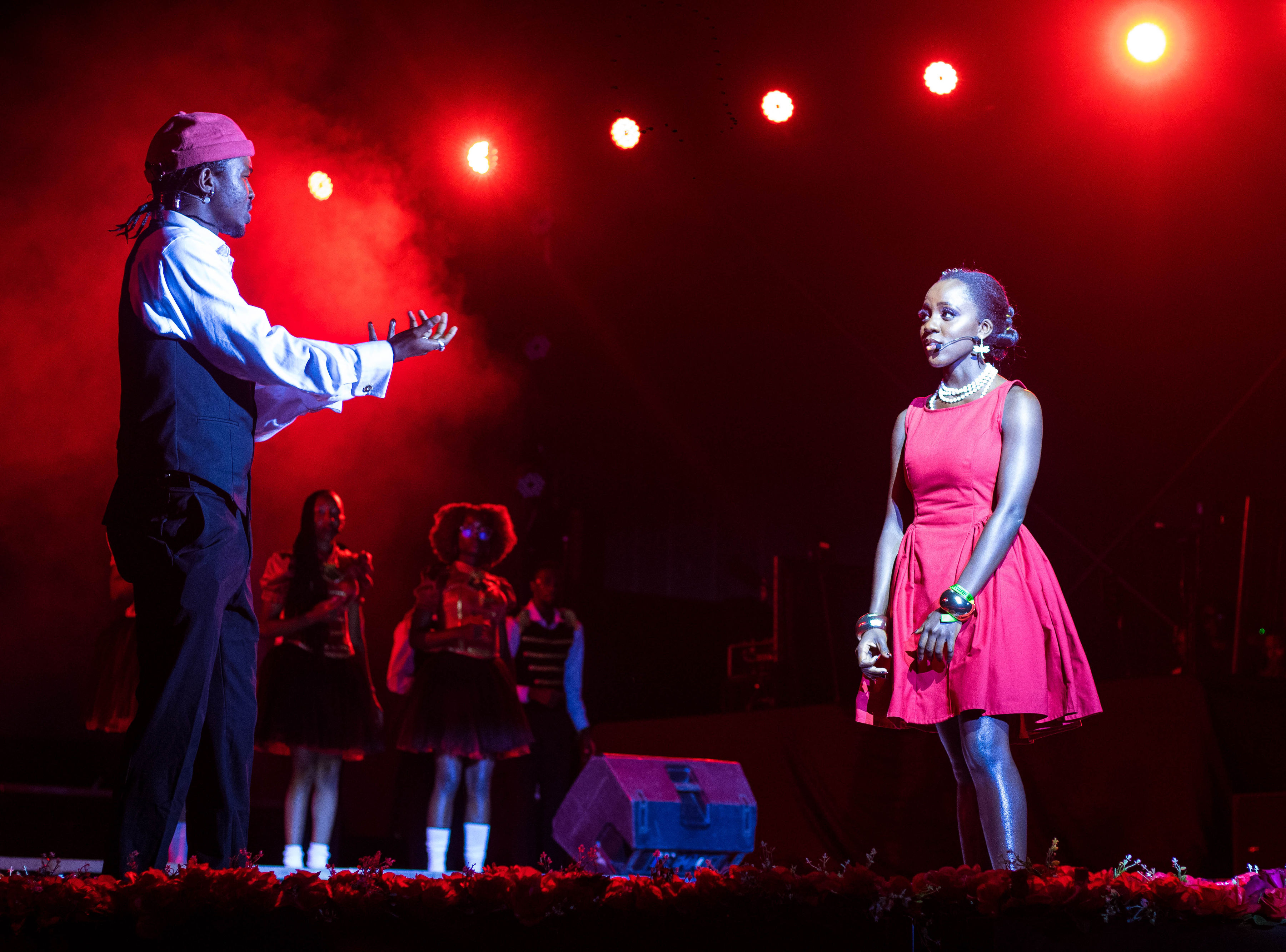
At the heart of it all were Lover Boy and Dream Girl, played with convincing tenderness and occasional chaos by Tobit Tom and Faith Wambui; two characters whose relationship forms the backbone of the entire production. Then there was The Herald, portrayed by Mercy Mutisya, who doubled as both narrator and scriptwriter, gliding in and out of scenes with spoken word pieces that stitched the story together like a careful seamstress. But then…then…you had the Greek Chorus, consisting of Ibrahim Muchemi, Fischer Maina, and Amina Hussein. And these three, without question, were my favourite part of the entire ensemble.
Because while
everyone else was busy falling in love, losing it, and finding it again, the
Greek Chorus had one clear, unwavering mission; to ensure that Lover Boy did
not know peace. Ever. They hovered at the edges of his joy, lurked in the
corners of his heartbreak, and when the inevitable breakup came - as it always
does in stories that want to mean something - they descended on him like agents
of chaos. Taunting him. Mocking him. Refusing to let him romanticise his own
suffering. At one point, as Lover Boy wallowed in heartbreak, Ibrahim steps
forward with the authority of a man who has seen too many of his friends make
poor emotional decisions and declares; “Mwanaume ni kuamka asubuhi na kulock
in,” before promptly forcing him into push-ups, as if physical exertion might
somehow bench-press the pain out of his system.
And somehow, beneath all that humour and mischief, the story still held its shape. Because what unfolded across those six episodes was, at its core, a familiar but deeply effective arc. Love found, love strained, love lost, and because this is still a story that believes in second chances, love rediscovered. By the time Lover Boy and Dream Girl find their way back to each other, older, slightly bruised, but wiser in the ways that only heartbreak can teach, the reunion feels earned. And in a final, almost poetic twist, their union is formalised at the altar, presided over by Nyashinski himself, holding what appears, at first glance, to be a Bible, but is in fact something far more personal; a collection of thoughts, ideas, and fragments he has been quietly gathering over the years, now brought together into this day…this moment…this masterpiece of a show.
And then there was the machinery behind the magic; the choir, the dancers, the acrobats, each one moving in and out of the story like well-placed brushstrokes on a canvas that refused to sit still. They were not background, they were texture, tension, punctuation. At one point, as Nyashinski held the arena in song, a tiny acrobat girl began to climb a silk rope that disappeared into the ceiling, twisting herself upward with a calmness that felt almost disrespectful to gravity itself. And just when you had adjusted to her being up there, somewhere between art and risk, she let go. Not slipped. Not fumbled. Let go. She dropped in one clean, terrifying motion, slicing through the air and stopping just short of planting her head onto the stage. I had seen the move during rehearsals. I knew it was coming. And yet, in that moment, my heart still rose to my throat like it had been personally betrayed. That’s the thing about live performance, you can know the trick and still fall for the magic.
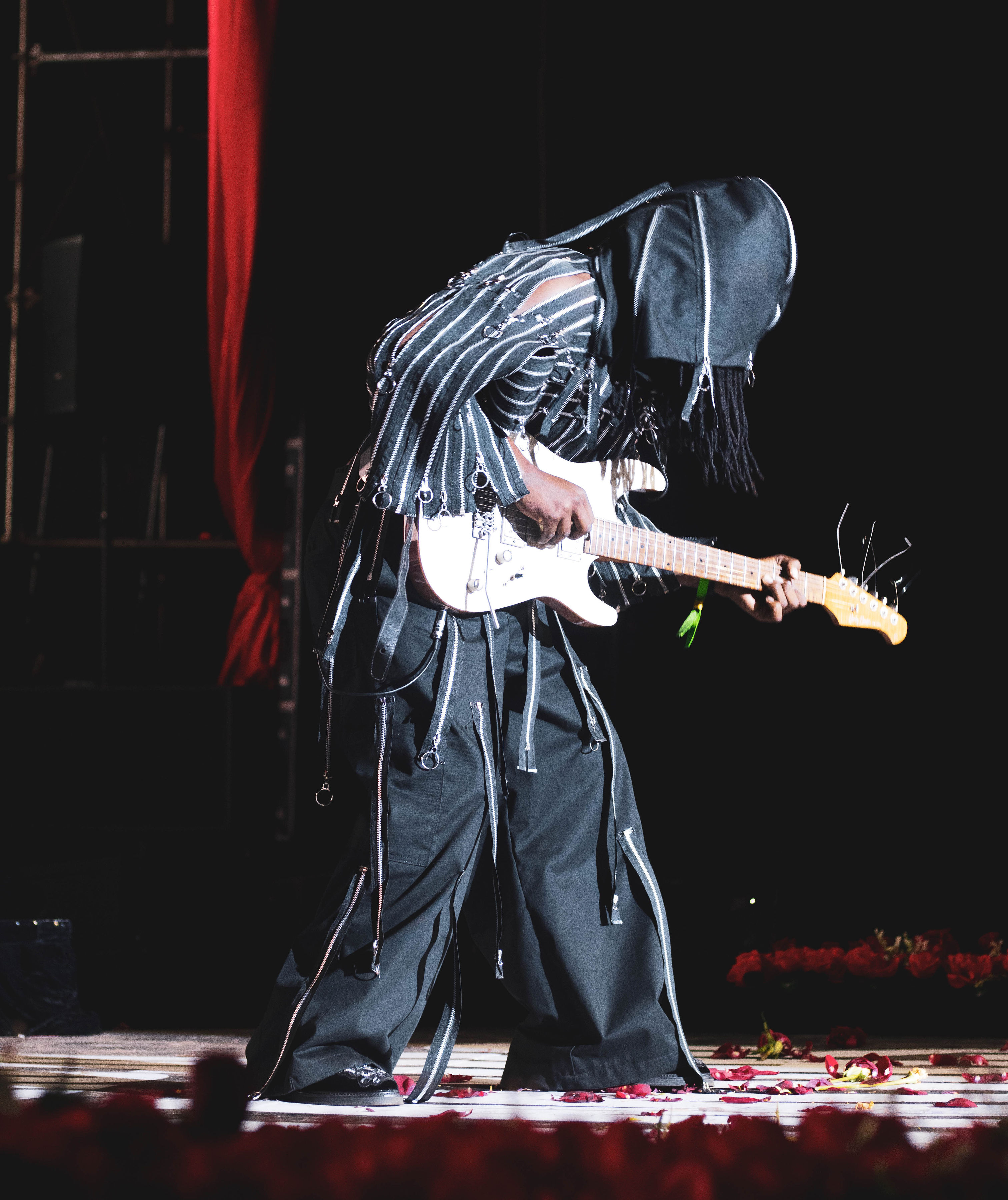
Then there was guitarist Peti Masupo, a dreadlocked yet quiet-looking chap who treated the stage less like a platform and more like a playground that owed him rent. At one point he sprinted across it with reckless commitment, and at another, he was hoisted into the air, suspended mid-performance, still strumming that guitar with the kind of wild, unbothered energy that makes you wonder whether the instrument is an extension of him or the other way around. It wasn’t just playing, it was possession.
Faces flickered in
quiet succession: Rex Masai,
E-Sir, Nameless and Wahu, Collins Injera,
Naiboi, Khaligraph Jones, Sauti Sol, Mzee Ojwang, Leonard Mambo Mbotela, Papa Shirandula, Juliani, Conjestina Achieng, Them Mushrooms, Wangari Maathai, Joe Kadenge, Njeri Migwi, Queen Jane, Tom Mboya…and then, finally, Baba.
When that image of
Raila
Amollo Odinga came
across the screen, suddenly, unmistakably, and heavy with everything his name
carries in this country, something shifted in me. Not loudly, not dramatically,
just enough to catch me off guard. Exactly three tears - three, not two, not
four, I counted - slipped down my face with the quiet precision of a moment
that had decided, without consulting me, that it mattered. I glanced across the
aisle, the way you do when you need confirmation that you’re not the only one
feeling things you didn’t budget for, and there was Willis Raburu, trying to act composed but only just standing
on the edge of the same emotional cliff.
So I did the only
sensible thing a grown man in that situation can do. I called over one of the
tequila girls and asked her to pour me a shot, and to take one across to Willis
as well. No long speeches, no dramatic acknowledgements. Just a quiet, mutual
understanding. We raised those glasses in the air, a small, steady salute
across the room, and knocked them back in unison, balancing tears and tequila
with the kind of discipline you don’t learn in a classroom. It was, in its own
strange way, a toast to everything happening at once; to the weight of legacy,
to the emotions the moment had stirred, and to the undeniable realization
settling in that this show, this carefully constructed, beautifully executed
spectacle, was beginning to take its final bow.
A Bible, a Dream...and Ksh.40 million:
The Genesis
After the show, once the lights had softened and the adrenaline had begun its slow, reluctant exit from the room, I caught up with Nyashinski’s manager and the show’s overall director, Fakii Liwali, a man who by this point looked like he had just successfully landed a very large, very complicated aircraft. When we asked him about the genesis of the entire idea, he spoke about it less like a sudden spark and more like a slow, deliberate build. This, he said, had been living in Nyashinski’s mind for a long time, but it really began to take shape after Shin City in 2022, when the question shifted from what next? to how do we elevate this?
Somewhere along that journey, Nyashinski began sketching his thoughts into what the team internally refers to as ‘the Bible,’ a physical notebook that carried the DNA of the entire show. (Remember it? From Lover Boy and Dream Girl wedding up there? Okay, here's a photo, ptho!)
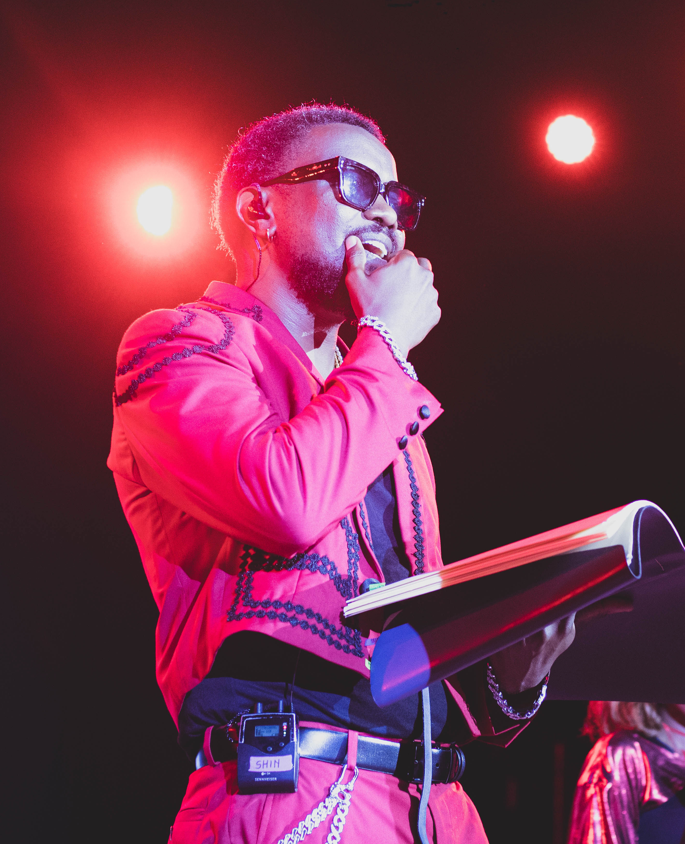
“That’s where he started drawing up the idea of what he wanted to do,” Fakii explained, adding that the vision was also inspired by global productions like Michael Jackson’s This Is It and The Greatest Showman, before being carefully reinterpreted through Nyashinski’s own music and storytelling lens.
From there, the
world of Lover Boy, Dream Girl, and the surrounding cast was born, characters
designed to carry a love story that would thread seamlessly through his
catalogue. Once that framework was in place, it was handed over to a wider
creative team consisting of names like Mugambi Nthiga, Queen Gathoni, and Mercy
Mutisya, who then translated it into a full script, pulling together choir,
dancers, acrobats, and actors into what would eventually become the show we
witnessed.
But perhaps the most striking part of that conversation wasn’t the creativity, it was the commitment. Because when we asked about funding, Fakii didn’t flinch. “The show is self-sponsored,” he said plainly, before clarifying that this was never about immediate returns. To them, this was a proof of concept, a statement piece meant to show what is possible when ambition is allowed to breathe. “The money is not the focus for us for this particular one… it will come later,” he added, almost dismissively, as if Ksh.40 million - Yes, they spent forty million on the 7 shows - was just a necessary inconvenience on the road to something bigger.
In a twist
that felt both poetic and practical, he pointed out that the real backers of
the show were the fans themselves. “When they buy tickets, they’re actually
paying for this,” he said, grounding the spectacle back to the people it was
built for. That long-term thinking also explains moves like Nyashinski’s
partnership with Sony Music; a strategic step, Fakii noted, to push beyond
Kenyan and East African borders, expand streaming reach, and tap into global
publishing structures. In other words, this wasn’t just a show, it was a
signal. A declaration that the ambition had already outgrown the room, and was
now looking outward.
Let me take you
back a little bit, for some background. A week before the show, I had walked over
to my boss and inquired about passes to The
Showman Residency. He
gave me a calm, confident assurance that things will be handled. A few minutes
after he left the office, he called me from his car and said Fakii had reached
out and asked that I be sent over to the rehearsals. Now, I don’t know what
alignment of stars made that timing possible, but I wasn’t about to ask
questions that could potentially reverse the blessing. I simply showed up.
And what I walked
into was not just preparation, it was obsession, carefully disguised as
process. There, in that rehearsal space, I watched Nyashinski in his element, and it quickly became
clear that the polish we admire on stage is paid for in private, one
painstaking correction at a time. He was meticulous to a fault. A perfectionist
in the most unapologetic sense of the word. He would stop mid-performance, not
because he had forgotten a line, but because the light was a fraction too late,
or a fraction too dim; because a character’s stance was off by inches; because
one flag, just one, was not moving in harmony with the rest; because a visual
on the screen didn’t quite match the feeling he was chasing. And then they
would reset. Again. And again. And again.
I sat through it
all, the repetitions, the pauses, the quiet recalibrations, as the team circled
the same moments over and over, sanding them down until there were no rough
edges left to betray the illusion. And somewhere in between those restarts and
refinements, it dawned on me that what we would later applaud as effortlessness
was, in fact, the result of a relentless refusal to settle.
Then midway
through they called for a lunch break, and I, being both a journalist and a
professionally curious nuisance, took that as my cue to wander over to the
show’s director and script architect, Mugambi Nthiga, and politely interrupt
his peace. I asked him what had been quietly forming in my mind since I walked
into that rehearsal space: What exactly possessed you people to turn a
concert into theatre?
He smiled and
explained that from the very beginning, Nyashinski
“wanted something that incorporated theatrical elements,” an idea he had been
carrying even before the rest of the team was brought in. But ambition, as he
put it, comes with its own anxieties; they were very aware of the risk that
audiences might enjoy one element and mentally check out of the other. “We
didn’t want it to be a reverse musical,” he said, “where you’re enjoying the
spoken bits and when you break into music, you switch off… or the other way
around.” The goal, then, was delicate but deliberate; to make sure the music
and theatre didn’t feel like separate acts awkwardly sharing a stage, but like
one continuous, breathing experience.
What struck me most as he spoke was how little ego seemed to exist in a project that could very easily have been consumed by it. Mugambi described a process that was less about hierarchy and more about harmony, where roles overlapped, ideas collided, and no one was overly protective of creative territory. “There really wasn’t any line,” he admitted, almost casually, explaining that Nyashinski had opened the floor for full collaboration, trusting the team to build around a central idea that guided everything.
When I pressed him on what that idea actually
was, the thing at the heart of all this movement, music, poetry, and spectacle,
he paused just long enough to make it feel intentional, then said simply: “It’s
all about love.” From there, the rest fell into place; the characters, the
arcs, the emotional beats, each one designed to reflect not just a story on
stage, but fragments of a society Nyashinski has been speaking to through his
music for years. The real challenge, he admitted, was making all those moving
parts fit together “like a puzzle piece” without losing the essence of the
whole. And listening to him, it became clear that this was never just about
putting on a great show, it was about stretching the boundaries of what a
Kenyan live experience can be, and then daring everyone else to catch up.
Afterwards, I wandered off in search of the man himself, Nyashinski, giving him just enough time to finish his meal, because even greatness deserves to eat in peace. When I finally caught up with him, I asked the obvious question: how do you go from being known for music to orchestrating something this layered, this theatrical, this… ambitious? He paused, as if weighing whether the answer could even fit into words, before admitting, almost casually, that it wasn’t one singular decision but “many things coming together.” He spoke about watching international shows and wondering, “how can we do this here at home in a way that makes sense?” A question that feels simple until you realise how few people actually attempt to answer it.
But more than that, he
pointed to the abundance of talent across disciplines in Kenya; actors,
dancers, acrobats, choirs, and how rarely music platforms make room for them.
“If you go for a play, you’ll find them playing our music,” he said, almost
amused, “but when you come to a concert, you rarely see any acting.” And
somewhere in that imbalance, the idea began to take shape, not just as a show,
but as an exchange. A deliberate effort to create something that allows each
craft to stand in its full light. “It’s a great honour… a dream come true,” he
added, “to expose our audience to something as magical as this.”
And yet, for all the vision and conviction, there was no pretending that this was easy territory to step into. When I asked him what, exactly, scares him about constantly being the first to try these things; there was the comeback, then the Shin City experience, and now a first-of-its-kind residency, he shrugged it off with the quiet philosophy of a man who has learned to move before doubt can catch up. “I just move by faith,” he said, simply. “The tip of the spear always gets the most headwind.” It’s the kind of line that sounds like a quote until you realise he actually lives it.
He spoke
about responsibility too, about occupying a position where, if he doesn’t push
boundaries, others might assume those boundaries are fixed. And so he pushes,
not just for himself, but as a signal to the artists coming up behind him, that
there is always another level, another way to evolve, another ceiling to test.
But beneath all that courage and forward motion, there was one challenge he
didn’t dress up: the cost. The investment, he admitted with a slight chuckle,
was a headache, citing a team that runs close to a hundred people. And beyond
that, the difficulty of translating a vision this complex into something others
can see before it exists. “It’s hard to put that into words… too many
elements,” he said. But once the team understood, once the rehearsals began to
align and the pieces started falling into place, everything else became, in his
words, “pretty much downhill.”
And so now, once again, here I am, in my dark, little corner, after all
the lights have dimmed and the last note has settled. I find myself unable to return to that neat, confident declaration
I once made, that Nyashinski is the G.O.A.T. Because the more I think about it,
the more that title feels… insufficient. Too human. Too grounded. It suggests
limits, comparisons, a ranking among equals, as though he exists on the same
scale as everyone else.
But what I
witnessed was not a man competing. It was a man creating, curating,
orchestrating entire worlds with the patience of a craftsman and the audacity
of someone who does not ask what is possible, but decides it. And maybe that’s
the real problem with the G.O.A.T conversation, it assumes he is playing the
same game as everyone else. Perhaps he isn’t. Perhaps he hasn’t been for a
while now. Because if greatness is about dominance within a field, then what do
you call a man who keeps redefining the field itself?
No, Nyashinski may no longer fit comfortably in the category of the greatest of all time. And maybe that’s because, on a night like this, he didn’t think, move, or create like a man at all. Maybe we’ve been using the wrong word all along, because that wasn’t a G.O.A.T on stage, that was a god.
Join the Discussion
Share your perspective with the Citizen Digital community.
No comments yet
This discussion is waiting for your voice. Be the first to share your thoughts!