
Equity keeps the handle as Kenya’s largest, most profitable bank
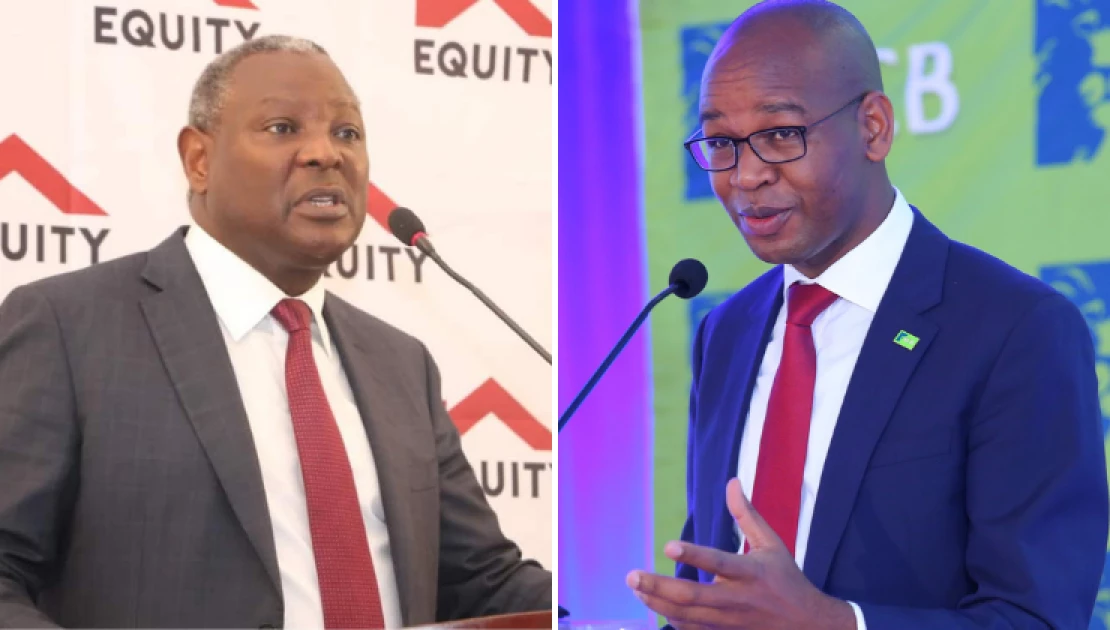
Equity Group CEO James Mwangi and KCB boss James Oigara.

Audio By Vocalize
This is after posting a 98 per cent jump in net profit for the 12 months to Ksh.39.2 billion from Ksh.19.8 billion in 2020.
Equity’s asset base has meanwhile topped an asset base of Ksh.1.3 trillion having expanded from a flat Ksh.1 trillion balance sheet a year prior.
The grip which not only transcends the country but also the region sees Equity stay ahead of KCB Group which represents the closest peer and proverbial arch-rival in the industry.
Like a noisy neighbour in the theatres of competitive sports, KCB remains within striking distance with an asset base of Ksh.1.140 trillion and with Ksh.34.1 billion in net profits for the year ended December 31.
Both of the banks' growth trajectory over the past year are a near carbon copy of each other with Equity growing its total operating income by 21 per cent to Ksh.113.4 billion while KCB’s net income was up by 13.5 per cent to Ksh.108.6 billion.
The pair of lenders have benefited from rebounding loan repayments by customers and ongoing digitization to grow both their net interest and non-interest funded income (NFI) over the last 12 months.
Operating costs by the pair nevertheless differed with Equity trimming expenses by 15.4 per cent to Ksh.61.5 billion against KCB’s 11.9 per cent hiked expenses which stood at Ksh.47.8 billion at the end of the year.
This is despite both banks trimming their provisions for bad loans by 78.2 per cent for Equity and 52 per cent for KCB to Ksh.13 billion and Ksh.5.8 billion respectively.
Besides greater income and leaner costs, both Equity and KCB have leveraged mergers and acquisitions (M&As) to expand regionally with both becoming forces to reckon with in the region.
Last year Equity completed the acquisition of Banque Commerciale Du Congo which put the bank at pole position to dominate the market while KCB acquired a controlling stake in the Banque Populaire Du Rwanda (BPR) to bolden its size in the country.
Despite failing to capture BancABC in Tanzania, KCB is betting on more acquisitions to grow its regional stake even as its primary focus remains on taking a piece of the DRC banking scene.
“We intend to push for DRC from the market opportunity we see and the integration of regional countries. The Northern Corridor is very important for us. Our interest in Tanzania does not negate our ambition for growth in the DRC market,” KCB Group Managing Director Joshua Oigara said on Wednesday last week.
For Equity, it may be a cooldown in terms of taking new banks but the lender says it is ready to dip its foot back to M& A action as and when the opportunity presents itself.
“Mergers and acquisitions have always remained part of our strategy. The assets must however be right and must be in a market we have strategically planned for. At the moment, there is nothing on the table but if something came across, we would evaluate it within the Group’s M&A policy,” said Equity Group Managing Director James Mwangi.
Equity has a higher return on equity rate (RoAE) at 26.1 per cent versus 22.4 per cent for KCB but has a higher cost to income ratio at 49.1 per cent from KCB’s 44 per cent.
Equity’s cost of funds however stands at 2.7 per cent, narrowly beating KCB’s 2.8 per cent.
At the same time. Equity has a better asset quality with its gross non-performing loans (NPLs) as a share of gross loans standing at 8.3 per cent in comparison to KCB’s 16.5 per cent.
However, KCB has a wider regional footprint which comprises 28.4 million customers and 492 branches in five countries against Equity’s customer base of just under 17 million.
Equity and KCB are set to pay out dividends of Ksh.9.6 billion and Ksh.11.3 billion respectively.
The pair has a combined asset base of Ksh.2.443 trillion.
Join the Discussion
Share your perspective with the Citizen Digital community.
No comments yet
This discussion is waiting for your voice. Be the first to share your thoughts!