
A troubled Northern Corridor and corrupt watchdogs shrugging off as accidents claim lives
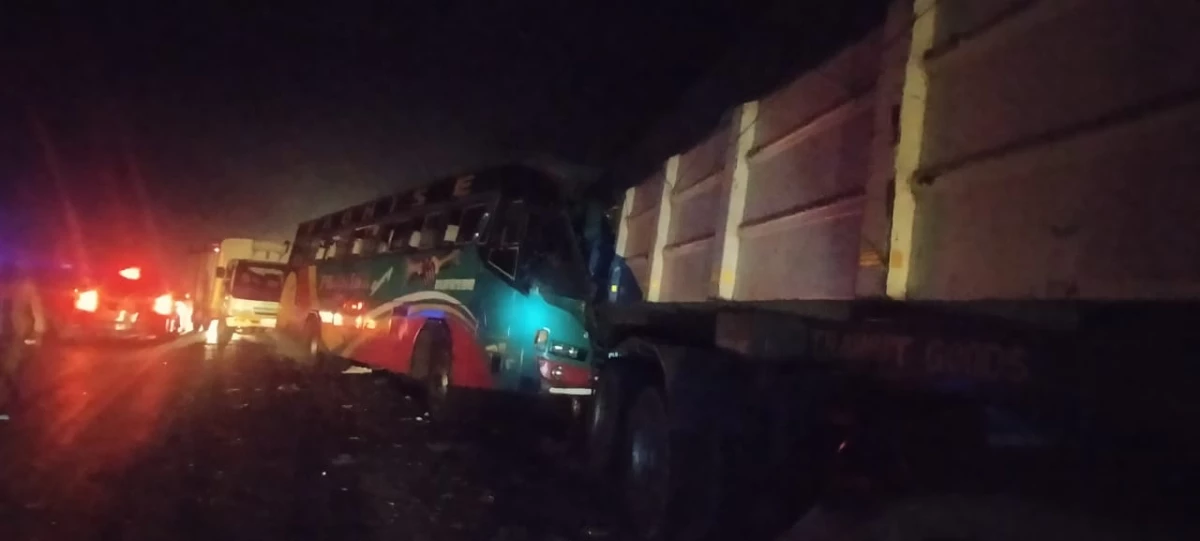
Vehicles involved in a road accident at Timboroa on Thursday, January 4, 2023. Photo/Handout

Audio By Vocalize
A good number of citizens were left wondering how lofty the solution to the ravaging carnage could be, while at the same time, a number of critical observers know where the weak link lies.
It is a pity that those who should fix the problem are at the very root of the accident malaise. It is a fact, that is seldom officially acknowledged, that corruption in Kenya is a big driver of the unbridled road carnage in the country.
Kenya's road traffic deaths have hovered around 4,000 annually for the past five years, albeit with fluctuations.
In 2021 the country recorded 4,579 deaths, 4,690 deaths in 2022, deaths recorded in 2023 were at 4, 324. The year 2024 recorded 4, 311, while over 4, 458 fatalities were reported in 2025, indicating a worrying upward trend, with pedestrians and motorcyclists most affected.
However, these are the officially recorded statistics, and observers say they could very well amount to under- reporting as many people die from road accidents in far-flung areas, which are neither reported nor recorded.
Towards the tail end of 2025 and the beginning of 2026, Kenya’s road carnage hit a peak, and this caught the attention of the police, the same office charged with enforcing traffic regulations and laws.
They decried the sharp increase in road accidents, describing the situation as a crisis requiring “urgent and decisive action.” According to initial analysis by road safety authorities, most of these accidents were due to preventable human error.
The police cited reckless driving, driver fatigue, speeding, and drunk-driving as leading contributors to the reported accidents. Persistent violations by commercial motorcycle riders (known locally as Boda-boda riders), who habitually ride against traffic and on pedestrian walkways, were also singled out as a major risk factor.
The police also claimed they had been working closely with the National Transport and Safety Authority (NTSA) and other transport stakeholders under a multi-agency framework to enforce the Highway Code, but as is evident, it has borne little fruit.
Doomed Northern Corridor
Data gleaned from the police reports indicate that fatal crashes are highly concentrated in a few locations. 45.7% of fatalities are located in 8 (out of 47) counties representing 32% of the population. The data shows road accidents are highly concentrated on specific roads.
Many road accidents occur within the Northern Corridor, which is responsible for a large share of fatalities that occur in the counties that this corridor crosses. The Northern Corridor roads in Kenya refer to the major roads connecting the Port of Mombasa to landlocked East African nations, including the Mombasa to Nairobi Road (A109), and parts of the Nairobi to Malaba Highway (A1).
These roads facilitate road transit into Uganda, Rwanda, Burundi, South Sudan and Eastern DRC, supporting regional trade and integration.
Nairobi, as a county, is a hotbed for road accidents. Five roads in Nairobi County, which constitute 2% of its road network, account for 36% of all fatal accidents in the county. While 26% of accidents in Nairobi are responsible for 30% of all accidents in the country, these occur between 7 pm and 10 pm.
The time frame here, which is after the peak-rush hours, allows for freer roads and hence higher speeds. With reduced visibility, high speeds easily lead to road accidents, which could be made worse while driving under the influence of alcohol.
Corruption undermining traffic laws
Corruption, the big worm in the wood, is neither ‘seen’ nor ‘heard’ in road accident discussions, but it is there. In undertaking road infrastructure plans, old and new, corruption walks into the big offices, and it negatively influences the design and implementation of many roads in the country.
As a result, the public gets inferior roads, and in the process, some roads become death traps. Corruption is not done yet; it ventures further into the road and transport sector, where the enforcement officers enthusiastically welcome the vice.
Here, it goes to work by systematically undermining the enforcement of traffic laws, regulations and order, and thereby compromising the integrity of safety on the roads. Enforcement officers are culpable for allowing brazen flouting of road rules, mainly by public transport vehicles and influential citizens.
They look aside as unqualified drivers take the road; they allow road-unworthy vehicles on the roads, and the most brazen yet is when they set up extortion roadblocks each day to demand bribes from motorists, pocketing millions to the consternation and chagrin of many Kenyans.
This assertion is buttressed by a report released by the NTSA in 2023 that observed that there is an important interaction between enforcement and behavior. The NTSA notes that based on 198 breathalyzer tests conducted in Nairobi in 2023, 52% of which were above the legal limit, never appeared in court and therefore did not pay a fine.
To the broader purposes of safety, herein is a divergent view, that whereas the NTSA only rued the loss of income by those who never appeared in court to pay fines, the noble and main purpose of making a court appearance would be to serve justice.
If found culpable and sentenced, this would send a message to deter and desist from such behavior on the roads. More deterrent measures, away from court fines alone, such as community service for convicted offenders, might work towards a more powerful dissuasion tool for ‘would-be’ errant drivers.
Economics of road carnage and human behaviour
On the economic front, the carnage on our roads is having a significant impact felt significantly. Last year, in 2025, it is estimated that the economic cost of road accidents in Kenya reached as high as Ksh.800 billion annually, a figure which is representative of roughly 5% of Kenya's annual GDP, not to mention the unquantifiable human suffering, lost productivity, and vast weight of dependency accidents leave on families.
The government is aware of the high costs of road accidents to the economy and the accompanying human sufferings it brings to citizens of this country. It therefore, through the NTSA, came up with the National Road Safety Action Plan (2024 – 2028) to run for five years.
This action plan outlines the Government's commitment to reducing road traffic accidents and enabling all Kenyan roads to be safe for all road users. The Safety plan proposes working jointly in the coordination and implementation of these strategies.
But the sticky issue remains a worrying lack of coordination and collaboration between the various government agencies charged with policy, regulation and enforcement. The last time the Kenya Police and the NTSA tried working on the roads closely, the cost of bribery skyrocketed, and then there was the usual sibling rivalry of who has more authority on the road.
The resultant effect was that the NTSA were ordered by the president to get off the roads and concentrate on regulatory and policy aspects of road safety.
Whereas official police statements insist that the major causes of road accidents in Kenya are mostly linked to human behavior, vehicle condition, and road environment. Other police statements list the causes of road accidents in Kenya as poor road design and infrastructure, incompetent driving, drunk driving, road-unworthy vehicles on the road, pedestrian negligence, driver fatigue, extreme weather conditions, and “over-speeding.”
However, "over-speeding" is an amorphous term usually used by the Kenyan police to express that a car was going at a speed beyond the given limits for that stretch of road. Technically, the word “over-speeding” would mean an engine which is going beyond its design limits.
Untouched loopholes
Corruption, which is an enabler of most of these causes of road accidents, is not mentioned even in passing.
This is despite the Kenya Police consistently being ranked as the most corrupt institution in Kenya. Once again, it topped the 2025 Kenya Bribery Index by Transparency International (TI) Kenya, with an 84/100 score on the bribery index.
The institution is involved in nearly 40% of all bribes in the country, which is indicative of deep structural flaws despite repeated calls which have highlighted the urgent need to retrain traffic officers in public ethics, de-incentivize bribery, digitise police procedures and strengthen oversight from civilian bodies.
Meanwhile, the loopholes that make corruption in the police and the civil service very lucrative remain untouched. TI-Kenya says the police suffer from deep-rooted issues, including flawed recruitment exercises, weak oversight, impunity and a pervasive culture of corruption.
TI-Kenya is not the only organization to single out the Kenya police's poor reputation on corruption. In 2025, the Ethics and Anti-Corruption Commission (EACC) intensified efforts against Kenya Police corruption by launching systemic reviews, conducting arrests of officers for bribery and extortion, predominantly the traffic police, and highlighting deep-seated issues like daily bribe collection. This confirmed widespread graft requires urgent policy changes within the National Police Service (NPS). The EACC's investigations revealed systemic weaknesses, leading to recommendations for better governance and accountability to tackle routine corruption within the force.
A cycle of flaws
One of the important actions and findings by the EACC on the Kenya police traffic department and the NTSA took issue with how corruption within these entities led to weak enforcement of regulations.
They allow overloading vehicles, vehicles that speed beyond stated limits on given roads, a flawed licensing system, operating road-unworthy vehicles on the public roads, and tampering with essential safety gadgets like speed governors. This culture of impunity makes drivers feel they can disregard safety rules as long as they can "buy" their freedom.
Citing the NTSA, the EACC found that a flawed licensing system was key to the acquisition of fraudulent driving licenses. The EACC report also cited the flaws at the vehicle inspection centers by the NTSA, which went ahead to clear defective vehicles at a “fee,” not minding the fact that this amounted to significantly increased risks of fatal accidents.
The EACC observed a crippling culture of lack of accountability, which drives corruption within the judiciary and other law enforcement government agencies, as seldom do any government officials face consequences for their actions. This systemic failure perpetuates a cycle where safety is sacrificed for personal gain, and the public loses trust in public institutions meant to protect them.
In essence, corruption compromises every layer of the road safety system in Kenya, creating an environment where disregard for the law and safety standards is normalized, and human lives are lost as a direct consequence.
The Road Safety Action Plan 2024-28 over the next two years is a good blueprint that was meant to show how road carnage could be mitigated; however, political will is lacking.
The Action Plan, meant to achieve a minimum 50% reduction in deaths and serious injuries, as measured from a 2022 baseline, will soon turn out to be a mirage if corrective action is not taken today.
The five-year safety strategy should have been a period of immense potential, action and change; unfortunately, it will remain a window of potential that Kenya threw away.
Join the Discussion
Share your perspective with the Citizen Digital community.
No comments yet
This discussion is waiting for your voice. Be the first to share your thoughts!