
Battling to survive, Hamas faces defiant clans and doubts over Iran
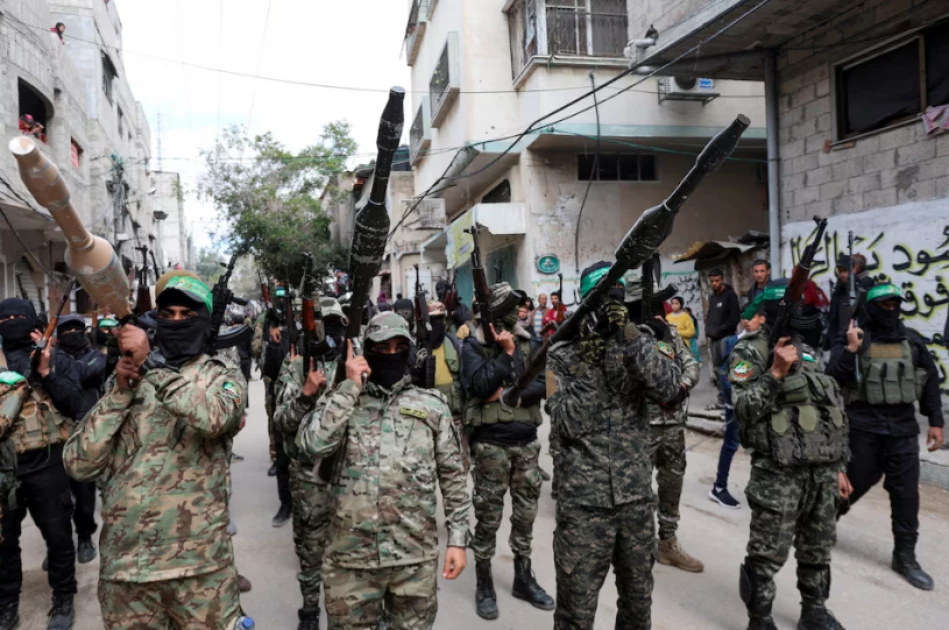
Hamas militants carry grenade launchers at the funeral of Marwan Issa, a senior Hamas deputy military commander who was killed in an Israeli airstrike during the conflict between Israel and Hamas, amid a ceasefire between Israel and Hamas, in the central Gaza Strip, February 7, 2025. REUTERS/Ramadan Abed/File Photo

Audio By Vocalize
Short of commanders, deprived of much of its tunnel network
and unsure of support from its ally Iran, Hamas is battling to survive in Gaza
in the face of rebellious local clans and relentless Israeli military pressure.
Hamas fighters are operating autonomously under orders to
hold out as long as possible, but the Islamist group is struggling to maintain
its grip as Israel openly backs tribes opposing it, three sources close to
Hamas said.
With a humanitarian crisis in Gaza intensifying international pressure for a ceasefire, Hamas badly needs a pause in the fighting, one of the people said.
Not only would a ceasefire offer respite to weary
Gazans, who are growing increasingly critical of Hamas, but it would also
allow the Islamist group to crush rogue elements, including some clans and
looters who have been stealing aid, the person said.
To counter the immediate threat, Hamas has sent some of its
top fighters to kill one rebellious leader, Yasser Abu Shabab, but so far he
has remained beyond their reach in the Rafah area held by Israeli troops,
according to two Hamas sources and two other sources familiar with the
situation.
Reuters spoke to 16 sources, including people close to Hamas,
Israeli security sources and diplomats who painted a picture of a severely
weakened group, retaining some sway and operational capacity in Gaza despite
its setbacks, but facing stiff challenges.
Hamas is still capable of landing blows: it killed seven
Israeli soldiers in an attack in southern Gaza on Tuesday. But three
diplomats in the Middle East said intelligence assessments showed it had lost
its centralised command and control and was reduced to limited, surprise
attacks.
An Israeli military official estimated Israel had killed
20,000 or more Hamas fighters and destroyed or rendered unusable hundreds of
miles of tunnels under the coastal strip. Much of Gaza has been turned to
rubble in 20 months of conflict.
One Israeli security source said the average age of Hamas
fighters was "getting lower by the day". Israeli security sources say
Hamas is recruiting from hundreds of thousands of impoverished, unemployed,
displaced young men.
"They're hiding because they are being instantly hit by
planes, but they appear here and there, organising queues in front of bakeries,
protecting aid trucks, or punishing criminals," said Essam, 57 a
construction worker in Gaza City.
Asked for comment for this story, senior Hamas official Sami
Abu Zuhri said the group was working for an agreement to end the war with
Israel, but "surrender is not an option".
Hamas remained committed to negotiations and was "ready
to release all prisoners at once", he said, referring to Israeli hostages,
but it wanted the killing to stop and Israel to withdraw.
Hamas is a shadow of the group that attacked Israel in 2023,
killing 1,200 people and taking another 251 hostage, according to Israeli
tallies. Israel's offensive has killed more than 56,000 people, according to
Gaza health authorities.
The damage inflicted by Israel is unlike anything Hamas has
suffered since its creation, with most of its top military commanders in Gaza
killed. Founded in 1987, Hamas had gradually established itself as the main
rival of the Fatah faction led by President Mahmoud Abbas and finally seized
Gaza from his control in 2007.
With a U.S.-brokered truce in the Iran-Israel war holding,
attention has switched
back to the possibility of a Gaza deal that might end the conflict and
release the remaining hostages.
One of the people close to Hamas told Reuters it would
welcome a truce, even for a couple of months, to confront the local clans that
are gaining influence.
But he said Israeli Prime Minister Benjamin Netanyahu's
terms for ending the war - including Hamas leaders leaving Gaza - would amount
to total defeat, and Hamas would never surrender.
"We keep the faith, but in reality, it doesn't look
good," the source said.
Yezid Sayigh, a senior fellow at the Carnegie Middle East
Centre in Beirut, said he believed Hamas was simply trying to survive. That was
not just a physical challenge of holding out militarily, he said, but above all
a political one.
"They face being eliminated on the ground in Gaza if
the war doesn't stop, but they also face being erased from any governing
formula that ends the war in Gaza (if such a thing can be found)," he
wrote in response to Reuters' questions.
Palestinian tribes have emerged as part of Israel's strategy
to counter Hamas. Netanyahu has said publicly that Israel has been arming clans
that oppose Hamas, but has not said which.
One of the most prominent challenges has come from Abu
Shabab, a Palestinian Bedouin based in the Rafah area, which is under Israeli
control.
Hamas wants Abu Shabab captured, dead or alive, accusing him
of collaboration with Israel and planning attacks on the Islamist group, three
Hamas sources told Reuters.
Abu Shabab controls eastern Rafah, and his group is believed
to have freedom of movement in the wider Rafah area. Images on their Facebook
page show their armed men organising the entry of aid trucks from the Kerem
Shalom crossing.
Announcements by his group indicate that it is trying to
build an independent administration in the area, though they deny trying to
become a governing authority. The group has called on people from Rafah now in
other areas of Gaza to return home, promising food and shelter.
In response to Reuters' questions, Abu Shabab's group denied
getting support from Israel or contacts with the Israeli army, describing
itself as a popular force protecting humanitarian aid from looting by escorting
aid trucks.
A Hamas security official said the Palestinian security
services would "strike with an iron fist to uproot the gangs of the
collaborator Yasser Abu Shabab", saying they would show no mercy or
hesitation and accusing him of being part of "an effort to create chaos
and lawlessness".
On Thursday, a tribal alliance said its men had protected
aid trucks from looters in northern Gaza. Sources close to Hamas said the group
had approved of the alliance's involvement.
Israel said Hamas fighters had in fact commandeered the
trucks, which both the clans and Hamas denied.
Palestinian analyst Akram Attallah said the emergence of Abu
Shabab was a result of the weakness of Hamas, though he expected it to fail
ultimately because Palestinians broadly reject any hint of collaboration with
Israel.
Nevertheless, regardless of how small Abu Shabab's group is,
the fact that Hamas has an enemy from the same culture was dangerous, he said.
"It remains a threat until it is dealt with."
Israel's bombing campaign against Iran has added to the
uncertainties facing Hamas. Tehran's backing for Hamas played a big part in
developing its armed wing into a force capable of shooting missiles deep into
Israel.
While both Iran and Israel have claimed victory, Netanyahu
on Sunday indicated the Israeli campaign against Tehran had further
strengthened his hand in Gaza, saying it would "help us expedite our
victory and the release of all our hostages".
U.S. President Donald Trump said on Wednesday that great
progress was being made on Gaza, adding that the strike on Iran would help get
the hostages released.
A Palestinian official close to Hamas said the group was
weighing the risk of diminished Iranian backing, anticipating "the impact
will be on the shape of funding and the expertise Iran used to give to the
resistance and Hamas".
One target of Israel's campaign in Iran was a Revolutionary
Guards officer who oversaw coordination with Hamas. Israel said Saeed Izadi,
whose death it announced on Saturday, was the driving force behind the
Iran-Hamas axis.
Hamas extended condolences to Iran on Thursday, calling
Izadi a friend who was directly responsible for ties with "the leadership
of the Palestinian resistance".
A source from an Iran-backed group in the region said Izadi
helped develop Hamas capabilities, including how to carry out complex attacks,
including rocket launches, infiltration operations, and drones.
Asked about how the Israeli campaign against Iran might
affect its support for Hamas, Abu Zuhri said Iran was a large and powerful
country that would not be defeated.
Join the Discussion
Share your perspective with the Citizen Digital community.
No comments yet
This discussion is waiting for your voice. Be the first to share your thoughts!