

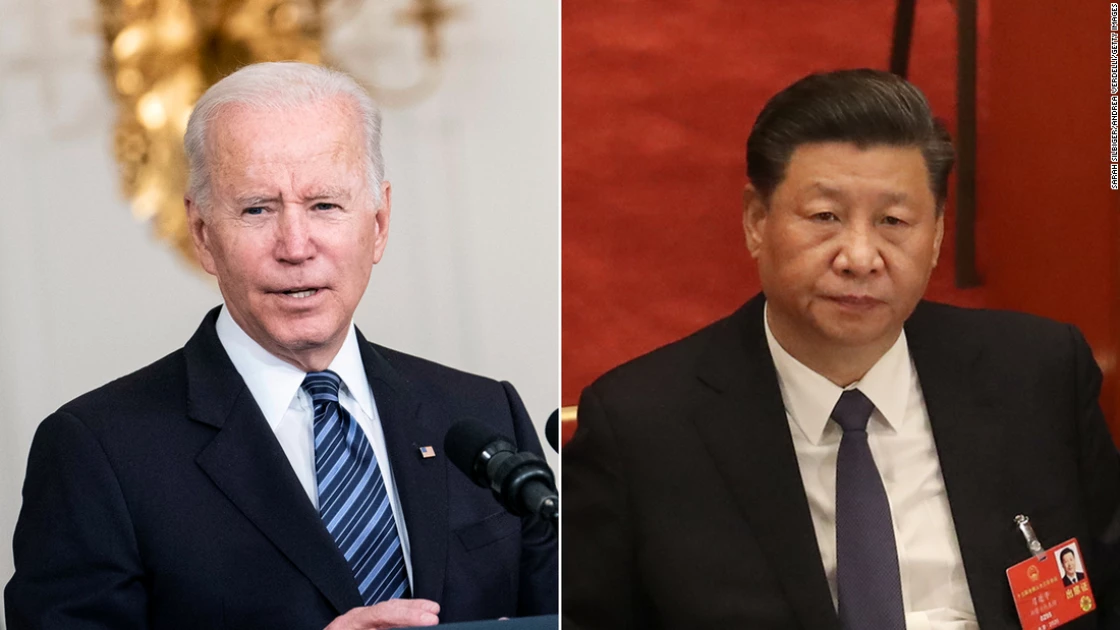
Biden speaks with China's Xi Jinping as tension grows over Taiwan

Audio By Vocalize
President Joe Biden
and his Chinese counterpart Xi Jinping held a lengthy and candid discussion
about Taiwan on Thursday as tensions mount between Washington and Beijing,
despite Biden's one-time hope of stabilizing the world's most important
country-to-country relationship.
The two leaders did
agree to begin arrangements for a face-to-face summit, their first as Xi
resists travel amid the COVID-19 pandemic. And certain areas of cooperation,
including climate change, were hashed out.
But the Taiwan issue
proved among the most contentious. The issue has emerged as a serious point of
conflict, as US officials fear a more imminent Chinese move on the
self-governing island and as a potential visit by House Speaker Nancy Pelosi prompts warnings from Beijing and a concerted effort by the Biden administration to
prevent tensions from spiralling out of control.
The matter was
discussed at length in the two-hour-and-17-minute phone call Thursday. Xi
offered an ominous warning to Biden, according to China's version of events.
"Public opinion
shall not be violated, and if you play with fire you get burned. I hope the US
side can see this clearly," he told Biden, according to China's state news
agency.
The White House's
account of the call was less specific.
"On Taiwan,
President Biden underscored that the United States policy has not changed and
that the United States strongly opposes unilateral efforts to change the status
quo or undermine peace and stability across the Taiwan Strait," a US readout
read.
A senior US
administration official called the Taiwan discussion "direct and
honest" but downplayed Xi's warning, suggesting it was standard for the
Chinese leader to warn about the risks of "playing with fire."
The phone call was
Biden and Xi's fifth conversation since February 2021. Ahead of time, US
officials said a range of topics -- from the tensions surrounding Taiwan to
economic competition to the war in
Ukraine -- were likely to arise.
But hopes for
substantially improving ties with Beijing were low. Instead, Biden's aides hope
maintaining a personal connection with Xi can, at most, avoid a miscalculation
that might lead to confrontation.
"This is the kind
of relationship-tending that President Biden believes strongly in doing, even
with nations with which you might have significant differences,"
communications coordinator for the National Security Council John Kirby said
this week.
As Thursday's call was
concluding, the two leaders made note of how much work they had created for
their teams, including arranging the possible in-person meeting. They have yet
to meet face-to-face as presidential counterparts.
An opportunity for a
summit could arise in November, when a series of summits will occur in Asia --
including the Group of 20 in Bali, Indonesia, and the Asia-Pacific Economic
Cooperation in Bangkok, Thailand. People familiar with the matter said US
officials are looking to arrange such a meeting on the margins of one of the
summits.
Planning for Biden's
phone call with Xi predated the furore over Pelosi's proposed visit to Taipei.
Neither side revealed whether Pelosi's plans were discussed specifically.
Biden is also
currently weighing whether to lift some Trump-era tariffs on China in a bid to
ease inflation, though White House officials said he hadn't yet made up his
mind and suggested ahead of time the topic wouldn't factor heavily into his
conversation with Xi.
Instead, it is China's
escalating aggression in the region -- including over Taiwan and the South
China Sea -- at the centre of the current tensions. US officials fear without
open lines of communication, misunderstandings could spiral into unintended
conflict.
That includes how
Beijing responds to Pelosi's potential visit to Taiwan.
Administration
officials have been working quietly over the past week to convince
the House speaker of the risks inherent in visiting the self-governing island.
Defense Secretary Lloyd Austin said Wednesday he'd spoken to Pelosi to provide
his "assessment of the security situation."
Pelosi has not made
any announcements about her plans for a trip, which haven't been finalized.
"I never talk
about my travel. It's a danger to me," she said Wednesday.
Yet even unofficial
word that the third-in-line to the US presidency was considering a visit to
Taiwan prompted an outsized response from Beijing, which considers visits by
top-ranking American officials a sign of diplomatic relations with the island.
"If the US
insists on taking its own course, the Chinese military will never sit idly by,
and it will definitely take strong actions to thwart any external force's
interference and separatist's schemes for 'Taiwan independence,' and resolutely
defend national sovereignty and territorial integrity," Ministry of
Defense Spokesperson Tan Kefei said Tuesday in response to questions over
Pelosi's reported trip to Taipei.
The White House called
those comments "unnecessary" and "unhelpful," saying the
rhetoric only served to escalate tensions "in a completely unnecessary
manner."
They also revealed
what US officials have said is a misunderstanding by Chinese officials over the
significance of Pelosi's potential visit. The officials said China may be
confusing Pelosi's visit with an official administration visit since both she
and Biden are Democrats. Administration officials are concerned that China
doesn't separate Pelosi from Biden much, if at all.
That adds pressure to
Biden's call with Xi. Officials were circumspect about whether Pelosi's visit
would arise, or how much it would factor into the conversation. But China's
apparent confusion over the differences between the White House and Congress
could inject a level of personal animus into the talks.
Administration
officials' concerns over Pelosi's trip are rooted partly in its timing. It
would come at a particularly tense moment, with the upcoming Chinese Communist
Party congress during which Xi is expected to seek an unprecedented third term
putting pressure on the leadership in Beijing to show strength. Chinese party
officials are expected to begin laying the groundwork for that conference in
the coming weeks.
With China recently
reporting its worst economic performance in two years, Xi finds himself in a
politically sensitive situation ahead of the important meeting.
Biden and Xi spent
many hours in each other's company when each was his country's vice president,
travelling across China and the United States to form a bond.
Biden last spoke to Xi
in March, when he worked to convince the Chinese leader not to support Russia amid
its invasion of Ukraine. Officials have been watching closely how Beijing
responds to the invasion, hoping the mostly united western response --
including a withering set of economic sanctions and billions of dollars in arms
shipments -- proves to illuminate as China considers its actions toward Taiwan.
US officials believe
there's a small risk China would miscalculate in responding to a potential
Pelosi visit. Biden administration officials are concerned that China could
seek to declare a no-fly zone over Taiwan ahead of a possible visit as an
effort to upend the trip, potentially raising tensions even further in the
region, a US official told CNN.
That remains a remote
possibility, officials said. More likely, they say, is the possibility China
steps up flights further into Taiwan's self-declared air defense zone, which
could trigger renewed discussions about possible responses from Taiwan and the
US, the US official added. They did not detail what those possible responses
would entail.
Leave a Comment