

Gov’t signs deal to restore Ngong Forest, boost community livelihoods
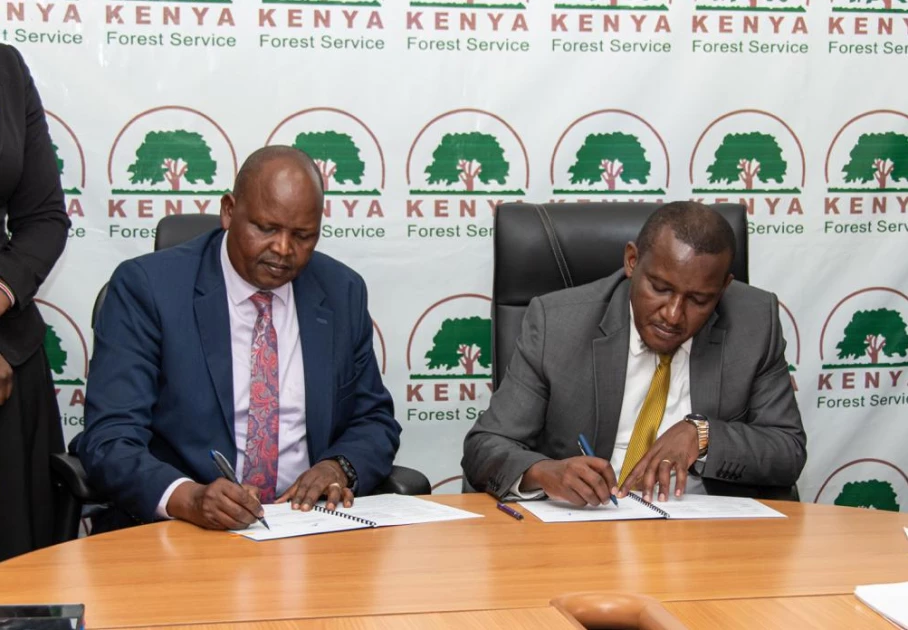
Chief Conservator of Forests Alex Lemarkoko and Irrigation PS Ephantus Kimotho sign an agreement under the Ngong Forest Integrated Conservation and Livelihood Improvement Programme (ICLIP) on Thursday, March 26, 2026. PHOTO | COURTESY

Audio By Vocalize
The government has signed a framework agreement with the Kenya Forest Service (KFS) to restore Ngong Forest while enhancing community livelihoods through conservation-linked initiatives.
Principal Secretary for Irrigation Ephantus Kimotho and
Chief Conservator of Forests Alex Lemarkoko signed the agreement on Thursday,
marking what officials described as “a significant milestone in advancing
sustainable forest management and climate resilience under the Ngong Forest
Integrated Conservation and Livelihood Improvement Programme (ICLIP).”
Ngong Forest, which comprises three blocks: Oloolua, Kibiko
and Ngong Hills, is expected to benefit from the partnership that seeks to
restore degraded ecosystems while integrating community-driven approaches to
conservation.
A key component of the framework is large-scale tree
planting and forest restoration, including the establishment of a modern tree
nursery with a capacity of 1 million seedlings and the planting of 350,000
trees over the next three years.
The initiative will also include strategic fencing to protect
rehabilitated areas, as highlighted during a recent resource mobilisation dinner where stakeholders
committed funds towards fencing 23 kilometres out of the targeted 25 kilometres
of Oloolua Forest.
Restoration efforts are already underway, with activities
launched during the International Day of Forests on March 21, where 3,000 trees
were planted, and 2,000 fruit trees donated to surrounding communities.
To further drive public participation, organisers have
scheduled a marathon on April 25 to rally stakeholders and citizens around
environmental conservation.
The framework also places strong emphasis on improving
livelihoods for communities living around the forest through initiatives such
as beekeeping and the establishment of modern tree nurseries.
“These interventions are designed to empower surrounding
communities while reducing reliance on forest resources,” stated PS Kimotho.
Additional measures under the programme include borehole
development to enhance water security, rollout of clean cooking solutions to
reduce deforestation, installation of solar systems to promote renewable
energy, and strengthening of Mazingira Clubs to promote environmental
stewardship among young people.
The project will be implemented under strict environmental
and social safeguards, with KFS leading the Environmental and Social Impact
Assessment (ESIA) process alongside public participation to ensure
transparency, sustainability and community ownership.
Leave a Comment