

New Philippine President Marcos Jr. praises dictator father during inauguration address
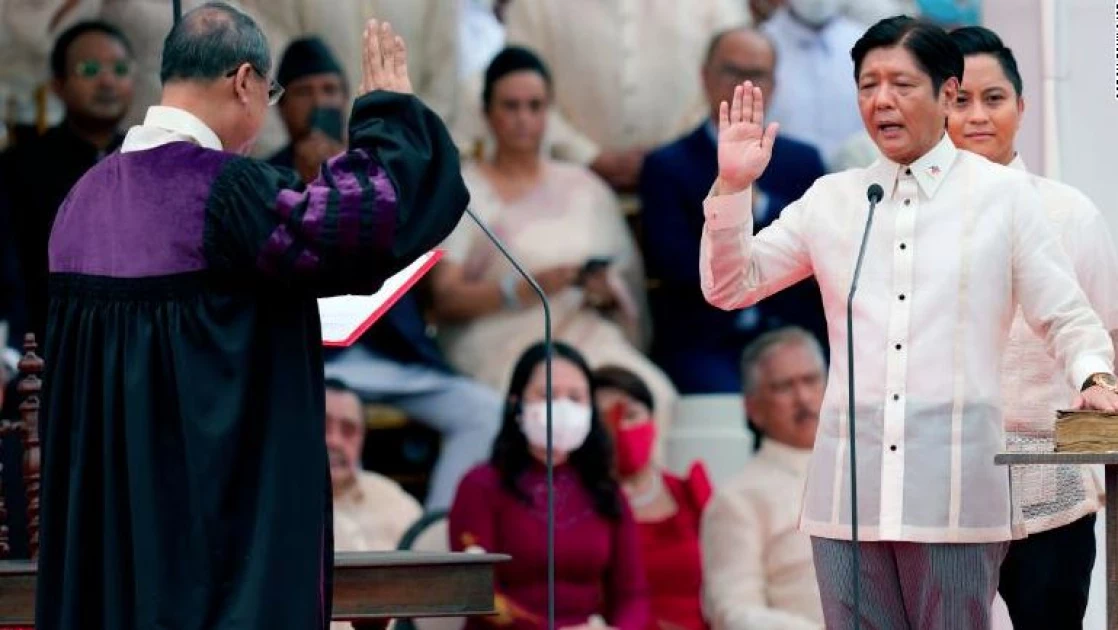
Ferdinand "Bongbong" Marcos Jr. is sworn in as President of the Philippines by Supreme Court Chief Justice Alexander Gesmundo at National Museum on June 30 in Manila, Philippines.

Audio By Vocalize
Ferdinand Marcos Jr. was sworn in as the 17th
President of the Philippines on Thursday, restoring one of the country's most
notorious political dynasties to the Malacañang Palace 36 years after his
father was ousted in a popular uprising.
Marcos Jr., known as "Bongbong" in
the Philippines, won by a landslide in May 9 elections on a platform of
national unity and a promise of more jobs, lower prices and more investment in
agriculture and infrastructure.
But critics say his rise to power was the culmination
of a decades-long attempt to rebrand the Marcos family's name and image, most
recently through a supercharged social media campaign.
Marcos Jr., 64, is the son and namesake of
late dictator Ferdinand Marcos Sr., whose 21-year kleptocratic rule of the
country from 1965 to 1986 was marked by human rights abuses, widespread
corruption, and plunder of the state coffers.
The former senator and congressman took his
oath of office at the National Museum of Fine Arts in the capital Manila before
Supreme Court Chief Justice Alexander Gesmundo, according to CNN affiliate CNN
Philippines.
In his inauguration speech, Marcos Jr. said
his "call for unity" resonated with the people to "deliver the
biggest electoral mandate in the history of Philippine democracy."
"This is a historic moment for us
all," he said. "You picked me to be your servant, to enable changes
to benefit all. I fully understand the gravity of responsibility you put on my
shoulders. I do not take it lightly but I am ready for the task."
Marcos Jr. thanked his mother, the
92-year-old former first lady Imelda Marcos, who attended the ceremony. He also
praised his father, the late dictator, in his speech.
"I once knew a man who saw what little
had been achieved since independence. In a land of people with the greatest
potential for achievement, and yet they were poor. But he got it done.
Sometimes with needed support, sometimes without. So will it be with his son --
you will get no excuses from me," he said.
Marcos Jr. spoke of healing divisions in the
country, promised to grow the economy, recover from the pandemic and lead a
more unified, prosperous country.
"I am here not to talk about the past, I
am here to tell you about our future. A future of sufficiency, even plenty, of
readily available ways and means to get done what needs doing," he said.
"I will get it done."
Activist groups planned to protest the
inauguration in Manila, calling for accountability for alleged crimes committed
under the Marcos Sr. dictatorship, CNN Philippines reported.
On Tuesday, Marcos Jr. survived a last-ditch
attempt to disqualify him when the Supreme Court unanimously ruled against two
petitions seeking to cancel his candidacy for alleged tax offenses, according
to CNN Philippines.
Marcos won the election with 31.6 million
votes, or 58.77% of ballots cast -- a margin not seen in decades -- and
replaces outgoing President Rodrigo Duterte.
His running mate, Sara Duterte-Carpio, the
former President's daughter, was sworn in as vice president on June 19, and
they will serve until 2028.
Marcos Jr. had previously asked the world to
judge him by his actions, not by his family's past.
But his election campaign was dominated by
his father's legacy, including the slogan "rise again" tapping into
the nostalgia of some who saw the period under Marcos Sr. as a golden era for
the country.
His father's corrupt and brutal rule of the
Philippines was bolstered by almost a decade of martial law from 1972 to 1981.
During that time, tens of thousands of people were imprisoned, tortured or killed
for perceived or real criticism of the government, according to human rights
groups.
The Presidential Commission on Good
Governance (PCGG), tasked with recovering the family's ill-gotten wealth,
estimates about $10 billion was stolen from the Filipino people.
The Marcos family has repeatedly denied
abuses under martial law and using state funds for their personal use.
Campaigners say the Marcoses were never held fully accountable and victims of
martial law are still fighting for justice.
Critics of Marcos Jr. see his rise to the
presidency as a whitewashing of Philippine history and an attempt by the Marcos
family to rewrite the abuses and corruption committed during his father's
dictatorship.
Marcos Jr.'s inauguration marks the end of a
six-year term for Duterte, whose bloody legacy is tied to a nationwide
crackdown on drugs that has claimed the lives of more than 6,000 people,
according to police.
Duterte's administration targeted civil
society and the media -- slapping tax evasion charges on local, independent
media outlets that challenged the government's policies and claims, and
arresting editors.
On Tuesday, Nobel Peace Prize laureate Maria
Ressa said the government had ordered her news organization Rappler to shut
down.
Outspoken Duterte was also known for a
history of disparaging remarks, including misogynistic comments about women,
the Catholic Church, and world leaders.
Some fear Marcos Jr. will continue down
Duterte's path and that disinformation will further obscure the truth, making
it harder to hold those in power accountable.
Despite his record on human rights and the
Covid-19 pandemic, which worsened the country's hunger crisis, Duterte remained
hugely popular domestically.
Supporters expect Marcos Jr. and
Duterte-Carpio to continue Duterte's policies on infrastructure and his
controversial "war on drugs."
Leave a Comment