
Petitioners accuse Parliament of contempt over IEBC commissioner gazettement
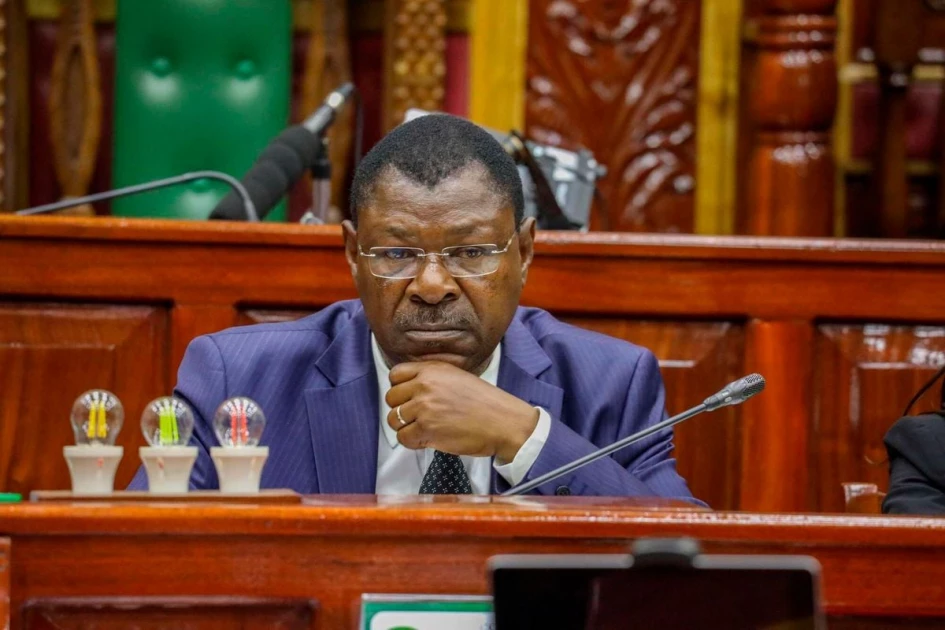
National Assembly Speaker Moses Wetang’ula.| FILE/National Assembly

Audio By Vocalize
Petitioners challenging the nomination
process of Independent Electoral and Boundaries Commission (IEBC) commissioners
have told the Milimani Law Court that the respondents are in contempt of court
for gazetting the commissioners despite existing court orders.
Led by lawyer Paul Muite, the petitioners on
Monday argued that the National Assembly, under the leadership of Speaker Moses
Wetang’ula, defied orders from both the High Court and the Court of Appeal.
"It is our submission that the
National Assembly—whose Speaker is Moses Wetang’ula, who happens to be my
personal friend—has acted in contempt," Muite told the court. "This
court has already found that he cannot serve as both the Speaker and the
Chairman of Ford-Kenya."
He emphasized the Speaker’s central role in
the legislative process, asserting that Wetang’ula’s defiance directly
undermines the authority of the judiciary.
On the urgency raised by the respondents
that a commission must be in place ahead of the 2027 elections, Muite remarked,
"I agree elections are important, but let us look at the bigger
evil."
He further challenged the legality of the
Memorandum of Understanding (MoU) signed between the ruling party and the
opposition, which he argued formed the basis of the current nomination process.
According to Muite, the MoU violates Article 3(2) of the Constitution.
"Sub-article one provides that every
person must uphold and respect this Constitution," he said.
"Sub-article two states that any attempt to establish a government
contrary to what is provided for in the Constitution is unlawful and unconstitutional."
In response, the court acknowledged the
gravity of the issues raised but stated it was not ready to issue a ruling at
this stage.
“We do appreciate these are important
issues, but we are not making a determination now,” the judge said, adding that
a ruling will be delivered in due course.
President William Ruto appointed a new
electoral body chaired by Erastus Ethekon
in a Kenya Gazette notice published on June 10.
This was despite conservatory orders issued by the High Court on May 19 blocking vetting and approval of the
IEBC appointees by the National Assembly, pending the determination of a
petition filed by two individuals.
The petitioners contend
that the process of choosing the IEBC commissioners was unlawful and that some
of the nominees do not meet the eligibility threshold for appointing Kenya’s
electoral commissioners.
But the National
Assembly, in concert with the executive, told the court that halting the
process would disrupt a constitutionally time-bound exercise and undermine
public participation.
Join the Discussion
Share your perspective with the Citizen Digital community.
No comments yet
This discussion is waiting for your voice. Be the first to share your thoughts!