

This Chinese company is now selling more electric cars than Tesla
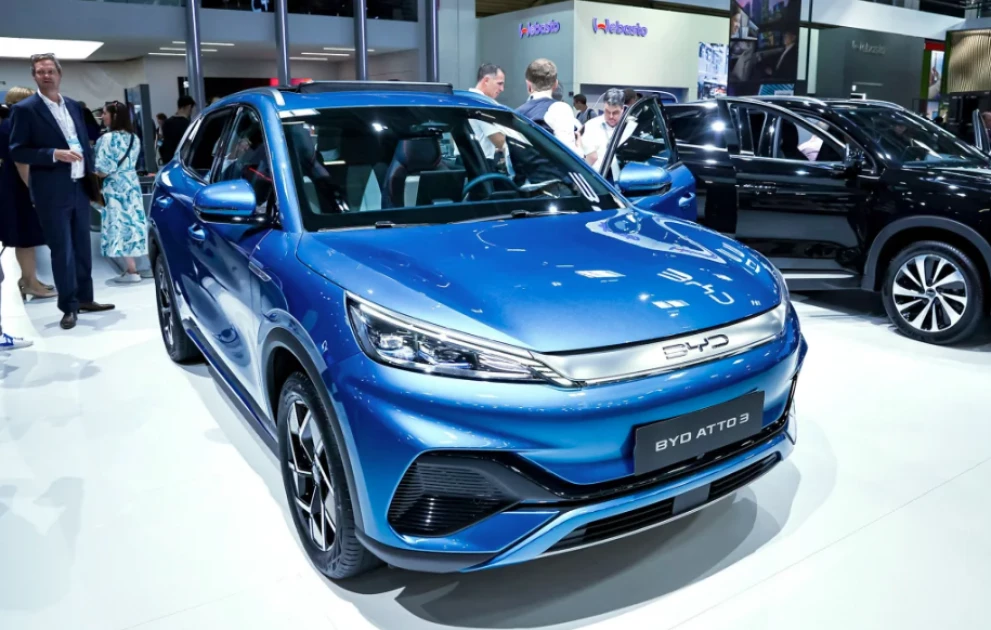
BYD's ATTO 3 model displayed in Munich, Germany on September 4, 2023

Audio By Vocalize
BYD
overtook Tesla to become the world’s biggest electric car company in the final
quarter of 2023.
The Chinese company sold a record number
of cars last year, including 525,409 battery electric vehicles (BEVs) in the
three-month period to December 31, according to a stock exchange filing. Tesla
said Tuesday it delivered 484,507 — also a record — during the quarter.
Over the year as a whole Elon Musk’s Tesla still outpaced BYD, selling 1.8 million
electric cars. BYD sold 1.57 million electric vehicles, up 73% on 2022, as well
as 1.44 million hybrids.
But that means Tesla’s gap over its Chinese rival, at about
230,000 units in 2023, was significantly narrower than the 400,000 units posted
in 2022.
The rapid growth of BYD, which is backed by Warren Buffett, is a symbol
of China’s rising EV industry.
China is progressing quickly in its
transition to electric vehicles, thanks to strong government support for the
industry. And its carmakers have been pushing into Europe to the alarm of
traditional rivals such as Volkswagen and Renault. EU policymakers have
launched an investigation into Chinese state subsidies.
Beijing has set a target that at least 20% of new cars sold
annually in China by 2025 should be new energy vehicles (NEVs), which include
BEVs, plug-in hybrids and hydrogen fuel cell vehicles. By 2035, the government says, NEVs should become the
“mainstream” of new car sales.
The first goal was achieved in 2022, about three years early. The second
may also be reached earlier than expected.
In
the first 11 months of 2023, 8.3 million units of new energy vehicles were
sold, accounting for more than 30% of total car sales, according to data
released last month by the China Association of Auto Manufacturers.
Miao Wei, former minister of China’s Ministry of Industry and
Information Technology, said at a car forum in November that the
government’s NEV penetration target of 50% by 2035 is likely to be achieved by
2025 or 2026 at the latest, according to state media.
China’s
leading role in the global industry is also thanks to its market scale, cheap
labor and supply chain dominance, according to analysts.
“China is now leading in production and increasing its comparative
edges, banking on its massive domestic market and the first mover advantage,”
analysts from Natixis Asia, a French investment bank, wrote in a report in late
November.
Its
first mover advantage and government support through infrastructure investment
and subsidies have made it easy for Chinese EV makers to expand domestically
and internationally, they said.
However, intensifying competition and a brutal price war last year
have impacted the profit margins of many car makers.
As
China’s economy lost momentum, automakers were concerned about a demand
slowdown. In January, Tesla cut prices in China to attract customers and stem
slowing growth, triggering a price war. Dozens of auto makers followed suit to
stay competitive.
The price war has driven up sales, but threatened industry-wide
profitability. For the first 11 months of last year, China’s car industry
recorded a profit margin of just 5%, lower than 2022’s 5.7% and 2021’s
6.1%, according to figures published by the Chinese Passenger Car Association,
a government-backed industry group.
To offset the slowing domestic market, Chinese car makers have
been seeking growth outside the mainland by
expanding in Europe, Australia and Southeast Asia.
BYD sent a big delegation to a car show in Germany last September.
A spokesman said then that the company was aiming to double the number of
dealer partners in Europe in 2023 and was targeting overseas sales of 250,000,
up from about 56,000 in 2022.
Last month, it announced it would build an EV factory in Hungary,
which would be its first passenger car plant in Europe. It already has
a bus factory in Komárom, Hungary.
Leave a Comment