

Women leading Karura Forest conservation using indigenous knowledge, tech solutions

Audio By Vocalize
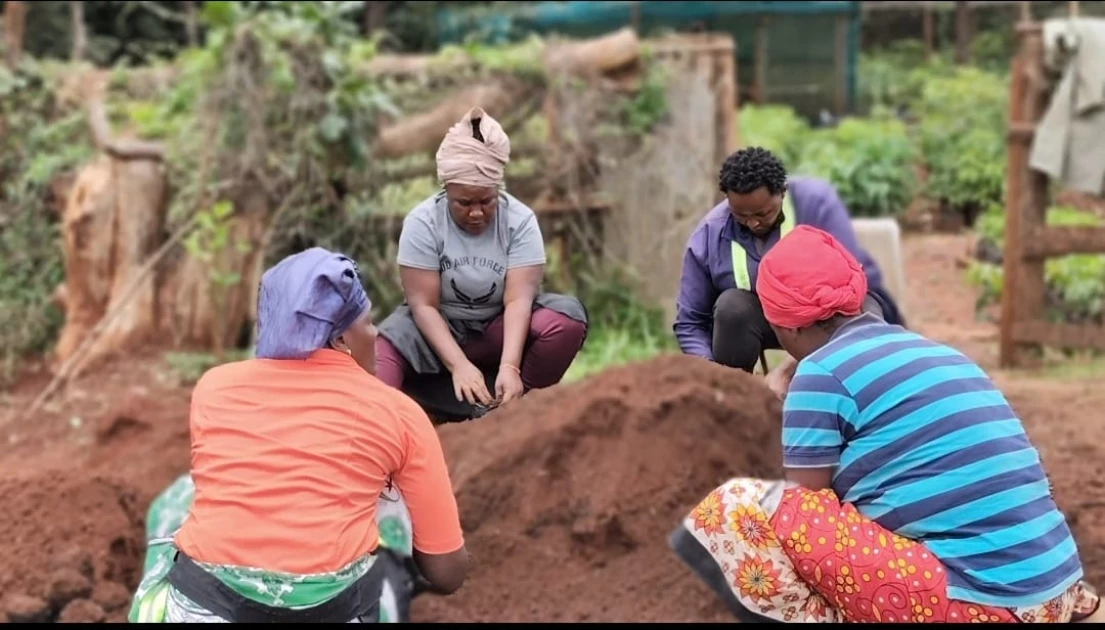
Using their hands, they scoop the soil and fill the sachets, repeating the process until the heap of soil is finished. In the end, hundreds of sachets remain, ready to receive seedlings from the nursery.
About 300 metres away from the women, another group moves through the forest, deep in discussion. A man holds binoculars, while several women carry phones and files as they walk up and down.
These women are part of the Karura Forest community, working together using both technology and traditional knowledge to reverse the effects of climate change caused by human activities. Their efforts aim not only to restore but also to conserve Karura Forest.
Through the merger of digital technology and traditional knowledge, Karura forest tree cover has increased from 25 percent in 2010 to 65 percent in 2025.
Ann Wanjiku, a research assistant with Friends of Karura working at Karura forest, attributes the growth in the tree cover in the forest to the use of technology and indigenous knowledge from the community members.
“We start by collecting data for wildlife motoring in the forest. We also collect data from the rain gauge, both analogue and the digital weather station. Once we have data, we analyse it digitally, and it helps us determine the health of our forest,” said Ann.
To identify degraded areas of Karura forest, Ann says they use Geographic Information System (GIS) technology to inform their decision-making on which areas to restore or deforest in case of invasive weeds.
“I can say the conservation impacts are positive. We use GIS tool to map areas which need restoration, forest trails, deforested areas and wildlife hotspots. The information we get from these tools helps us to know where to plant trees, or deforest, in case there is an invasive weed because this is a forest ecosystem. We also use the information to monitor wildlife and maintain ecological balance the ecosystem,” added Ann.
To sustain the environmental efforts, Karura Forest Environmental Education Trust has been creating conservation within the community and nurturing learners through environmental education.
“We nurture young learners to understand environmental conservation and especially those undertaking competence-based education curriculum. We take them through practical sessions to help them understand and identify different bird sounds, various species of trees and different tools that can be used for environmental conservation,” said Getrude Chepwogen training specialist at KFEET.
According to Getrude, the use of digital tools and applications to teach practicals helps learners connect the theory they learn in class with the real-life experiences they observe in the field.
Chepwogen explains, “We use the binoculars to observe the characteristics of animals and birds, and when we record these features in our database, we can analyse and conduct research on how many species we have in the forest. This is something we couldn’t do without the help of these tools. We also teach learners how to use camera traps to collect data, as well as other apps we use here in Karura forest to monitor the health of the forest.”
The community around Karura forest has contributed largely to the traditional knowledge. Being the natives of Karura, they know the best indigenous trees that survive well in that area. Through the Karura community forest association, they collect seeds from the forest to prepare seedlings in their nursery.
Joseph Kamau, a tree carer, says each of the community members had a role to play in the conservation of the forest.
“We plant indigenous trees, not exotic ones. You will find men mostly involved in tasks like clearing invasive plants, while women concentrate on the transplanting of seedlings,” he said.
They also earn a living from the conservation work in Karura forest. Sophia Mukami Mugo leads the casual labourers working in the forest.
“I come from Huruma area around the Karura forest. We earn our daily bread from this forest by pruning trees, planting and handling general maintenance of the forest. Today, for example, we are 70 of us working,” said Mukami.
Ecosystem biodiversity coordinator at the Friends of Karura Peter Fundi, says that through collaborative efforts, they have been able to restore more than 400 hectares of the 1,041 hectares of Karura forest.
"Here in Karura, we use technology in many ways, especially for research to understand the forest. We are using mobile digital platforms like Cobo to monitor wildlife during census exercise. We also use K- Macho for Citizen science, where we involve employees who are not researchers so that they can record simple data, such as dead animals, garbage along the river, or habitat changes, based on their observations. This has been very critical for forest management," added Fundi.
He adds that the community has come in handy in protecting Karura forest.
"Everyone is involved in the conservation work. But, the community is the first social fence for the forest security. They understand the forest so well that involving them has a huge benefit. We are also tapping into traditional knowledge by understanding the native trees and where to get quality seeds”, added Fundi.
Agenda 2063, the African Union's blueprint for transforming Africa into a global powerhouse, highlights the critical role of women and technology in achieving environmental sustainability, agricultural modernization, and economic prosperity. It aims to empower women by ensuring their full participation in all spheres of life, particularly through science, technology, and innovation, to drive conservation and sustainable development.
As part of Agenda 2063, STISA-2024 focuses on improving technical competencies and promoting women in research and development (R&D), including in environmental science and biodiversity conservation.
Also, the United Nations Framework Convention on Climate Change (UNFCCC) places strong emphasis on technology development and transfer to address climate change and conservation challenges.
In addition, the UNFCCC documents emphasize that technology development and climate action must involve women and gender-responsive approaches to ensure equitable benefits.
Leave a Comment