
OPINION: Fundraising nightmare for political aspirants
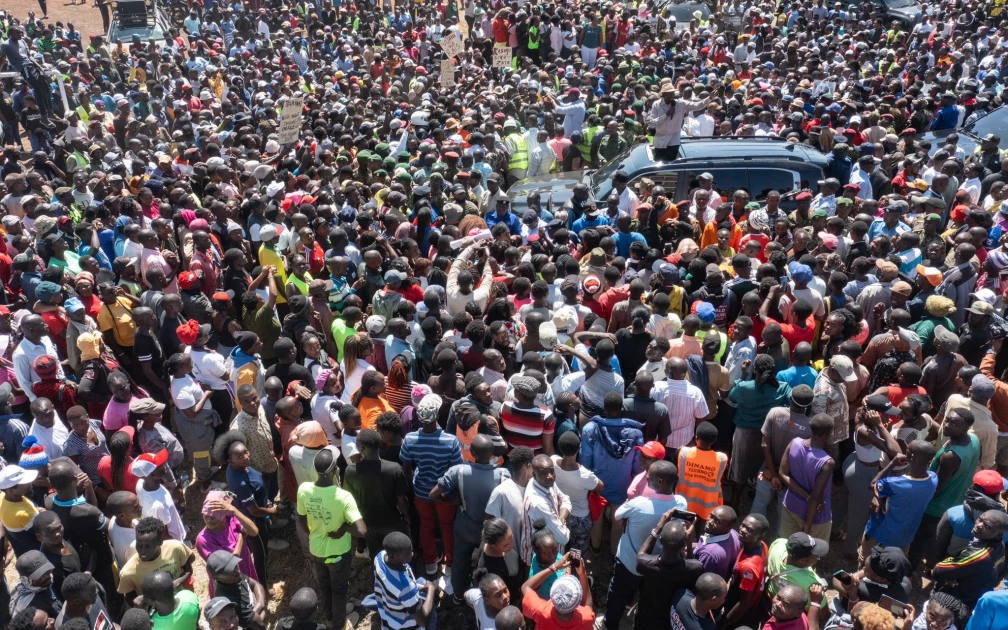
File image of President William Ruto addresses a crowd during his tour of the Nairobi region on March 14, 2025. Photo: PCS

Audio By Vocalize
As Kenya edges toward another general election, the campaign machinery is beginning to whirr into life. Posters will soon appear on every available wall, convoys will clog rural roads, and aspirants will fan out across constituencies in the familiar ritual of handshakes, funerals, church visits, and fundraising dinners. Yet beneath this spectacle lies a shared and rarely discussed anxiety that cuts across party lines and positions: how to pay for it all.
I have been involved, directly and indirectly, in political fundraising in
Kenya and the wider region for many years. The lesson is brutally simple. For
most aspirants, politics is an investment with no guaranteed return. Lose the
election, and the capital—financial, social, and reputational—is largely
unrecoverable. Win, and the scrutiny begins immediately, particularly when
campaign spending bears little resemblance to what an elected official can
legally earn in office.
Campaign financing in Kenya has long occupied a grey zone between regulation and reality. Official limits exist, and institutions such as the Ethics and Anti-Corruption Commission (EACC) routinely point out the glaring mismatch between authorized earnings and actual campaign expenditure.
Estimates
suggest that a credible bid for a National Assembly seat can cost at least
KSh40 million. In competitive constituencies, particularly for first-time
aspirants without an established political network, the figure can be
significantly higher. Multiply this across gubernatorial, senatorial, and
presidential races, and the sums involved run into the hundreds of millions of
shillings.
This financial pressure distorts behavior long before a vote is cast.
Campaign spending in Kenya is rarely about policy communication or voter
education. It is dominated by what is politely called “facilitation”: funeral
contributions, school fees, medical bills, transport allowances, and, in its
most corrosive form, outright bribery.
These practices are not accidental. They are the predictable outcome of
a system that treats elections as transactional exchanges rather than
democratic choices.
Yet the old assumptions are beginning to fray. The Kenyan voter is changing faster than the political class realizes. The dramatic emergence of the Gen Z protest movement—including its audacious breach of Parliament, one of the country’s most secure institutions—was not just a security failure. It was a political signal. Deference is eroding.
Patronage no longer guarantees
loyalty. Increasingly, voters are willing to accept money and still vote
according to conscience, ideology, or anger. As the Latin phrase has it: pecunia
non omnia emit; money does not buy everything.
This shift makes the fundraising challenge even more acute. Traditional
methods, such as church harambees and last-minute appeals to wealthy patrons,
are proving insufficient for serious campaigns. They are episodic,
unpredictable, and poorly aligned with modern voter expectations. More
importantly, they encourage short-term thinking—raising cash to survive the
next rally rather than building a campaign that can win on credibility and
message.
What consistently undermines Kenyan campaigns is not merely a lack of
money, but a lack of planning. Fundraising is often treated as an emergency
response rather than a core strategic function. Few aspirants develop a clear
fundraising plan. Fewer still assemble professional teams capable of donor
mapping, compliance management, digital outreach, and narrative framing.
Instead, responsibility is delegated to loyal friends or relatives whose main
qualification is proximity to power.
In mature democracies, political fundraising is institutionalised.
Campaigns invest heavily in data, compliance, and messaging. Donors are
segmented, expectations are managed, and spending is tracked meticulously. None
of this eliminates money’s influence, but it imposes discipline. In Kenya, by
contrast, fundraising is personalized and opaque, creating fertile ground for
corruption and post-election disillusionment.
There is also a deeper economic reality at play. Kenya’s political
campaigns are financed largely from private wealth in an economy marked by
inequality. This raises uncomfortable questions about representation. If only
the wealthy, or those backed by wealthy patrons, can afford to compete,
electoral politics risks becoming an elite club masquerading as mass
participation. The result is a Parliament and county governments that struggle
to reflect the lived experiences of the majority.
Reform is often discussed, but rarely implemented with seriousness.
Enforcing spending caps, strengthening disclosure requirements, and reducing
the cost of campaigns would help. So would expanding public funding tied to
transparent criteria. But regulation alone will not solve the problem.
Aspirants themselves must rethink how they approach campaigns—shifting from
consumption-driven politics to persuasion-driven politics.
That requires courage. It means telling voters uncomfortable truths,
resisting the pressure to monetize every interaction, and investing in ideas
rather than theatrics. It also requires professionalizing fundraising—not as a
desperate scramble for cash, but as a disciplined, ethical, and strategic
process aligned with democratic values.
Kenya stands at a crossroads. The country’s elections are vibrant,
competitive, and deeply consequential. But unless the financing model changes,
they will continue to reward excess over substance and money over merit.
For aspirants, the nightmare is not simply raising funds. It is
navigating a system where the price of entry is high, the rules are bent, and
the returns—both moral and financial—are increasingly uncertain. Money may
still matter in Kenyan politics. But it is no longer enough. And that, for the
country’s democracy, may be the most hopeful sign of all.
The Author is an Independent Fundraising Expert and CEO for Kenya Veterans for Peace
Join the Discussion
Share your perspective with the Citizen Digital community.
No comments yet
This discussion is waiting for your voice. Be the first to share your thoughts!