

FIFA confirms Saudi Arabia as 2034 World Cup host
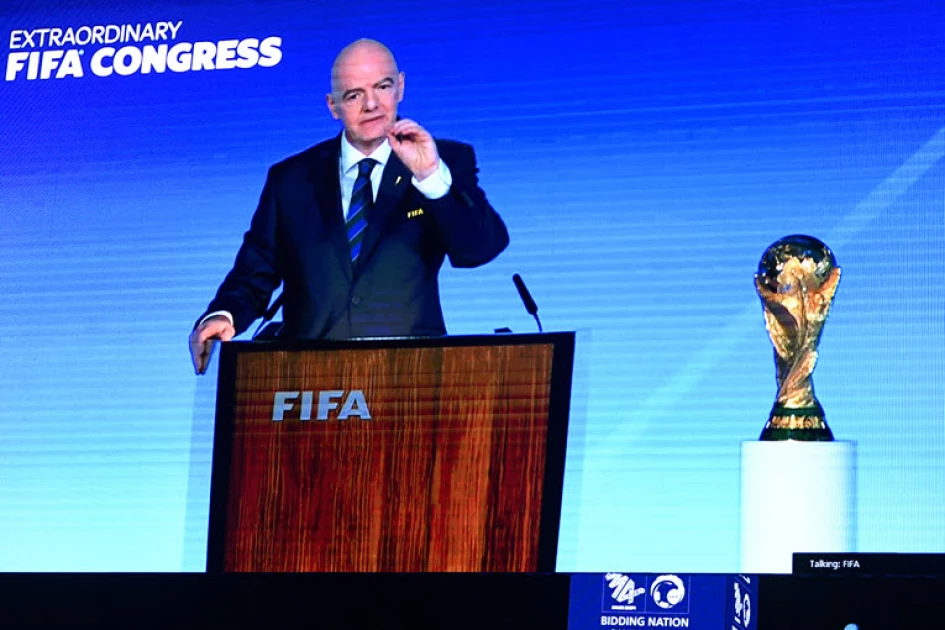
A speech by President of FIFA Gianni Infantino is broadcasted on a screen during a ceremony in the capital Riyadh on December 11, 2024, as the FIFA Congress votes for the hosting rights for the 2034 World Cup with Saudi Arabia being the sole candidate. (Photo by AFP)

Audio By Vocalize
At the same time, a virtual Congress of world football's
governing body confirmed that Morocco, Spain and Portugal will be joint hosts
of the 2030 World Cup, in which three games will also be played in South
America.
The Saudi bid was waved through by acclamation during the
meeting of FIFA's 211 national member associations, with no rivals standing in
its way.
"It is a proud day, a day of celebration, a day that we
invite the entire world to Saudi Arabia," said Abdulaziz bin Turki bin
Faisal al Saud, the Saudi Minister of Sports.
"We intend to have an extraordinary version of the
World Cup in our kingdom."
However, there was immediate condemnation from rights groups
who insisted that handing the organisation of the tournament to the country
puts the lives of construction workers at risk and "marks a moment of
great danger".
FIFA had invoked its principle of rotating the World Cup
between continents, which meant only bids from Asia or Oceania were welcome for
2034.
The unprecedented organisation of the 2030 tournament will
involve three continental confederations in Europe, Africa and South America,
while the next World Cup in 2026 -- the first involving 48 teams -- will take
place across North America.
Controversially, the body gave potential bidders barely a
month last year to submit candidacies, and Australia and Indonesia abandoned
their interest.
That left Saudi Arabia as the sole candidate, clearing the
way for the World Cup to return to the Gulf region so soon after Qatar hosted
in 2022.
The kingdom's de facto ruler, Crown Prince Mohammed bin
Salman, has been using sport for some time to amass influence and improve its
global image -- critics say he is effectively "sportswashing" by
diverting attention from Saudi Arabia's rights record.
The awarding of the World Cup to Saudi will make the issue
of human rights a major talking point again, just as it was two years ago.
"We are inclusive and we are non-discriminatory, and we
want to obtain positive social impact," FIFA president Gianni Infantino
said in closing remarks.
"We are of course aware of critics and fears, and I
fully trust our hosts to address all open points from this process and deliver
a FIFA World Cup which meets expectations."
He added that "social improvements and positive human
rights impacts" are "responsibilities of hosting a World Cup."
Rights groups highlight mass executions in Saudi Arabia and
allegations of torture, as well as restrictions on women under the conservative
country's male guardianship system. Free expression is severely restricted too.
FIFA's decision to award the tournament to Saudi Arabia
"despite the well-known and severe risks to residents, migrant workers and
visiting fans alike, marks a moment of great danger," Amnesty
International and 20 other organisations said in a joint statement.
"Based on clear evidence to date, FIFA knows workers
will be exploited and even die without fundamental reforms in Saudi Arabia, and
yet has chosen to press ahead regardless," said Steve Cockburn, Amnesty's
Head of Labour Rights and Sport.
England's Football Association meanwhile said it had
received assurances from Saudi Arabia that LGBTQ fans would be "safe and
welcome" at the tournament.
The 2030 tournament will mark a century since the first
World Cup was held in Uruguay, and as a result the unrivalled joint bid by
Morocco, Spain and Portugal will also see the South American nation handed one
game along with Argentina and Paraguay.
FIFA confirmed over a year ago that the joint proposal led
by Morocco, Spain and Portugal was the sole contender for 2030, with all other
potential candidacies having fallen by the wayside.
Four South American countries launched a joint bid in 2019,
convinced that the centenary World Cup should entirely take place on the
continent where it all began.
Meanwhile, Morocco replaced Ukraine as a partner for Spain
and Portugal, while South America agreed to step aside in exchange for hosting
three games.
Following these "centenary celebrations" in the
southern hemisphere winter, the six teams involved will cross the Atlantic to play
the rest of the tournament.
Spain, which hosted the 1982 World Cup, should be the main
host as it boasts 11 of the 20 proposed stadiums.
Morocco -- after failing in five previous bids -- will
become the second African nation to host the competition after South Africa in
2010.
Potential venues for the July 21 final include the Santiago
Bernabeu in Madrid and Barcelona's renovated Camp Nou as well as the planned
Hassan II stadium between Casablanca and Rabat, set to boast a 115,000
capacity.
Leave a Comment