

Japan wants to host 2031 World Cup to fire up women's football
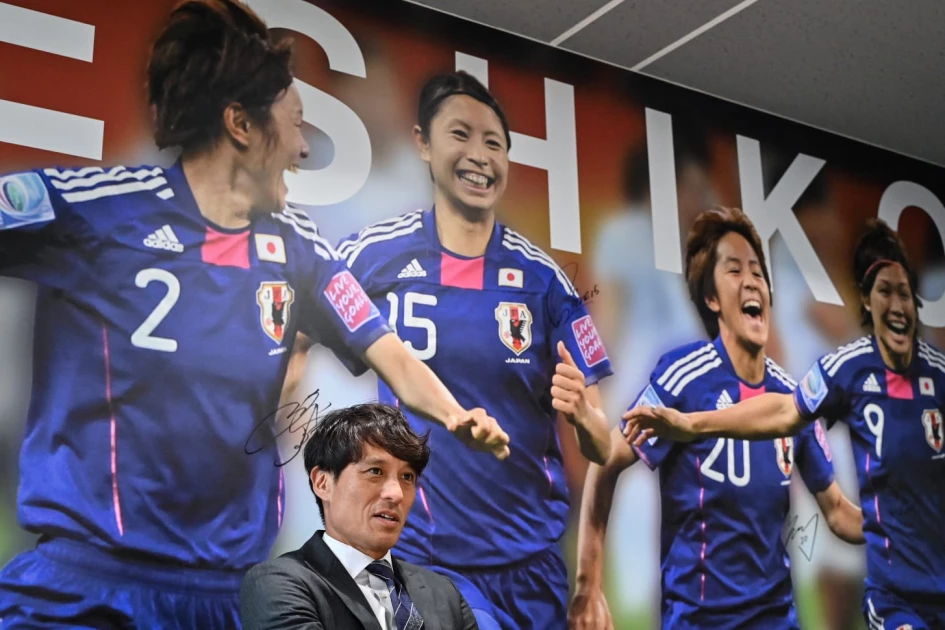
Tsuneyasu Miyamoto, former Japan national player and team captain, and current Japan Football Association (JFA) president, takes part in an interview with AFP at the group's headquarters in central Tokyo on October 21, 2024. Japan wants to host the Women's World Cup in 2031 to ignite the domestic game and cut the gap on Europe and North America, the country's football chief told AFP. (Photo by Richard A. Brooks / AFP) / TO GO WITH: FBL-JPN, INTERVIEW BY ANDREW MCKIRDY

Audio By Vocalize
Japan wants to host the Women's World Cup in 2031 to
ignite the domestic game and cut the gap on Europe and North America, the country's
football chief told AFP.
In 2011 Japan won the competition but they have
since been overtaken, with women's football booming in Europe in recent years.
"We would like to raise the value of women's
football here," Japan Football Association president Tsuneyasu Miyamoto
said in an interview at JFA headquarters in Tokyo, in front of a giant photo of
Japan's World Cup-winning team.
Miyamoto was captain of the Japan men's team when
they co-hosted the World Cup with South Korea in 2002, a tournament that helped
spark huge interest in football among the Japanese public.
Now 47, he took over as JFA chief this year and has
similar hopes for the 2031 Women's World Cup. The country has never hosted the
event.
Japan is likely to face stiff competition for hosting
rights however with a joint bid from the United States and Mexico expected.
England and China are also reportedly interested.
"We have the WE League, and it has been
struggling to gather an audience," Miyamoto said.
"We would like to increase the number of women
players here."
The professional women's WE League launched in 2021
but it has failed to attract anything like the attendances and revenue enjoyed
by women's leagues in Europe and the United States.
Japan's women have not gone beyond the World Cup
quarter-finals since they lost to the US in the 2015 final.
Miyamoto says Japan "could have done
better" to capitalise on the 2011 triumph, which triggered massive
interest in women's football before it quickly fizzled out.
The former defender wants Japan to develop a more
passionate football culture all round, saying his stint with Austrian side Red
Bull Salzburg "inspired me a lot".
"They have their own culture, they have
football in their daily lives," he said.
"We haven't built that kind of community here
in Japan. I'd like to make football our culture in Japan."
Miyamoto played 71 times for his country, captaining
the side at the 2002 and 2006 World Cups.
He spent most of his career in the domestic J.
League, at a time when only a handful of Japan internationals played for
European clubs.
Japanese players are now all over Europe and the
national team has benefitted as a result, regularly appearing in the World Cup
knockout rounds.
"It's very normal for them to play in the
Champions League," Miyamoto said of the current generation of players.
"When facing big teams like Germany or Spain...
they have no fear."
The steady stream of players to Europe has helped
Japan's national team but also posed problems for J. League clubs.
Miyamoto says they need to keep producing talent but
argues that "transfer fees for Japanese players are low compared to
players from South America".
Brighton paid just 2.5 million pounds to sign winger
Kaoru Mitoma in 2021, while prolific goalscorer Kyogo Furuhashi joined Celtic
for 4.5 million pounds the same year.
"In Europe clubs are very strong, but in Japan
clubs are not that strong," said Miyamoto.
"Players who only have six months left on their
contract are still playing in official matches. After the season, they will be
free to go anywhere, and in that case, clubs can't get any money."
Miyamoto wants to bring a new way of thinking to
Japanese football.
He is a graduate of the FIFA Master sports executive
programme and also had a stint coaching J. League side Gamba Osaka.
He is the first JFA president to have played at a
World Cup, and the youngest since the end of World War II.
"Former players, especially players who played
at a high level, know how the football world works," said Miyamoto.
"Forty-seven is not young as a person. Talking
about leaders of national organisations, maybe 47 is young.
"Maybe a new generation might be able to bring
something new into this world."
Leave a Comment