

Tigray footballers play for victory and Ethiopian unity
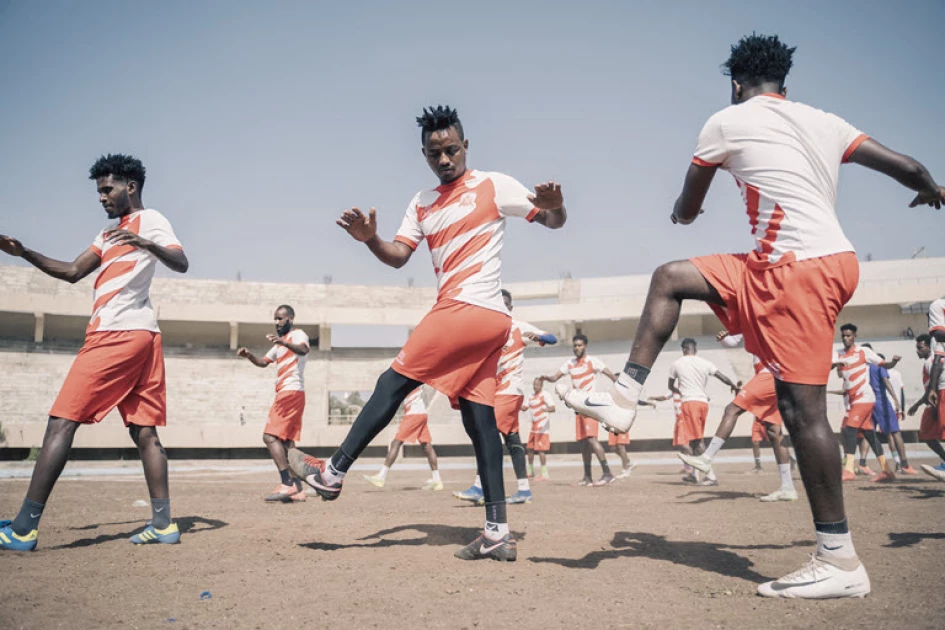
Mekelle 70 Enderta football players participate in a warm-up exercise during a practice session at the Mekelle football stadium in Mekele, on May 24, 2024. The Ethiopian Football Federation has announced the return of the football clubs from Tigray to the Ethiopian Premier League after a two-year war between Ethiopia's government and Tigrayan rebel authorities tore the northern region apart before a November 2022 peace deal. The three Tigray-based teams, Mekelle 70 Enderta, Shire Endaselassie, and Welwalo Adigrat University, which were prominent in the league before the outbreak of the conflict, are now set to resume their positions and participate in the upcoming season. (Photo by Amanuel Sileshi / AFP)

Audio By Vocalize
Tigrayan football captain Anteneh Gebrekirstos Haile vividly
remembers the day in July 2019 when his team Mekelle 70 Enderta won its first Ethiopian
Premier League title.
The stadium in Tigray's capital, Mekele, "was alive
with energy and excitement, and the seats were filled with passionate
fans", the 31-year-old recalled, describing it as "the happiest day
of my life".
But a two-year war between Ethiopia's government and
Tigrayan rebel authorities left the stadium an empty shadow of its former self
as the region was torn apart before a November 2022 peace deal ended the
fighting.
The conflict drew in Tigrayans from all walks of life,
including footballers like Anteneh, a Mekele native who said that "the
war was devastating and harmful, not only for me or the Tigray Region but for
the whole of Ethiopia".
"There was a prevailing mindset that rather than dying
at home, it was preferable to go to war," he said.
Haunted by trauma
Mekelle 70 Enderta is one of three Tigrayan teams, along
with Shire Endaselassie and Welwalo Adigrat University, that have been
readmitted to the Ethiopian Premier League for the first time since the
conflict.
Kibrom Asbeha, a 26-year-old striker for Mekelle 70 Enderta, said he and his younger brother took up arms in order to find their
parents, who had both entered the fray.
He suffered many heartbreaking losses, including his brother
who died in battle, before the peace deal brought an end to the conflict and
allowed him to reunite with his parents.
Even during the heat of battle, the love of football never
left him.
"I even watched Ethiopian Premier League games on
Facebook Live, holding onto hope that after the war, I could return to playing
football again," he said.
But coming home has
not been easy
Apart from a chronic shortage of money -- none of the team's
members are drawing a salary -- the trauma of the conflict lingers.
"On the battlefield, the intensity of the moment often
masks the emotions, but the memories haunt you once you return home," he
said.
In addition to killing untold numbers of people, the Tigray
war was also marked by vicious sexual violence carried out by all parties.
UN investigators also accused Ethiopia's government of using
starvation tactics against Tigray in a bid to weaken the rebel authorities.
Head coach Goytom Haile said it was a struggle to bring
the players back to the pitch and reunite them as a team after the fighting
eased.
"It took us a long time to reunite everyone and help
them transition back to social life and focus on football," the
39-year-old said.
"The war robbed us of many things... It will take time
to catch up, but we will get there," he said, urging the government and
wealthy Ethiopians to help the team find its feet again.
He said he sees football as "a unifying force",
citing the role played by Ivorian legend Didier Drogba in brokering a ceasefire
in his war-torn country.
In Ethiopia too, Goytom remains hopeful that the beautiful
game can help his fellow citizens "overcome hate and learn to appreciate
one another".
Their efforts have already seen the team earn a spot in the
Ethiopian Premier League, raising fans' hopes that its glory days are still
ahead.
"If we support each other and perform well next season,
everything will improve," said Zelalem Etakility, a fan since his teens.
"Even though it won't be the same as before, I am
optimistic that it will change," the 30-year-old told AFP. "Football
can help us rebuild politically, economically, and financially."
For Anteneh, the return to the pitch has already brought a
measure "of healing... and hope".
His side has maintained an undefeated streak this season,
claiming 11 victories and four draws in the 15 games they have played so far.
"We are endeavouring to rebuild our (pre-war) way of
life and recapture the spirit of those times," he said.
"We have returned to what we love most -- playing
football."
Leave a Comment