

The National Infrastructure Fund and a Ksh.5 trillion budget for Ruto's Singapore dream
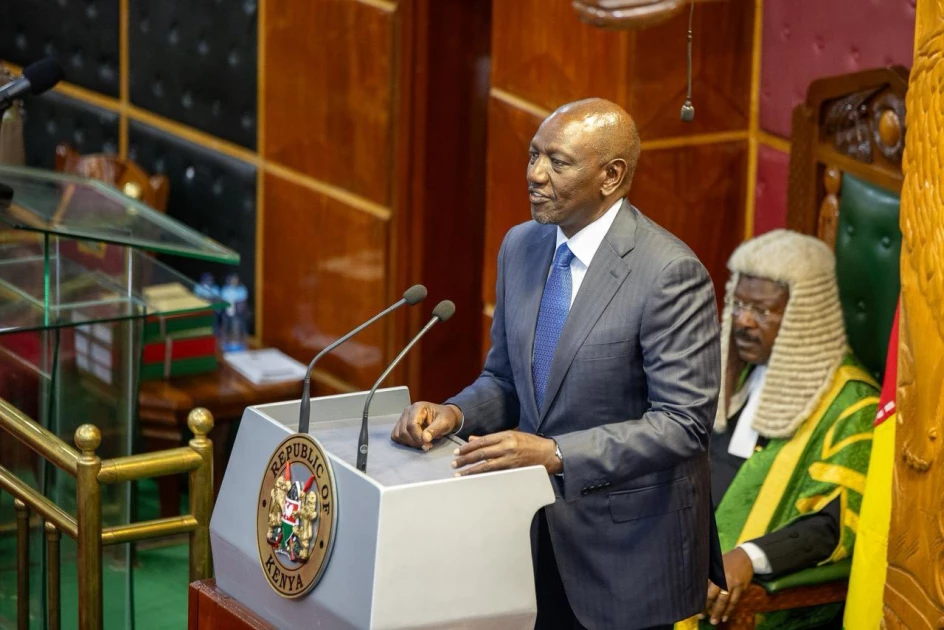
President William Ruto delivers the State of the Nation Address in Parliament on November 20, 2025. Photo: PCS

Audio By Vocalize
The President described the establishment of the fund as "the most consequential initiative in the development history of the nation."
Earlier on November 20, 2025, Ruto gave his 2025 State of the Nation address to a joint sitting of the National Assembly and the Senate.
He waxed lyrical on his administration’s accomplishments over the last three years, and stunned many when he delved into his future plans for the country, which he described as key cornerstones of his party’s manifesto promises to Kenyans, including a dream to transition Kenya into a first-world country, modelling countries such as Singapore, Japan, South Korea and Malaysia.
Ruto spoke of bold and costly projects which would easily run to over Ksh. 5 trillion. He also intimated that these projects would not be funded from the traditional sources of debt (international and domestic) or additional taxes on the citizens.
The Head of State laid out the government’s plans to set up and implement huge infrastructure projects whose funding will be sourced through a National Infrastructure Fund and a Sovereign Wealth Fund.
This approach is a novel source of funding in Kenya and a complete move away from its traditional sources of funding for heavy infrastructure. The level of funding alone, over Ksh. 5 trillion, is mind-boggling, and coupled with a short timeline to deliver on a multitude of infrastructure projects. Some Kenyans remain sceptical of its veracity.
However, on the other hand, many are also enthusiastic about the challenge to cope with financing infrastructure development through borrowing and additional taxes has been unsavoury to citizens, unsustainable and debt-piling.
Ruto’s Ksh. 5 trillion ambitions
The President, banking on this novel method of sourcing funds, targets to achieve his goals within 10 years. He stated that the government is keen and set to undertake four game-changing projects within the public sectors of education, transport, energy and water irrigation as he reckons they hold the key to Kenya’s prosperity, now and into posterity.
“This is why we will establish the National Infrastructure Fund (NIF), whose architecture will be underpinned by the reforms in the Government-Owned Enterprises Bill, passed by this August House, that I will be signing into law tomorrow,” Ruto stated.
The Head of State was upbeat that funding from Sovereign Wealth Funds (SWF) have performed exceptionally well in other countries hence the big bet on the National Infrastructure Fund (NIF), which, more than a financing tool, is “a generational strategy, to preserving value, mobilizing capital, accelerate delivery, and ensure Kenya becomes stronger, wealthier, and more competitive.”
In his address, the President said a set portion of dues earned from the production of natural resources, together with the proceeds from the sale of privatization of national assets, will form the seed funding for the SWF and NIF.
Kenya is turning to funding its infrastructure projects through Sovereign Wealth Funds (SWFs) such as the National Infrastructure Fund (NIF) due to its modest income level. Poor income levels impact negatively on per capita return, such as user fees, which are at times mooted for infrastructure projects on completion, while the risk perception remains high.
A closely associated challenge is a shallow debt market and low credit ratings by credit rating firms, factors which make it expensive to tap into funds from capital markets via issuance of infra bonds or project bonds.
Kenya's current credit ratings from major agencies are 'B' with a Stable outlook from S&P, 'B-' with a Stable outlook from Fitch, and 'Caa1' with a Positive outlook from Moody's. As much as these ratings reflect improved external liquidity due to factors like strong exports and remittances, the ever-rising risks from high debt servicing costs are a factor any investor would frown upon
Catalysts for blended finance
In mid to lower-income countries, private capital inadequacy is the unrelenting scenario. National Infrastructure Funds (NIF) and Sovereign Wealth Funds (SWF) step in to occupy a critical part in incentivising and unlocking the limited private capital, as well as attracting international investment finance to enable infrastructure investment that is critical to the host countries.
Governments’ ability to create and facilitate the deployment of blended finance, by using targeted public funds to leverage and “crowd-in” private finance to specific investment projects or finance facilities, is critical.
Blended finance is more than just a mechanism for complementing government funds with those from commercial or institutional sources. It can also activate and draw from the technical and implementation skills of civil society actors, philanthropic institutions, development banks and private for-profit institutions
The National Infrastructure Fund
A National Infrastructure Fund (NIF) is a specialized Sovereign Wealth Fund (SWF) dedicated to the sole purpose of mobilizing funds from dedicated sources and investments into national infrastructure projects. This, when competently done, saves the host country from more expensive sources of finance, such as commercial debt and additional taxes on citizens.
The NIF can work as a stand-alone specialized sovereign wealth fund, or it can operate within the ambit of a broad-spectrum Sovereign Wealth Fund (SWF) or a dedicated national investment fund.
Generally, Sovereign Wealth Funds (SWFs) are state-owned investment funds primarily comprising government-generated capital. The target source funds for SWFs are often created using surplus national reserves, such as revenues from exports, natural resources, as suggested in Kenya’s case, or budget surpluses.
These are then managed to achieve long-term financial objectives for the country in various sectors of public need and for future hedging against volatile economic factors.
Whenever a country is in a situation where it has excess revenues, it uses the SWF mechanism to channel the extra funds into economically impactful areas and, at times, uses a portion of the funds to invest in stable high-return portfolios.
Why use NIF to drive huge infrastructure projects?
The ability of governments in medium to low-income countries to create and facilitate the deployment of blended finance, by using targeted public funds to leverage and “crowd-in” private finance to specific investment projects or finance facilities, is critical.
This is where NIFs come in handy as they are instrumental in delivering huge infrastructure projects primarily because they provide a source of patient, long-term capital and act as a catalyst for attracting long-term private investment.
Unlike private investors who may seek quick returns, NIFs, just like SWFs, can invest over decades, aligning well with the long lifespan and high upfront costs of major infrastructure.
Economic strategists perceive Kenya as either ripe or overdue in setting up an NIF or a SWF. Kenya needs a Sovereign Wealth Fund (SWF) to manage its natural resource revenues, hedge against economic unpredictability, and ensure intergenerational equity by saving for the future. The need is especially pressing due to current economic pressures like high debt repayments and over-reliance on exported oil, volatile exchange rates, all of which the fund could help mitigate.
Benefits of setting up a NIF or an SWF
The benefits are more or less the same for both the NIF and SWF. However, the specific benefits of setting up a well-managed NIF would primarily result in a reduction of continuous commercial facilities taken by the Kenyan government to finance high-value infrastructure projects, especially in times of economic hardship.
An NIF reduces the need for the country to borrow always and thereby reduces, over time, a country’s debt as old debts are successfully retired.
This, in turn, would also occasion fewer tax demands to cope with high infrastructure expenditures, thereby enabling social stability within the country.
Lastly, it would provide a much-needed intergenerational equity by ensuring that future generations benefit from the nation's current wealth and prudent management of its resources and dues.
Potential challenges of setting up a National Investment Fund
Should Kenya set up and run a National Infrastructure Fund, it will not be a way-way ticket to prosperity or a walk in the park, as many other factors come into play, such as politics, management, fiscal discipline and resource life-spans.
Politics is the first game-spoiler as it could creep in early and result in a poorly designed or managed fund, staffed through nepotism or cronyism, making it easy prey for manipulation, opaque in managing inherent risks, and thereby negating the purpose for its very existence.
Competent management would ensure only tried and tested hands are put on deck. Not beholden to forces in the shadows, and with sufficient training and experience in running successful funds akin to the one at hand. It cannot be overstated; competent, independent and professional management would be the lifeblood of a national infrastructure fund.
Lack of fiscal discipline is another risk factor that could derail any NIF. The success of the fund depends greatly on strong fiscal discipline, transparency, and high-level commitment to the rules governing it. If these are not adhered to and corrective actions are not taken immediately, they are identified; lack of fiscal discipline can cripple an NIF.
Limited resource life is a big factor in the success of an NIF. If an infrastructure fund suffers from substantially limited resource wells, the fund would be negatively impacted as it constrains the fund's ability to fulfil its mandate.
Success Factors of National Infrastructure Funds
Based on global best practices, successfully run NIFs employ Strong and Independent governance to achieve transparent and effective governance structures, in tandem with external reviewers and a good degree of independence from short-term political cycles. This would build confidence within the private sector and ensure decisions are evidence-based.
Thriving NIFs ensure that Strategic Planning and Prioritization are done because most funds have long-term infrastructure plans between 20 to 30 years that identify national priorities and are updated periodically. This move provides certainty to investors and ensures projects align with national development goals.
Effective NIFs should target Mobilization of Private Capital as a core strategy while using public funds to reduce risks within projects to attract large amounts of private financing, such as pension funds, and private equity through co-investments and public-private partnerships (PPPs).
A well-run NIF should focus on commercial viability by undertaking projects with high social and economic impacts. On the other hand, the NIF should prioritize financially viable projects and only intervene where private capital is not easily available.
Successful NIFs look at Sustainability and Environmental, Social and Governance (ESG) Integration by incorporating ESG factors, without losing focus on sustainable infrastructure, such as renewable energy and green transport. In a world keen on sustainability, conservation and climate goals, it is bound to attract capital investors who are keen on green causes.
Transparency and Data Sharing a core considerations for successful NIFs because open and transparent decision-making, procurement processes, and performance monitoring are crucial for accountability and attracting investments locally and internationally
Another important factor considered by successful NIFs is having Robust Project Preparation, which ensures that technical assistance and funding for project preparation will help create a pipeline of "bankable" projects, a common challenge in many countries.
National Infrastructure Fund vs private capital
When an NIF is set up, the legal and regulatory environment under which it operates is are important factor affecting the degree of competition between the state and private enterprises in terms of tax exemptions, government guarantees, transparency, capital access and bidding for government tenders.
For instance, the Indonesia Investment Authority (IIA) emphasizes the full support from the president, special tax treatment and the ability to navigate and accelerate regulation and permit issuance, factors which private enterprises might not command.
Singapore’s Temasek, a Sovereign Wealth Fund (SWF), was created in 1974 under the Companies Act as a private exempt company, which is any private company that is wholly owned by the Singapore government (Singapore Companies Act, Chapter 50/4). This status has allowed it more flexibility, because it is not subject to the same limitations as other private companies, as provided in law.
A case in focus could be the Senegalese Strategic Investments Fund (FONSIS), which has partnered with the French Infrastructure Fund (Meridiam Capital) to finance an energy project (solar-based) in Senegal. Similarly, Morocco created Ithmar Capital as a strategic investment fund in 2011 with the purpose of mobilizing national and international investment into the tourist sector.
Financed by the government, Ithmar Capital co-invests in Moroccan projects with other Sovereign Wealth Funds. Wessal Capital, another Morocco-based investment fund, is in a joint venture with Ithmal Capital, together with several Gulf-based investment funds, to finance the redevelopment of the port of Casablanca, in Morocco.
National Strategy Coordination Mechanism
As a matter of necessity, it is important that the governance of the NIF should involve all stakeholders within and out of the government to develop a clear national strategic framework for the organization. This would help with linking the NIF’s investment policies to Kenya’s long-term strategic goals, as this is where it ultimately would deliver value for generations yet to come. Alternatively, a clear national strategic framework would form the basis upon which it would approach cooperation and collaboration with other international investment funds successfully.
Successful National Infrastructure Funds
Worldwide, successfully managed national infrastructure funds (NIFs) normally operate as part of a country's wider sovereign wealth fund (SWF) architecture, and are characterized by strong governance, a long-term strategic plan, the ability to leverage private capital, and a focus on commercially viable, high-impact projects.
Key success stories could be related to Norway's Government Pension Fund Global (GPF), one of the world's largest SWFs, which invests globally in a highly transparent manner, with a strong focus on sustainable and ethical investments, including renewable energy projects.
UAE's Mubadala Investment Company and ADIA have been instrumental in developing national energy companies and investing in major global infrastructure, such as digital infrastructure in Europe.
Australia's Future Fund is another successful case of a commercially run public investment fund that focuses on growing national wealth and delivering transformative infrastructure. Singapore's Temasek and GIC Private Limited are highly regarded.
They invest in a wide range of assets, including global and national infrastructure. The Emerging Africa Infrastructure Fund (EAIF) is a multi-donor fund with a strong track record of providing debt financing to private infrastructure projects across Africa, and successfully attracting commercial capital from global institutions like Allianz Capital Partners.
If Kenya is to set up an Infrastructure Fund and a Sovereign Wealth Fund, it will be joining an ever-increasing number of NIFs or SWFs being established under conditions of capital scarcity, especially in low- and lower-middle-income countries such as Indonesia, India, Egypt and Nigeria, to contribute to national infrastructure development. These NIFs’ primary objective is to serve as a credible institutional partner to mobilize new inflows of foreign investment capital.
Ruto’s ambitious future tied to the success of novel funds
The upcoming Rironi – Nakuru – Mau Summit A8 Road is among the comprehensive plans to make dual roads for over 2,500 highways, as well as tarmac over 28,000km roads within the next ten years.
Ruto said the completion of the SGR line from Naivasha, where it currently terminates, to Kisumu and eventually to Malaba will start from January 2026. The Head of State emphasized the need to turn around our economy from a net importer to a net exporter of products, goods and services, the most urgent being imports of agricultural food products that cost us Ksh. 500 billion every year.
The President argued that the government has already made interventions to reduce imports of maize, sugar, edible oil, rice, and wheat, but our efforts are undermined by the natural limits of rain-fed agriculture.
Ruto strongly recommended building at least 50 mega dams nationwide, alongside 200 additional medium and small dams and thousands of micro dams, to collect and store water, not only to secure the supply, but to bring at least 2.5 million acres under irrigation within the next five to seven years.
As President Ruto presses forward in this new effort to accomplish these goals, it will be important that thorough legal and regulatory parameters underpin the planning and reviews to be undertaken before setting up a Sovereign Wealth Fund or the National Infrastructure Fund that is “fit for purpose.”
The promise of a Sovereign Wealth Fund is not in its enactment but in its robust legal suit. The upcoming Bill, “Kenya Sovereign Wealth Fund Bill, 2025,” will be a good place to start and see if the Sovereign Wealth Fund will be ring-fenced to deliver, or it will be another fancy cul-de-sac.
This article was updated on May 11, 2026.
Leave a Comment