
Treasury blasts Controller of Budget over IMF, World Bank loan interest rates
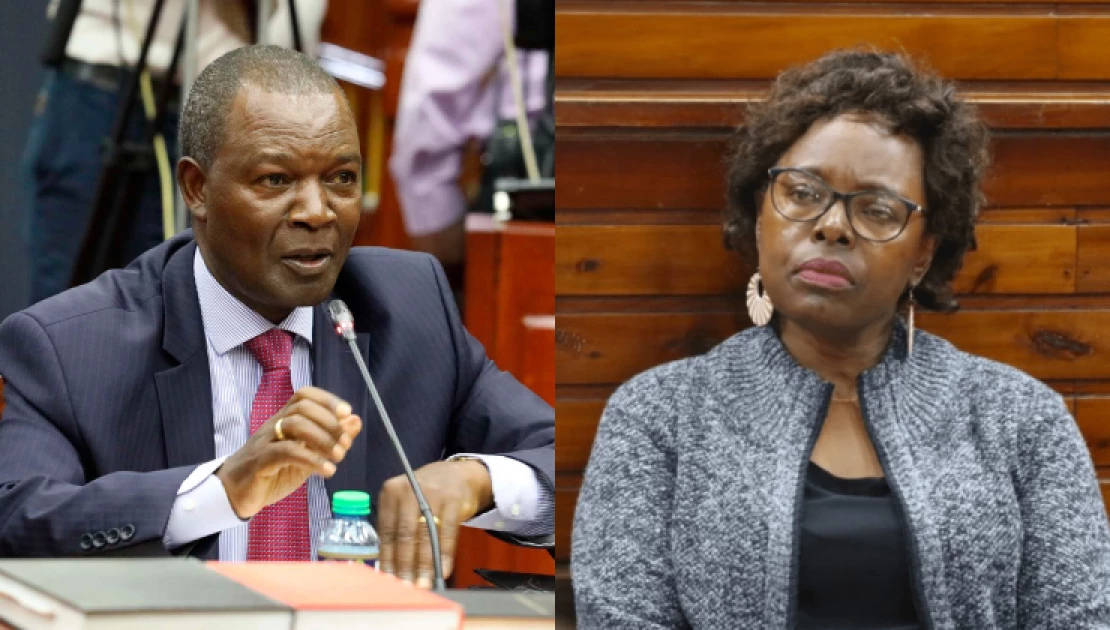
A side-by-side image of Treasury CS Njuguna Ndung’u and Controller of Budget Margaret Nyakang'o. PHOTOS | COURTESY

Audio By Vocalize
The National Treasury has dismissed reports
by the Controller of Budget that the government acquires loans from the International
Monetary Fund (IMF) and World Bank at 14.5 per cent interest rates.
Treasury
Cabinet Secretary Prof. Njuguna Ndung’u, in a statement on Friday, termed the
assertions by Controller of Budget Margaret Nyakang'o as “sensational and
misleading,” saying they are meant to taint the government’s image before the
eyes of the public.
CS
Ndung’u disputed Nyakang’o’s figures as captured by the media on Thursday
reiterating that interest rates for the IMF and World Bank range of loans are not
even to half the alleged percentage.
“The
Controller's assertions, suggesting exorbitant interest rates of 14.5 per cent,
are not only sensational but also inaccurate. Such misleading statements risk
causing confusion among Kenyans and straining our relationships with valuable
development partners and foreign investors,” the CS said.
“Contrary
to the Controller's remarks, Kenya does not hold any loans from the IMF or
World Bank with interest rates as high as 14.5 per cent. A cursory examination
of both multilaterals' official websites reveals that their lending products
range from 0 per cent to a maximum of approximately 6.74 per cent [SOFR +
1.44J.”
The
Cabinet Secretary went on to inform the public that Kenya owes the IMF a loan
of US$2.68 billion (approx. Ksh.391 billion), and the World Bank US$11.3
billion (approx. Ksh.1.6 trillion), all whose interest rates are below 7 per
cent.
“Presently,
Kenya's outstanding debt to the IMF amounts to US$2.68 billion, attracting
interest rates ranging from 0 to 6.07 percent per annum,” he noted.
“Similarly,
debt owed to the World Bank under the concessional IDA Window totals US$11.3
billion, with interest rates varying between 0.35 and 1.39 per cent per annum.
Additionally, debts under the non-concessional IBRD window stand at US$1.0
billion, with interest rates ranging from 2.19 to 6.74 per cent per annum.”
While urging Nyakang'o to desist from giving misleading
information to the public, the CS underscored that the Office of the Auditor
undertakes thorough scrutiny of the loans before and after approval, adding
that the process also involves Parliament.
“It's
important to note that the Controller of Budget has access to all loan
contracts and underlying documentation maintained in the Public Debt Management
Office. These documents, along with payment details, loan registers, and
statements, undergo annual audits by the Office of the Auditor General,” stated
CS Ndung’u.
“Moreover, the utilization of loan proceeds
and other public funds is subject to rigorous scrutiny by the Office of the
Auditor General, with reports submitted annually to Parliament. We urge the
Controller of Budget to disseminate factual information to the public to uphold
the integrity of the Constitutional Office.”
On
Thursday, while appearing before the National Assembly Committee on Public Debt
and Privatisation on the medium-term debt management strategy, Nyakang’o revealed
that the loans by the two international bodies might be expensive for the
country, though she did not provide any data.
“They
baptise their interest…the bulk of which they call service charge, which nobody
has ever fathomed,” she said, as quoted by the Nation newspaper.
“Our
analysis has revealed that the average interest paid on concessional loans has
averaged 14.5 per cent for many years, which is not cheap by any standards.”
Join the Discussion
Share your perspective with the Citizen Digital community.
No comments yet
This discussion is waiting for your voice. Be the first to share your thoughts!